
GEO website promotion: what it is, how it differs from SEO and how to check the result
 Yevhenii Chyzh
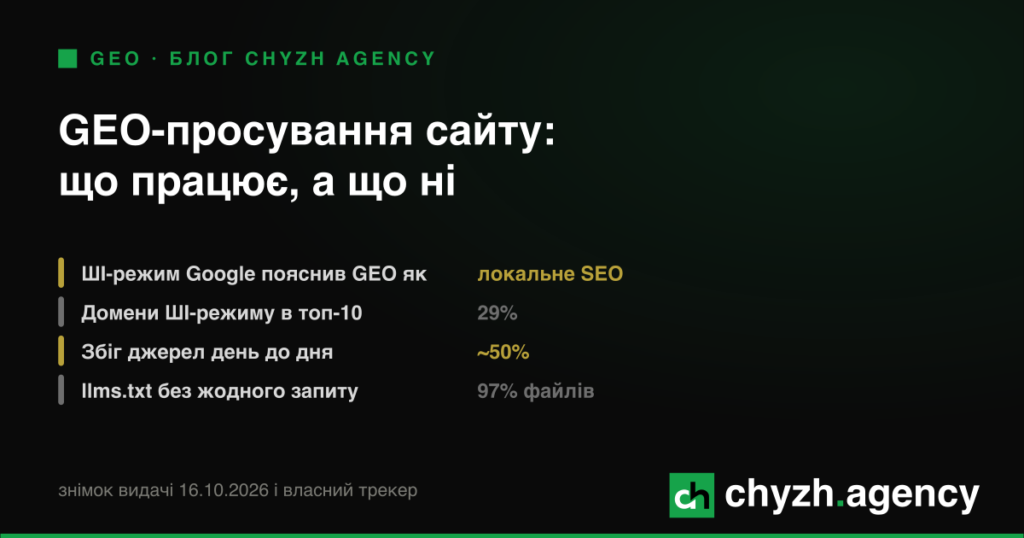
Short answer: GEO website promotion (Generative Engine Optimization) is the work of making sure AI systems, meaning Google AI Overviews and AI Mode, ChatGPT, Perplexity and Gemini, can find your site, extract an answer from it and mention your brand. It rests on classic SEO and does not replace it. The result is measured not by a screenshot but by your share of presence on a fixed set of queries, separately for each system.
Below is what usually gets skipped: Google itself reads the term in two different ways, some popular tips do nothing in Google, and AI answers change so fast that a single check proves nothing.
Google itself reads “GEO promotion” in two ways
Let’s start with a fact worth knowing before you sign a contract.
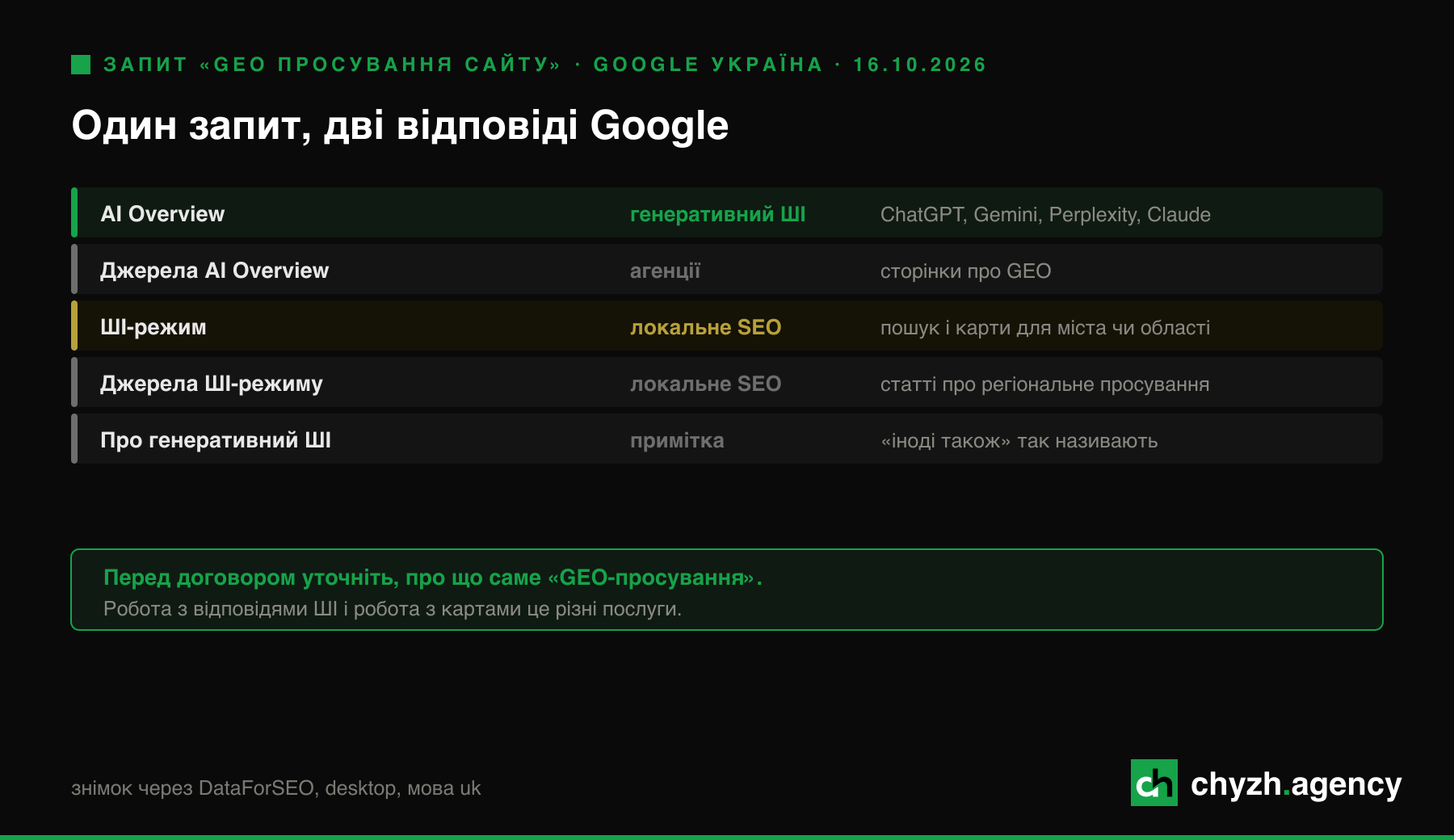
On 16 October 2026 we checked the query «geo просування сайту» (GEO website promotion) in Ukrainian Google. On a single results page, two AI surfaces answered differently.
| Google surface | How it explained the term | What it cited |
|---|---|---|
| AI Overview above the results | optimization for generative systems: ChatGPT, Gemini, Perplexity, Claude | agency pages about GEO |
| AI Mode | local, regional SEO: visibility in search and on maps for a specific city or region | articles about local promotion |
AI Mode mentioned only in a footnote that the abbreviation GEO is “sometimes also” used for generative AI optimization.
The practical takeaway is simple. If a commercial proposal says “GEO promotion”, ask what exactly is meant: work with AI answers, or work with maps and local results. These are different services with different goals. If you need the second one, that is local SEO, and the rest of this article is not about it.
How GEO differs from SEO
GEO is not a new discipline that replaces the old one. In its own guide to generative AI features in Search, updated on 10 July 2026, Google says plainly that this is the same SEO: there are no separate requirements for appearing in AI Overviews or AI Mode.
But what gets selected is different, and that is why GEO is treated separately.
| Classic SEO | GEO | |
|---|---|---|
| What competes | a page | a text fragment and a brand mention |
| Result | a ranking and a click | a citation, mention or recommendation in the answer |
| Where it happens | your site | your site and third-party sources that write about you |
| How to measure | rankings, traffic | share of presence by query and by system |
Ranking and citation are different lists, even within Google. In our daily tracker from 6 to 13 October 2026, covering seven English-language queries in a narrow legal niche in the UK and the US, only 29% of the domains cited by Google AI Mode were in the organic top 10 for the same query on the same day. In 35 answers out of 89 there was not a single domain from the first page.
In other words, high rankings give you a chance, but do not guarantee you will be cited.
What GEO promotion actually includes
Four areas. The first two almost fully overlap with technical SEO; the last two are what make GEO a separate job.
Access for the right bots. AI systems have separate search bots and separate training bots, and mixing them up is expensive. ChatGPT search relies on OAI-SearchBot, while GPTBot collects training data. Anthropic likewise has Claude-SearchBot and ClaudeBot. Blocking a training bot does not mean disappearing from answers; blocking a search bot means exactly that.
Text in the initial HTML. Major AI crawlers do not execute JavaScript. An analysis by Vercel and MERJ of more than 500 million bot requests (December 2024) did not find a single major AI crawler that does. If the page content is rendered by a script, the page is empty for AI, even when Google sees it.
Extractable fragments. AI takes a paragraph, not a page. Each section should answer its own question in its first sentences, and figures, thresholds, deadlines and names should be in the text, not in an image or a tab that a script expands.
Mentions on other sites. An Ahrefs study of 75 thousand brands found a correlation of 0.664 between brand mentions and presence in AI Overviews, and only 0.218 for backlinks. AI readily relies on roundups, reviews and industry platforms. So part of GEO work happens where you are not the editor.
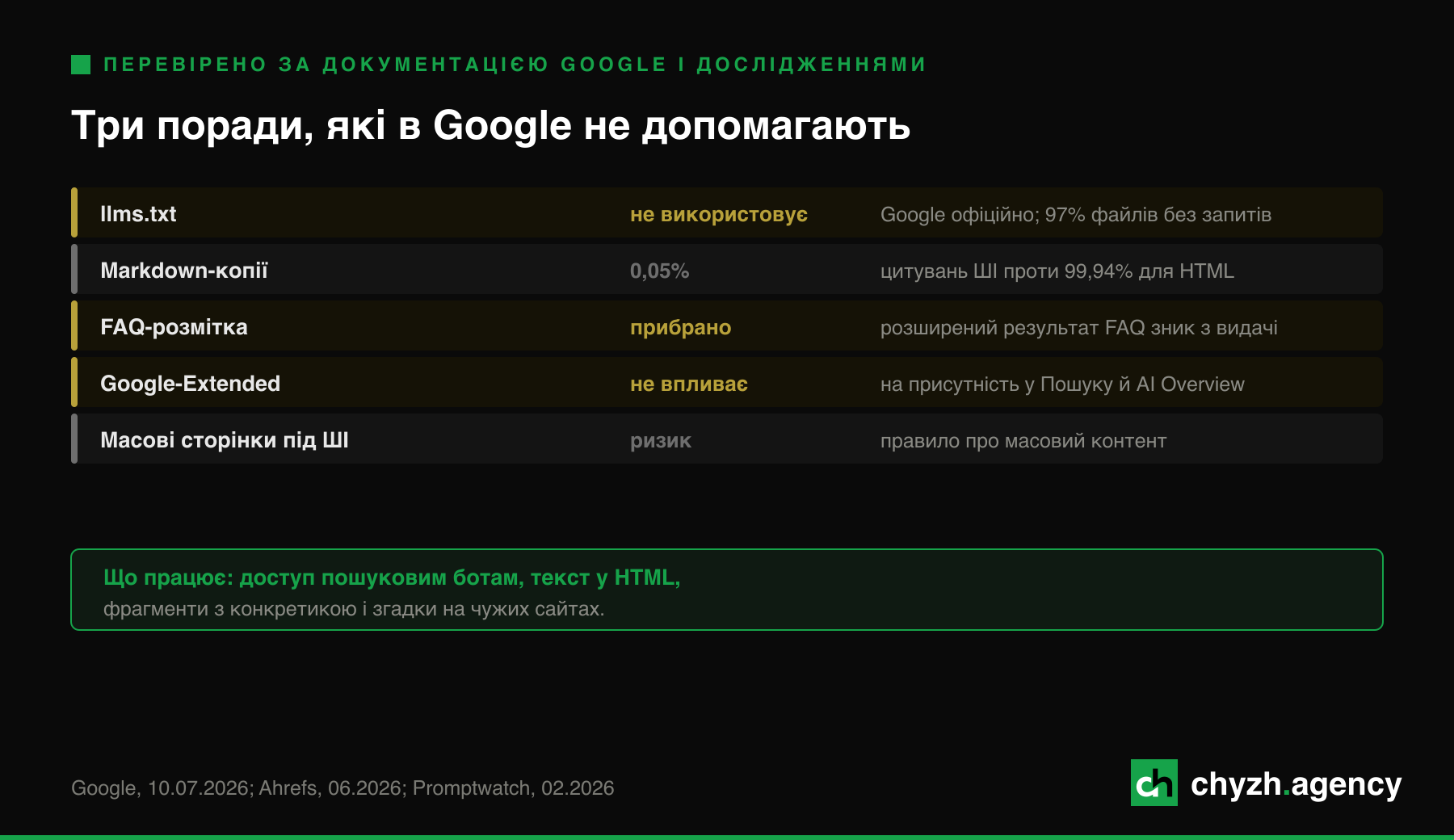
Three checklist tips that do not help in Google
These three items appear in almost every list of “what GEO includes”. We checked them against Google’s documentation and open studies.
1. llms.txt. A file for AI in the site root. Google officially does not use it. In June 2026 Ahrefs checked 137,210 domains: 97% of these files received not a single request. The story is similar with markdown copies of pages: in a sample of 1,665,674 AI citations, 99.94% went to ordinary HTML pages and only 0.05% to .md versions. The file does no harm, but working on it is not working on visibility.
2. FAQ markup as a way into AI Overviews. Google removed the FAQ rich result from search and deleted its documentation. Markup helps the system understand a page, but selling it as a separate lever for Google’s AI answers is incorrect. The question-and-answer block in the text itself is useful, because it consists of ready-made fragments. The text is useful, not the tag.
3. Access for Google-Extended. This token controls the use of content for Gemini and Vertex AI. According to Google’s documentation, it does not affect a site’s presence in Search, and therefore in AI Overviews. There may be other reasons to allow or block it, but not visibility in search answers.
Separately: the same Google guide warns explicitly that pages mass-produced for query variations to win AI answers may fall under the scaled content abuse policy.
How to measure the result without fooling yourself
This is the weakest point of almost every GEO proposal. The result is shown as one screenshot of an answer, and tomorrow that answer will be different.
In our tracker, the sources of Google AI Mode for the same query overlapped between neighbouring days only by half on average. One and the same site appeared in the answer for one query on 4 days out of 7 in one country and on 3 out of 7 in another. A screenshot from any of those days would be true and at the same time prove nothing.
So a working method looks like this.
- A fixed set of queries. 15-30 questions your clients actually ask. Any change to the set is recorded as a break in method, and figures before and after are not compared.
- Several measurements. At least three per query per period. The result is written as “k out of n”, not “yes” or “no”.
- Each system separately. AI Overviews, AI Mode, ChatGPT and Perplexity use different sources. An average across all of them hides the difference.
- First check that the block exists. In Ukrainian commercial queries AI Overviews appear often: in our snapshot of 2 October 2026 it was present in 33 queries out of 35. In a narrow English-language niche from our tracker it did not appear once in a week, although AI Mode answered every time.
- Competitors on the same set. A share of presence only makes sense next to the shares of others.
- Google’s own data. Search Console now has a performance report for generative features: impressions in AI Overviews and AI Mode. Visits from chatbots show up in analytics as referral traffic, and leads from them in the CRM.
How long to wait for results
The honest answer: a first appearance can be quick, stable presence is not.
Our own articles on an industry platform appeared in AI Overviews within a few days of publication. We broke down what exactly the AI cited, and it was a specific paragraph with a specific figure, not the article as a whole.
But one appearance does not mean presence. The set of sources changes every day, so GEO promotion should be judged by the trend of your share on the same set of queries after two or three months, not by the first screenshot.
Who should not start GEO promotion yet
A separate GEO budget does not always make sense.
- The site is poorly indexed. If Google does not see your pages, AI will not see them either. Technical basics come first.
- You need clients from a specific city. Then what matters is maps and local results, that is, local SEO.
- Nobody asks about your category. GEO helps you get into the answer to an existing question, but it does not create demand.
If, however, clients choose you deliberately, compare options and ask AI for advice before buying, presence in answers already affects sales, and it is worth measuring.
What we do not claim
Our tracker covers seven queries in one niche over a week. It shows that sources change quickly and that the top 10 does not match the answer, but it does not give exact values for your niche.
The snapshot of results from 16 October is one date. Next week AI Mode may explain the term differently.
And we do not claim that any of the actions above guarantees a citation. They make a site fit to be cited. The selection among dozens of candidates follows logic that nobody outside fully sees.
Frequently asked questions
What is GEO optimization in simple terms?
Work that helps AI systems find your site, extract an answer from it and name your brand.
Does GEO replace SEO?
No. Google itself considers it the same SEO. GEO adds work on text fragments, mentions on other sites and separate measurement for each AI system.
Are GEO promotion and local SEO the same thing?
No, but even Google’s AI systems confuse the term. Clarify what is meant before signing a contract.
Do I need llms.txt?
Not for Google: it does not use it. According to Ahrefs, 97% of these files receive not a single request.
How do I check the result?
A fixed set of queries, several measurements, each system separately, your share next to competitors. Plus the generative features report in Search Console.
Summary
GEO website promotion is the work of making AI systems find, understand and cite your site. It rests on SEO: access for search bots, text in the initial HTML, fragments with specifics and mentions on other sites.
Before starting, three things are worth knowing. The term is ambiguous even for Google: on 16 October AI Overviews explained it as generative optimization and AI Mode as local SEO. Tips about llms.txt, FAQ markup and Google-Extended add no visibility in Google. And the result is measured as a share on a fixed set of queries, because the sources of answers overlap between days only by half.
If you want to check how AI systems see you right now, start with a GEO audit and promotion on your own set of queries.
Prepared by Yevhenii Chyzh, founder of Chyzh Agency, and Dmytro Popryadukhin, Head of SEO.
Sources: snapshot of Google Ukraine results (queries «geo просування сайту», «geo просування», AI Overview and AI Mode), 16.10.2026; our own Google AI Mode tracker, 06 to 13.10.2026; our own snapshot of 35 commercial queries, 02.10.2026; Google’s guide to generative AI features in Search (updated 10.07.2026); Google documentation update on FAQ; Google documentation on Google-Extended; Ahrefs, llms.txt across 137,210 domains (June 2026) and mentions of 75k brands; Promptwatch, 1,665,674 citations (February 2026); Vercel and MERJ, 500M+ AI crawler requests (December 2024).