
Local SEO promotion in Google Maps
For “лазерна корекція зору київ” (laser eye surgery, Kyiv), the Centre Oka clinic ranks first at 8 of 25 points on our grid, yet fifth from the city centre. A Maps rank depends on where the search comes from, so we measure 25 points instead of one. We work only on what Google’s documentation and independent tests show moves rankings. We don’t put keywords in the business name or open “district” listings: both get profiles suspended.
Google’s three local ranking factors and what to do with each
Google names three groups of local signals: relevance, distance and prominence. You can influence two of them. Distance you can only measure.
Does the profile match the search? The strongest field is the primary category: #1 of 187 factors in Whitespark’s 2026 survey. Services from Google’s predefined list take effect in 24–72 hours (Sterling Sky test). Keywords in the profile description don’t move rankings.
How close the business is to the searcher. In Rankings.io’s study of 50 US cities, rankings dropped by 8 positions on average within the first mile of the address. There is no fixed radius, and no content changes distance.
How well known the business is. In Whitespark 2026 reviews carry about 20% of the weight, calls, direction requests and clicks 18%, citations 7%. Google hasn’t confirmed behavioural signals, but their share in the survey keeps growing.
Third place isn’t much of a prize. In BrightLocal’s test with 5,500 people, the first local pack result took 16–17% of clicks, the second 10–12%, the third only 2–3%. That’s why we don’t promise “top 3 across the city”. After the audit we pick the areas your customers come from and work on first or second place there.
What moves Maps rankings, what doesn’t, and what costs you the profile
We took common advice on reaching the Google Maps top 3 and checked each item against Google’s help pages, controlled tests and Whitespark’s 2026 survey. Some of it works, some does nothing, and a few items break Google’s rules.
Show the address or hide it: a choice that affects rankings
In September 2026 Sterling Sky ran a test: a home-services company hid its address for a month. Rankings fell sharply, the local pack disappeared for one of its main keywords, and calls dropped. With the address back, everything recovered, and a second profile showed the same.
City and neighbourhood pages make sense where there is a branch or a real service area with its own prices, photos and reviews behind them. Google treats a page where only the city name changes as a doorway and demotes it.
Collecting reviews without losing the profile
In Whitespark 2026 reviews carry about 20% of local ranking weight, and the share is growing. In 2025 Google also blocked or removed over 292 million policy-violating reviews and over 13 million fake Business Profiles.
Ask every customer right after the job
SMS, email or a QR code with a direct link to the form. Ask everyone and don’t dictate the content. Sending happy customers to Google and unhappy ones to a private form (review gating) is prohibited.No staff quotas, no staff names
Since 17 April 2026 Google’s policy explicitly bans review quotas for staff and asking customers to mention an employee by name. “Get 10 reviews that name you” is now a violation in itself.No discounts, gifts or prize draws
Any incentive for a review breaks the policy. For a profile caught with fake reviews, Google can pause new reviews, hide existing ones and show customers a warning banner.Reply to every one, and fast
93% of customers expect a reply and 34% expect it within 2–3 days. 88% would use a business that replies to all reviews, against 47% for one that never replies (BrightLocal, 2024). If the customer didn’t name the service or area, we mention it in the reply: that makes it more useful to people choosing.How many reviews you need depends on your niche. We check how many fresh reviews the top competitors in your grid got over the last 3 months and build a steady flow to match. A one-off burst looks like the review-farm pattern Google catches.
What gets a Business Profile suspended
Google publishes no breakdown. The largest public sample we found is 300 suspended profiles in Australia (Searchscope); the percentages below come from it.
Too many or too-fast edits — 23%
Don’t change the name, categories, hours and address together within a few days. We make edits in batches.
Address and service-area problems — 19%
A virtual office, a coworking desk without signage, an address where customers aren’t received.
Duplicates — 12%
Two profiles for one location, or “coverage” listings for districts. We find and merge them.
Keyword-stuffed names and fake reviews
The name must match the signage. Google catches review farms by their pattern: bursts, linked accounts, reviewers who could not have been your customers.
If a profile is suspended, recovery goes through the appeal form: an explanation of recent changes plus evidence such as signage photos, documents and invoices.
What changes for a business in the US, UK or EU
Most local ranking research comes from the US and Canada, so for US businesses it applies directly. We checked the distance effect on our own grids in Kyiv and Lviv: same mechanism. Four things are specific to your markets.
Apple Maps is a second map to manage
On 14 April 2026 Apple replaced Business Connect with Apple Business. Its Brand and Location Management, which controls your Apple Maps place card, is available in the US, Canada, the UK and most of Europe. Claim it with the same name, address and hours as your Google profile.Fake reviews break the law as well as the policy
In the US, the FTC rule banning fake reviews has applied since 21 October 2024, with fines per violation. In the EU, the Omnibus Directive has banned fake reviews since 28 May 2022. In the UK, the DMCC Act made them unlawful from 6 April 2025.BBB counts only in the US and Canada
Elsewhere, local and industry directories confirm that the business exists. Their ranking weight is small, about 7% in Whitespark 2026, so what matters is an identical name, address and phone in each of them.What only you can do on site
Google’s verification video is filmed on location from your phone: at least 30 seconds, one unedited take showing the street, signage that matches the profile name and staff-only areas. Signage and receiving customers at the address are also on you. We write the shot list; you press record.What we measure and how
Local SEO produces measurable actions in the profile, but each metric has to be read precisely — otherwise impressions get mistaken for inquiries. So we build analytics end to end.
Calls — taps on the “Call” button
These are clicks on the call button, not the number of actual conversations. To count real inquiries we add call tracking.Directions — route requests
How many times someone mapped a route to you. Whether they arrived, this metric can’t tell.Website clicks — visits to the site
Clicks from the profile to the site. A click becomes an inquiry only after a form, and UTM tags are how you count it.Views — profile impressions
How often the profile was seen. The metric has limited detail, so it isn’t a KPI on its own.To see inquiries and money, you need a CRM, call tracking, forms with UTM tags and offline conversions. GBP Performance, GA4 and UTM alone aren’t enough — they show the top of the funnel, not its end.
Local SEO: results in Google Maps
A Maps position depends on where the search comes from, so instead of a single rank we show the share of city points where the client ranks: a 5×5 grid, 3 km apart, around the address. Measured with DataForSEO, September 2026.
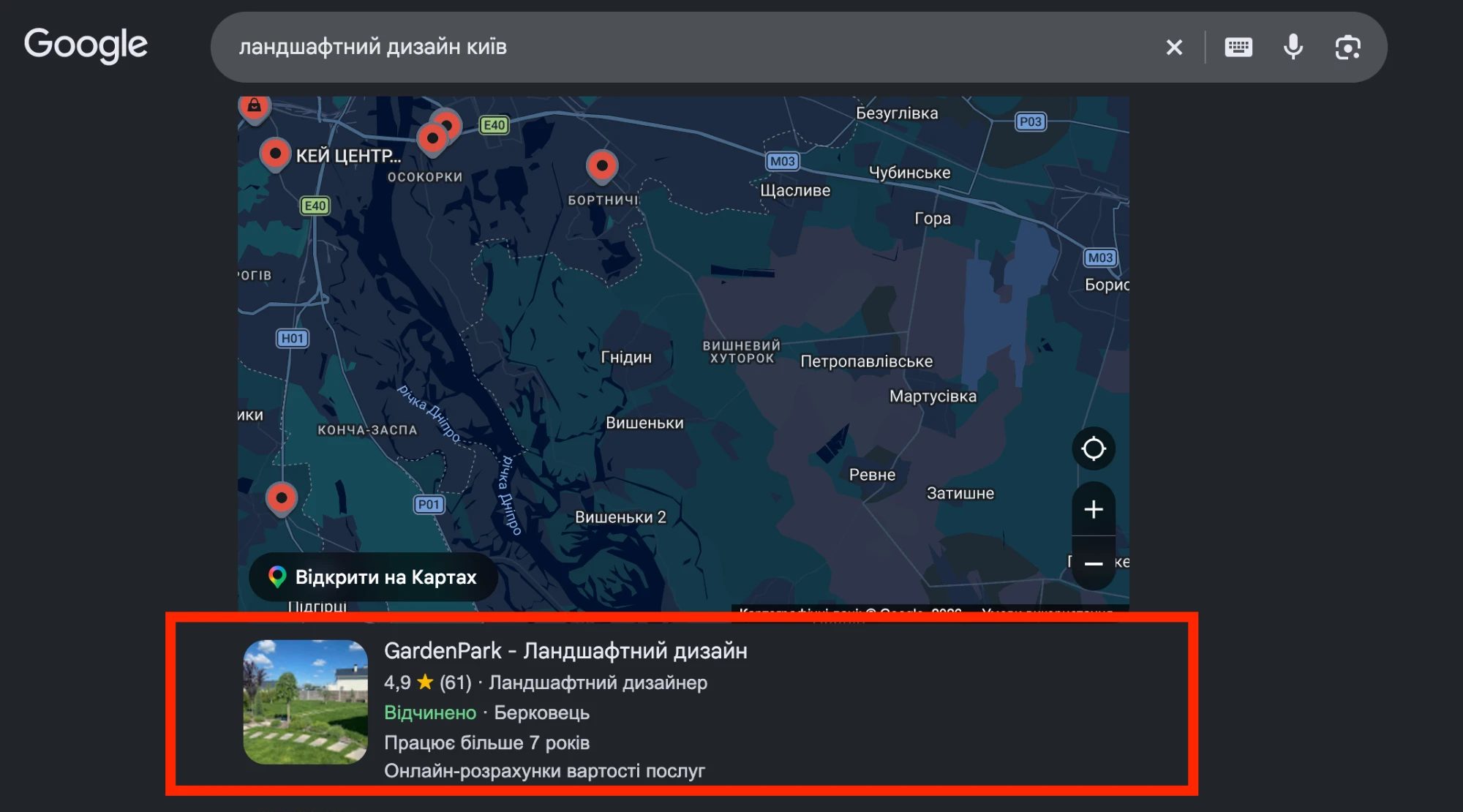
GardenPark
Landscape design and landscaping studio serving Kyiv and the region since 2017.
Brought the studio’s data into one consistent picture for Google: the address, phone and service area in the LandscapingBusiness markup match the Google profile, and the site is tied to the company’s entity in the Knowledge Graph.
“Ландшафтний дизайн київ” (landscape design Kyiv): #1 at 12 of 25 grid points around the office, top 3 at 18 of 25. Rated 4.9 from 61 reviews.
Full case →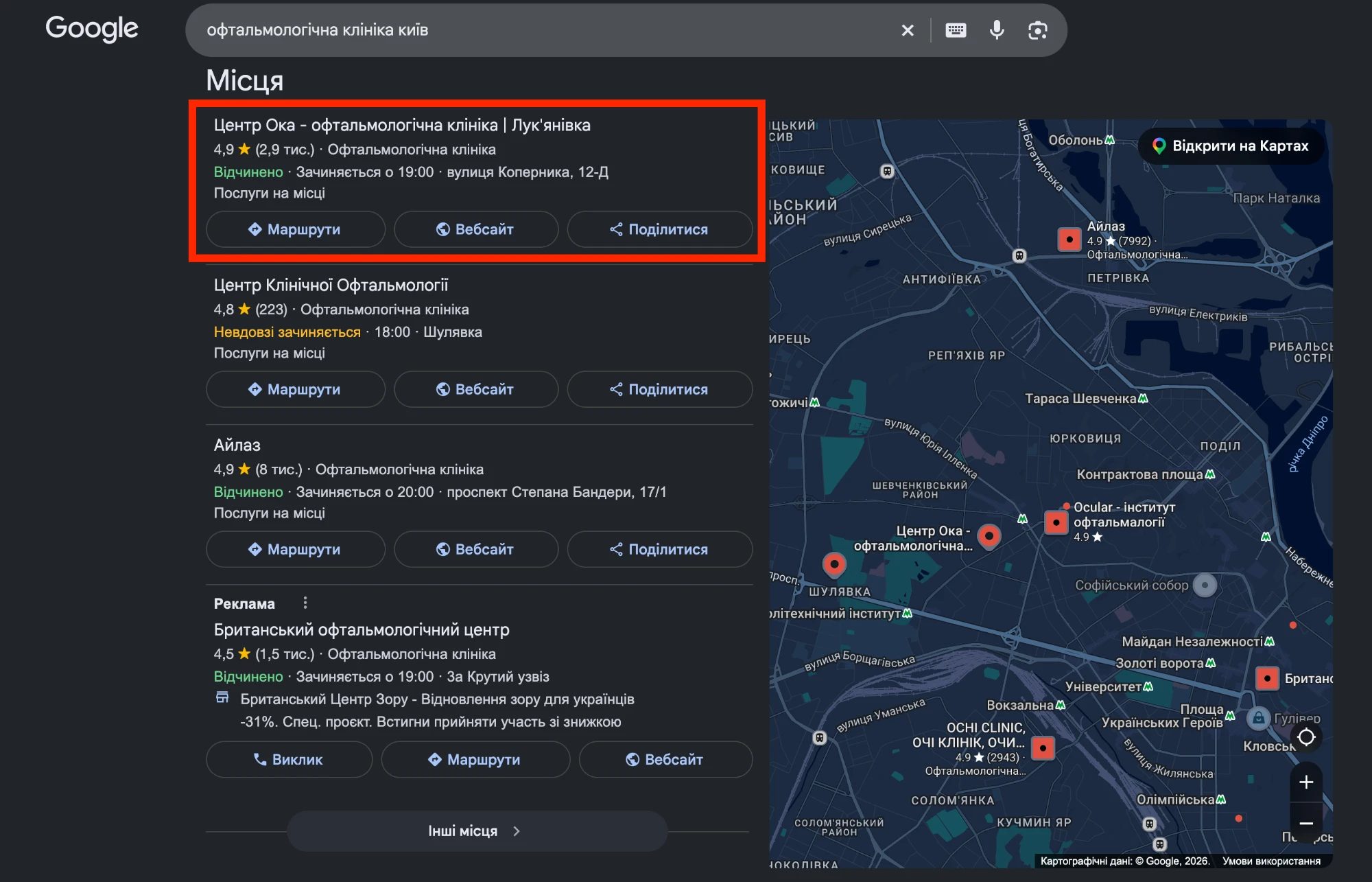
Centre Oka
Top-category eye clinic with two branches in Kyiv: 12-D Kopernyka St and 22 Zakrevskoho St.
Aligned the clinic’s data on and off the site: the Google profile, directories and aggregators show the same addresses, services and rating. On the site: MedicalClinic markup with both addresses, doctors as separate entities, reviews tied to specific procedures.
“Офтальмологічна клініка київ” (eye clinic Kyiv): first in Google’s local pack (search location: Kyiv). “Лазерна корекція зору київ” (laser eye surgery Kyiv): #1 at 8 of 25 grid points, top 3 at 17 of 25. Rated 4.9 from 2.9K reviews.
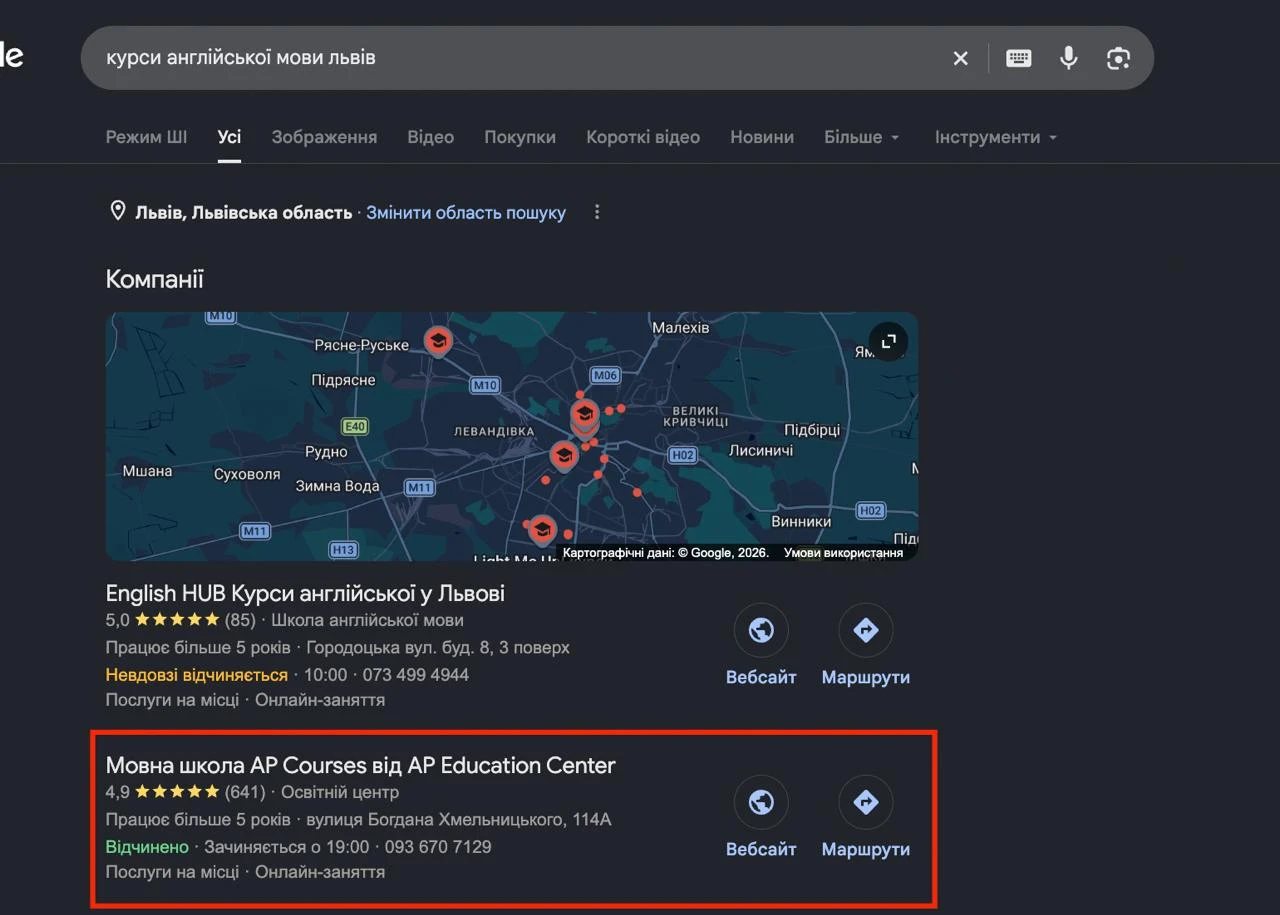
AP Courses
The language school of the AP Education centre: English, German and Polish, online and in person. 114A Bohdana Khmelnytskoho St.
Built the courses site around local and language queries: separate tracks for English, German and Polish, transparent prices and CEFR levels from A1 to C1, named teachers, structured data carrying the same facts about the school.
“Курси німецької мови львів” (German courses Lviv): top 3 at 10 of 25 grid points, top 10 at 16 of 25. “Курси англійської мови львів” (English courses Lviv): #1 at 4 points around the school. Rated 4.9 from 641 reviews.
The 13 points our audit starts with
The list takes half an hour, and you can run it yourself. Eleven points cover the profile and the site, the last two the map and AI answers.
Primary category
Is it the most accurate one for what you sell? Look at what the top three competitors chose.
Additional categories
Two or three that describe your business, no more.
Services
Google’s predefined ones first, then your own, one line per service.
Name
Exactly as on your signage and invoices. If the profile has words the sign doesn’t, decide consciously.
Address
If customers can come, show it. If not, hide it and don’t invent an office.
Hours
The ones you keep, including holidays and special hours.
Map pin
On the entrance, not in the middle of the block.
Recent reviews
How many new ones in the last 3 months, and what is the rating for that period against the overall one?
Replies
Is every negative review from the last year answered?
Review requests
Sent to every customer after the job, with no gifts and no staff quotas?
Website
Name, address and phone exactly as in the profile, on the homepage or the contact page. LocalBusiness markup.
Grid
Where on the map are you in the top 3, and where do you disappear? Check 25 points, not one.
AI answers
Ask ChatGPT and Google AI Mode three questions the way a customer would. Are you named?
The last two points are what our free Google Maps audit measures: 25 points around the address, the rating for the last 12 months and three customer-style questions to ChatGPT and Google AI.
Local SEO cost
Prices for local projects outside Ukraine. The final figure depends on the number of locations, competition, and the state of the site and profile.
For a single business with one location: put the profile, NAP, and reviews in order, get a transparent report.
- Audit of the profile, NAP, and site
- Google Business Profile setup
- Safe review collection system
- Basic LocalBusiness schema
- Monthly report on profile metrics
For a business competing within a city or several districts: site, landing pages, content, and inquiry analytics.
- Everything in Local Start
- Site and local landing pages
- Local content for queries
- Mentions and directories with consistent NAP
- Call analytics: call tracking + UTM
- Regular posts in the profile
For chains and companies with branches: location architecture and centralized profile management without duplicates and chaos.
- Everything in Local Growth
- Architecture of locations and pages
- Centralized profile management
- NAP and duplicate control across the network
- Consolidated reporting by location
One-time setup is separate; we define the exact scope and composition of work after the audit.
Local SEO questions
Guarantees, timing, address, business name, remote work and metrics.
Do you guarantee a top 3 spot in Google Maps?
No. Rank depends on the distance to the searcher, and no content changes that: Centre Oka is first at 8 of 25 grid points but fifth from the Kyiv city centre. And third place gets only 2–3% of clicks. We agree on the areas where your customers are and measure the same grid before and after the work.
How soon will we see changes?
The fastest lever is services in the profile: 24–72 hours in Sterling Sky’s test. Reviews and citations work gradually. We give a forecast for your niche and city after the audit.
We're a service-area business with no office. Can you help?
Yes, with a caveat. Google requires hiding an address customers don’t visit, and Sterling Sky’s 2026 test showed a hidden address lowers rankings. If you can receive customers at an office or showroom with signage, show the address. If not, we make up for it with reviews and a complete profile.
Should we add a keyword to the business name?
Only if it’s on your signage and documents. Keywords in the name lift rankings, but Google forbids them, and when it reverts the name the lift disappears. We treat it as a risk to the profile, not a tactic.
You're based in Ukraine. Can you work on a business in the US or Europe?
Yes. The profile, the site, citations, the review request flow and grid tracking are remote work, and we measure the grid for any city. The verification video, signage and the map pin at your entrance need someone on site; we prepare the checklist.
Can we offer a discount for a review?
No. Google bans any incentive for reviews, and fake reviews are also illegal in the US, the EU and the UK. We set up a request that goes to every customer after the job.
Are GBP Performance and GA4 enough to count leads?
No. They show views, call-button clicks and website clicks. Inquiries and sales appear only once calls go through call tracking and forms pass UTM tags into your CRM.
Related services
Local SEO works in tandem with other directions — choose what’s closer to your task.
Comprehensive SEO promotion of sites
General organic visibility beyond the local pack: semantics, content, technical base, and links. Read more →Development of local landing pages
When cities and branches need separate quality pages, built technically right from release. Read more →Local advertising in Google Ads
Fast inquiries while organic gains momentum: local campaigns and profile advertising. Read more →Portfolio and cases
Examples of projects in different niches — fintech, services, retail, HoReCa. Read more →Want to see where you show up on the map?
Leave a request: on a short call we’ll go through your profile, business model and the competitors in your grid, and after the audit you get a plan by area of the city. No commitment.