
GEO services
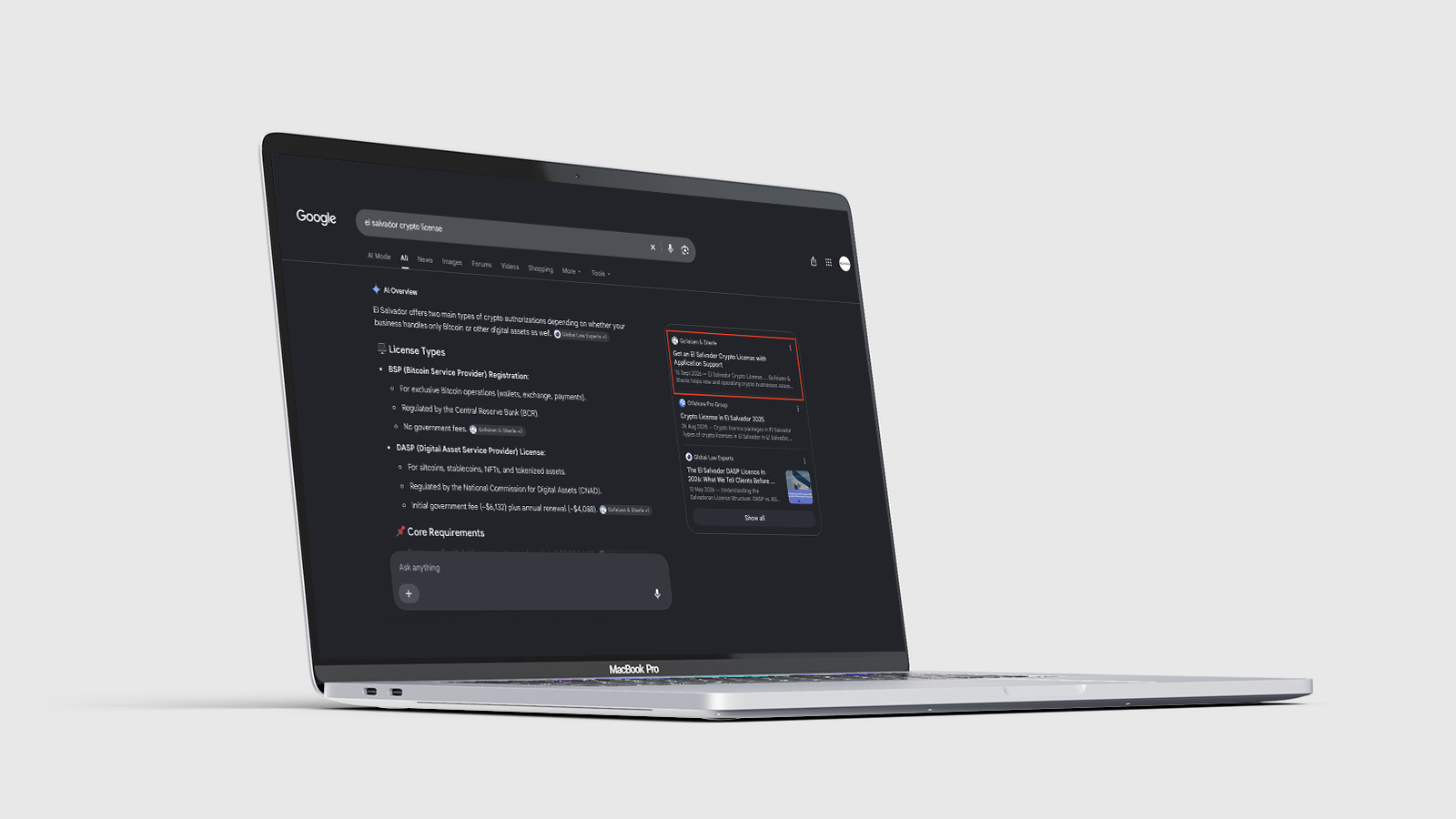
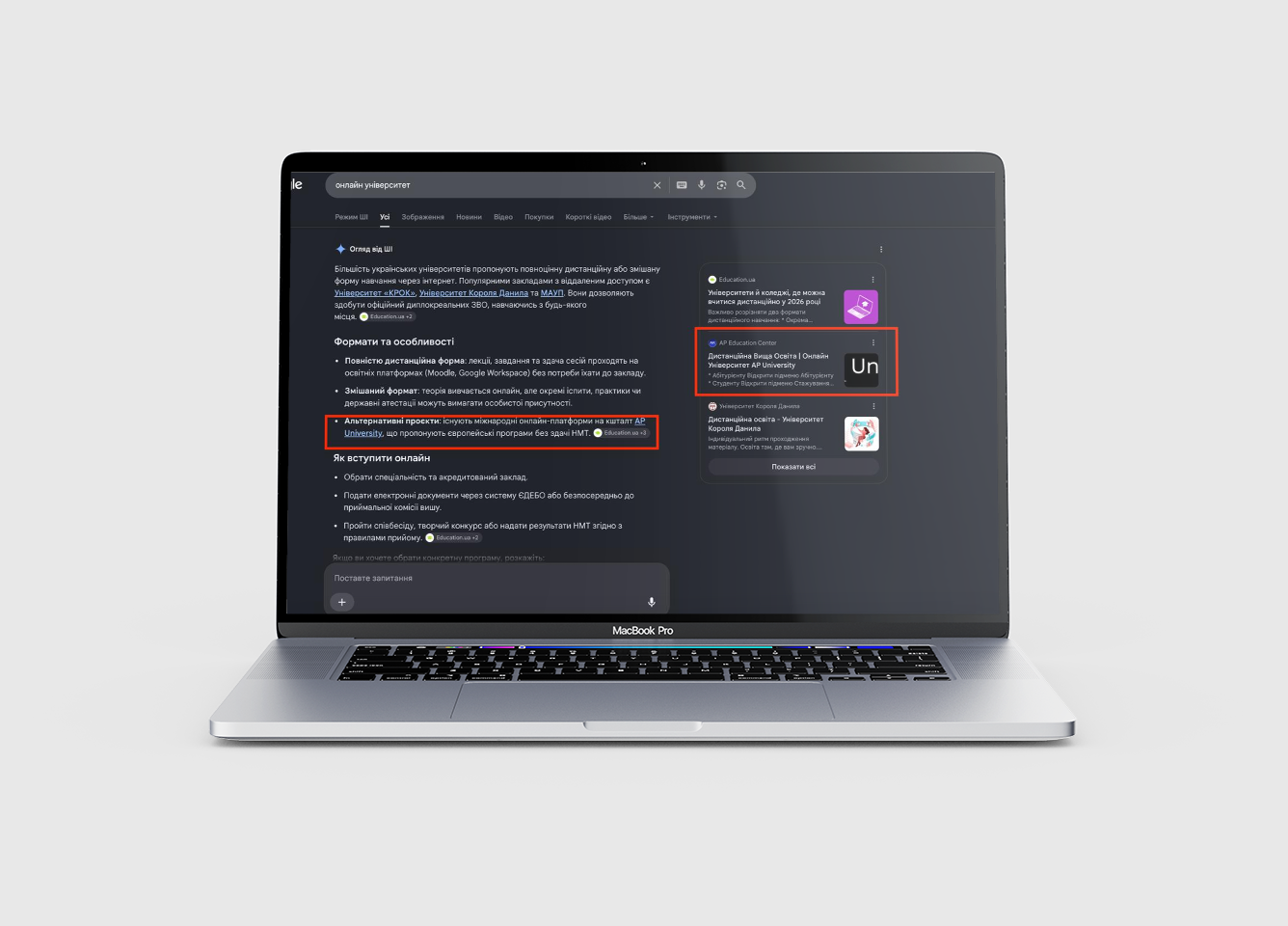
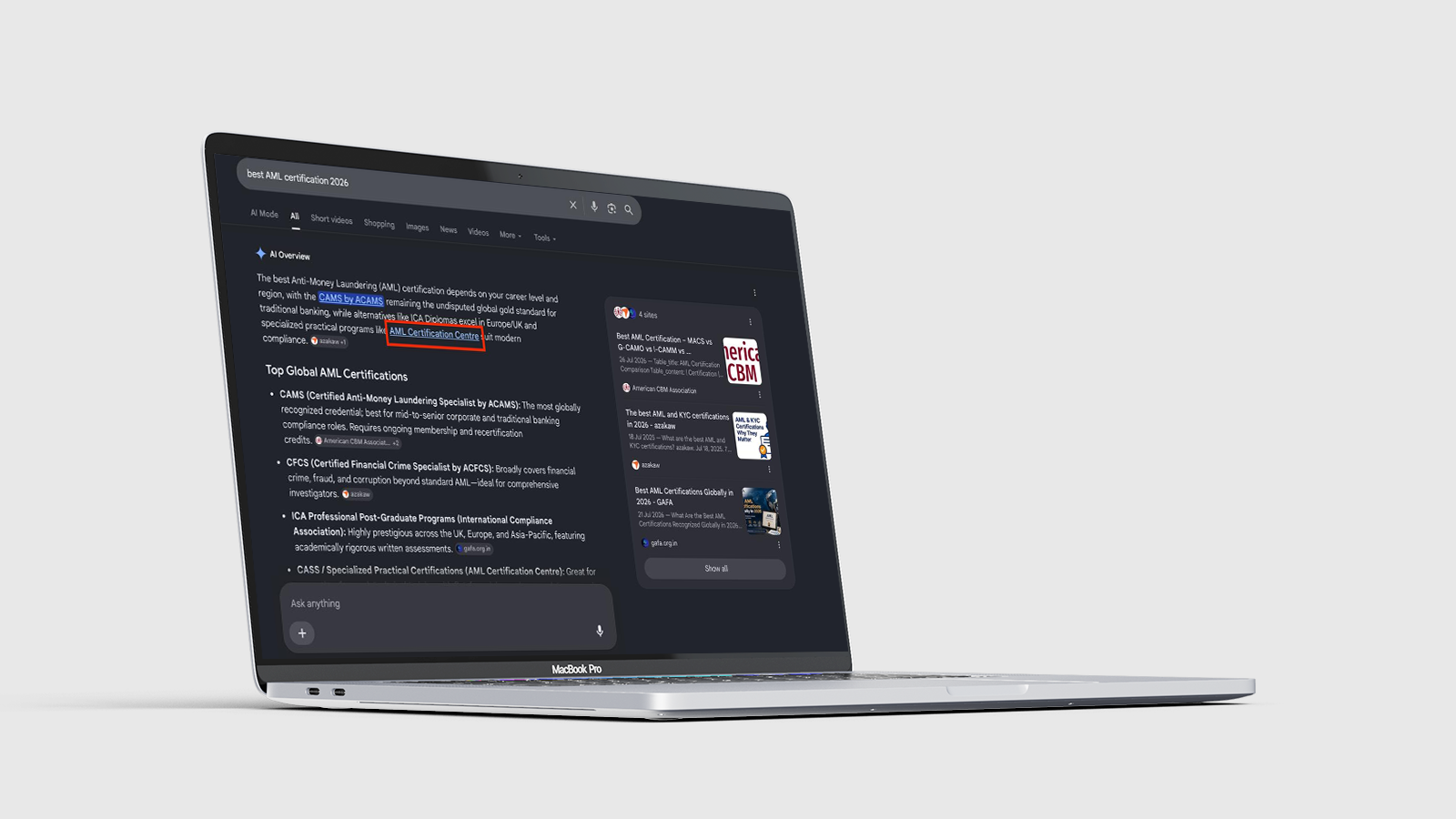
GEO promotion is work on your business’s visibility in AI search, raising the likelihood that your brand appears in citations, comparisons and recommendations from ChatGPT, Gemini, Perplexity, Claude, Copilot and other AI systems. GEO separately covers Google AI Overviews and AI Mode, and complements classic SEO rather than replacing it. Start with a free initial GEO diagnostic.
Users increasingly complete a large part of their decision journey inside AI systems — from the first question through comparison to a ready recommendation. If a brand is not present in those answers, it may never enter the set of options a potential customer considers.
Over years in SEO we have watched search behaviour shift repeatedly. Today it is not enough to measure rankings and organic traffic alone — what matters is whether the brand reaches AI answers, comparisons, citations and recommendations.

How GEO differs from SEO and how they work together
GEO promotion is the optimization of content and site signals so that generative search systems can correctly read, summarize, and cite your pages. SEO and GEO solve different problems. Search optimization helps a page enter traditional search results and compete for top-10 positions. GEO works differently: it builds signals that ChatGPT, Gemini, or Google AI Overview use to select a source for citation in their answer.
Position in search results
Citation in AI answers
In practice these approaches reinforce each other. A strong technical foundation, quality content, and correct semantics simultaneously improve Google rankings and increase the chance of appearing in AI answers.
Classic SEO builds positions in search — GEO builds citation in generative answers.
Who GEO promotion is for
GEO promotion works where the customer researches before buying, compares options and weighs expertise — and increasingly asks AI to recommend a specific product, service or company outright. Every niche needs its own strategy: AI models weigh content types, sources and trust signals differently.
E-commerce
What matters most: categories, product cards, comparisons, roundups, specifications, FAQ. Here AI answers «which is better», «which product to choose», «alternatives», «best models under a given budget» — and the goal is simple: get into those comparisons and recommendations.B2B and SaaS
Weight sits with solution pages, use cases, integrations, comparisons against alternatives, pricing, case studies. People look for a service or platform for a specific business task — and the brand’s job is to make the shortlist AI proposes.Local business
Service pages, geo pages, reviews, company profile, FAQ and local mentions do the work here. Queries like «where is better», «who provides this service nearby», «which company to choose» — this is where visibility in local AI recommendations is decided.Professional services
Law firms, consulting, agencies, recruiting, accounting, IT and other expertise. Trust is built by case studies, methodology, named authors and independent mentions — exactly what AI leans on when picking a contractor or expert for a task.Medicine and healthcare
Service and specialist pages, authored expert content, reputation, reviews. People look for a clinic, a doctor, a procedure, or compare services — and this content decides whether AI mentions the brand in a relevant answer.Education and EdTech
Programmes, courses, instructors, learning outcomes, comparisons, reviews. «Which course to choose», «where to study», «best programmes for…» are the typical queries that decide whether the product makes the AI roundup.Real estate and construction
Properties, services, locations, case studies, expert materials. When choosing a developer, a district, a property or a contractor, this is the content that decides whether AI names the company among the options.Finance and FinTech
Product pages, rates, terms, comparisons, FAQ, expert content. Here AI most often matches services, products, rates and terms against each other — and presence in those comparisons directly drives brand recognition.Expert and niche projects
Research, proprietary data, analytics, methodologies, guides, glossaries. Complex professional queries are the territory where the goal is not merely being mentioned but becoming the primary source AI cites.Manufacturers and industrial B2B
Technical specifications, product categories, industry solutions, documentation, case studies and application scenarios. In these niches AI often helps find a manufacturer, supplier or equipment for specific technical requirements — so it matters to be present both as a brand and as an expert source.The set of priority pages and trust signals differs in every niche — the free GEO audit identifies yours specifically.
What GEO promotion includes
GEO research and strategy
This is where the foundation is laid. We study the business, the niche and the competitors, and check how visible the brand is in AI answers today. We build a matrix of target queries and cluster them by intent, product and decision stage. Separately we examine what AI systems answer and which sources they cite — this is how citation gaps and source gaps surface. The result makes it clear what to tackle first.
Technical GEO optimization
The site has to be readable and accessible not only to search engines but to AI crawlers. We check indexation, robots.txt and sitemap, crawler access, site structure and internal linking. We add Schema.org, structured data and entity markup. We look for technical barriers blocking access to key content — and remove them.
Content GEO optimization
Content has to explain to AI systems what the company does and where its strength lies. We work on service and product pages, solution and use-case pages, comparison pages, alternative pages, FAQ. We add case studies, expert materials, research, proprietary data and statistics — everything an AI system can cite as a source.
Entity and reputation optimization
The goal is that information about the company does not contradict itself across sources. We work through brand and specialization data, products and services, team and experts, geography, clients and cases, reviews, certificates. We separately make sure these details match across every platform rather than diverge.
External GEO promotion
AI systems trust independent sources, so we strengthen the brand’s presence beyond the site: industry media, expert publications, rankings and roundups, review platforms, directories, communities, YouTube, partner resources, public relations in digital channels.
GEO monitoring and analytics
AI visibility shifts, and that has to be tracked: AI visibility, brand mention frequency, recommendation frequency, share of voice in AI answers, citation frequency, citation share, prompt coverage, source coverage. Plus how competitors move and how the brand’s positioning in AI answers changes.
The starting point is a free initial GEO diagnostic. It helps assess the brand’s current AI visibility, the main growth points, and the priority scope of GEO work.
Which AI systems we promote your site in
A GEO strategy covers every major AI platform, but there is no single approach that fits them all. Each one searches, selects and cites sources its own way — so we look at brand visibility separately in each system and set its own optimization priorities.
Google AI Overviews / AI Mode
A strong SEO foundation remains important for Google AI: pages have to be crawlable, indexed and relevant to the query. At the same time, the set of sources in AI Overviews and AI Mode does not necessarily mirror classic organic results. What we focus on: indexation, content quality and completeness, internal linking, clear page structure, up-to-date business data and correct structured data.ChatGPT Search
ChatGPT goes out to the open web and cites pages right inside the answer, with a link to the source. What we focus on: access for the OAI-SearchBot crawler, direct answers to target prompts, pages dense with facts, brand expertise, external mentions and content that is easy to use as a source.Perplexity
Perplexity lives on web sources and always shows exactly what it read while assembling the answer. What we focus on: factual accuracy, data freshness, primary sources, research, statistics, authorship, topical expertise, domain authority.Gemini
Gemini looks at how consistently the brand shows up across the Google ecosystem and the open web. Contradictions in your data are expensive here. What we focus on: a clear brand entity structure, a solid site, current information about the company, products and experts, structured data, independent mentions.Microsoft Copilot
Copilot leans on Bing’s search infrastructure — so it all starts with whether your pages are in the Bing index. What we focus on: Bing indexation, page freshness, structured content, strong topical pages and sources suitable for citation.Claude
Claude can search the web and pulls in external sources when the answer calls for it. What we focus on: deep expert content, primary sources, research, independent publications, factual accuracy, brand authority.How GEO promotion works
This is a cycle, not a one-off campaign: from setting goals to scaling what worked.
Define goals and presence zones
We look at business objectives, products, audience and markets — and decide in which scenarios AI systems should find and recommend the company.
Fix the baseline
We measure how the brand looks in AI search today: where it appears, how often it is recommended, which competitors sit alongside it, which sources the systems cite. This is the reference point for comparison.
Identify growth points
We compare the desired state with reality: where the brand is absent, where competitors win on recommendations, which topics are thinly covered, which proof of expertise is missing.
Build the action plan
We prioritise findings by business impact and implementation effort, and assemble the sequence of work — what to do first.
Execute the strategy
We make changes on the site and on external platforms: technical foundation, content, brand entities, external sources.
Measure the change
We re-run the same scenarios and compare against the baseline — whether mentions, recommendations, citations and share of presence have grown.
Adjust the strategy
We look at what delivered results, what needs reinforcing, where new opportunities appeared — and update priorities.
Scale the result
We carry what worked over to new products, audiences and markets. GEO becomes a permanent system, not a one-off project.
Exact timelines depend on three factors:
→ Site starting point — how ready the technical foundation and current SEO are.
→ Niche competition — medicine and finance are harder than niche B2B services.
→ Target AI channels — Google AI Overview and AI Mode connect slower than open AI chats.
We give an accurate estimate on a free 30-minute call.
How we measure GEO and what goes into the report
GEO cannot be measured by a single ranking. We watch how often the brand turns up in AI answers, whether it actually gets recommended, which sources are cited, how visibility shifts against competitors — and whether any of it reaches traffic, enquiries and sales. We count it in our own GEO monitoring system, with GA4, Search Console, Bing Webmaster Tools and CRM plugged in to verify traffic, technical health and business results.
We track the share of target prompts where the brand shows up at all in ChatGPT, Gemini, Perplexity, Copilot and other systems. This is the overall level of presence in generative search — and how it moves over time.
An AI mentioning your brand is one thing; recommending your company, product or service outright is another. We count the second. Commercial scenarios get tracked separately: supplier choice, comparisons, roundups, alternatives, «which is better» queries.
What share of presence in target AI answers your brand holds next to its main competitors. It shows not only your own trajectory but how the balance in the niche shifts.
How often AI takes your site as a source, which pages it cites, and which external resources shape answers in your topic. Separately we hunt for the Source Gap — sources already working for competitors but not yet for you.
Which groups of AI queries already have visibility and where the gaps are. We look at recommendations, comparisons, alternatives, company or product search, problem-solving scenarios and branded queries.
How AI sees your company: whether it presents it as a reliable, competent player, which strengths and weaknesses it names, what it leans on. We also check whether the information is out of date and whether the answers contain outright factual errors.
Actual visits from ChatGPT, Perplexity and other platforms: how many sessions, which landing pages, how people behave and how good that traffic is.
Enquiries, purchases, sign-ups and other target actions from people who arrived via AI platforms. We look not at traffic volume but at its contribution to the result.
We run monitoring from the first stage of work in our own GEO analytics system. You receive the results in the monthly report — with the dynamics of AI visibility, recommendations, citations and competitor positions.
In parallel we keep the technical side in check: indexation of priority pages, AI crawler access, robots.txt, sitemap, canonicals, crawl errors and anything else that can put content out of reach of search and AI systems.
Why trust GEO promotion to Chyzh Agency
Figuring out GEO on your own means months of experiments. The agency has already gone through this on real projects and works immediately with what delivers measurable results — no trial and error at your expense.
14 years & 50+ projects
Chyzh Agency has been operating since 2011: 50+ projects in 18 countries, official Google partnership. Listed on it-rating.ua and Clutch with verified client reviews. GEO/AEO is a dedicated priority direction.
A dedicated GEO team
GEO projects are run by a team combining SEO strategy, technical optimization, content, analytics and work with external sources. Strategy and the technical track are coordinated by Dmytro Popryadukhin, Head of SEO Strategy. All work is joined into a single GEO process and monitoring system.
Our own GEO monitoring system
We do not judge GEO by eye. In our own system we track AI visibility, recommendations, share of voice, citations, competitors and LLM matrix coverage. Every metric and its trend goes into the monthly report.
Why businesses need GEO right now
There are four reasons why your business needs GEO right now.
Audience scale
According to Google, June 2026: AI Overviews reaches over 2.5 billion users per month, and AI Mode over 1 billion. The channel has moved from experiment to mass adoption.AI traffic quality
According to Adobe, March 2026: AI traffic in retail converts 42% better than the average across other channels — a record figure to date. The reason: the model has already done the comparison and made its recommendation before the user reaches your site.Depending on a single source is a risk
AI systems can change the set of sources they draw on. A GEO strategy should therefore not depend on one platform, directory or community. A distributed information field is more resilient: your own site, expert content, independent publications, reviews, industry resources and other relevant sources.SEO rankings and LLM visibility are independent
A strong SEO foundation helps search and AI systems find, index and understand content, but a high position in classic results does not guarantee the brand appears in an AI answer. That is exactly why SEO and GEO visibility have to be measured separately.The takeaway: GEO is a compounding layer on top of SEO. The advantage goes to brands that start building authority early.
How much GEO promotion costs
The cost of GEO promotion depends on the scale of the business, the number of products and directions, competition in the niche, the size of the LLM matrix, content work and how much the brand’s external presence needs strengthening. We offer three levels of GEO support — the exact scope is set after an initial analysis of the project.
For companies that want to start working with GEO systematically and get controlled brand visibility across the main AI systems. Best for: small and mid-sized sites with one core product or direction.
- 1 priority business direction
- Basic LLM matrix of target prompts
- Monitoring across ChatGPT, Gemini, Perplexity and other major AI systems
- Analysis of core competitors
- Tracking of AI visibility and brand mentions
- Optimization of priority pages
- Content recommendations and regular edits
- Analysis of key citations and sources
- Monitoring in our own GEO analytics system
- Monthly report and plan for the next stage
For businesses that want to systematically grow their share of presence in AI answers and outpace competitors on commercially important scenarios. Best for: B2B, SaaS, e-commerce, local chains and companies with several products or directions.
- Several priority business directions
- Extended LLM matrix across different intents
- Monitoring of a wider competitor set
- AI visibility, recommendation rate and share of voice
- Prompt, citation and source gaps
- Regular GEO optimization of key pages
- New content built for target AI scenarios
- Comparisons, alternatives, FAQ, case studies and expert materials
- Work on brand entities and reputation signals
- Analysis of external sources and brand presence points
- Digital PR strategy
- Monitoring in the Chyzh Agency in-house system
- Monthly analytics and GEO strategy adjustment
For large sites and competitive niches that need GEO promotion at scale across several products, categories, languages or markets. Best for: large e-commerce, SaaS platforms, finance, healthcare, international and multilingual projects.
- Several products, categories or markets
- Large-scale LLM matrix
- Extended competitive GEO monitoring
- AI visibility, recommendation rate, share of voice and citation share
- Visibility analysis by individual products, topics and markets
- Scaling GEO content into new topical clusters
- Research, proprietary data and citation-worthy materials
- Systematic work on brand entities and perception
- Active strengthening of external sources
- Digital PR and independent brand mentions
- Regular GEO experiments and hypothesis testing
- Extended analytics in our own GEO monitoring system
- Strategic plan for scaling AI visibility
What shapes the final budget. The main drivers: the number of products and business directions; site size and complexity; the number of target prompts; competition level; the number of markets and languages; how much new content is produced; the need for digital PR and external publications; the technical state of the site.
Before we start, we run an initial analysis of the project and recommend the right level of support. Budgets for paid placements, separate developer work and large-scale content production are agreed separately.
Frequently asked questions about GEO promotion
When do the first GEO results appear?
Timelines depend on the niche, starting AI visibility, competition, site condition and how fast recommendations are implemented. First changes in individual prompt clusters can be observed within the first months, but we judge GEO by dynamics across a stable LLM matrix, not by a one-off appearance in an answer.
Does GEO guarantee appearing in AI Overviews?
No. The AI system itself controls the final choice of sources and how the answer is formed. GEO helps improve technical accessibility, relevance, clarity and the authority of information about the brand, but it cannot guarantee a specific citation or position.
Does GEO require new content?
Not necessarily from scratch. Often restructuring what exists is enough: add answers to frequent questions, name the author and date explicitly, mark up entities via JSON-LD. New content is warranted where the brand does not cover topics AI already cites from competitors.
How important are external mentions for GEO?
They matter. Independent mentions help build a broader information field around the brand. Relevant industry media, rankings, professional platforms, review platforms and partners are especially valuable, along with other sources that corroborate information about the company.
Is technical SEO needed for GEO?
Yes. Search and AI systems must be able to reach the important content on your site. So we keep an eye on indexation, robots.txt, sitemap, canonicals, JavaScript rendering, internal linking and other technical factors that can hinder crawling and interpretation of pages.
Does GEO replace SEO or complement it?
GEO does not replace classic SEO. Technical accessibility, indexation, quality content, internal structure and authority remain the shared foundation. SEO works on visibility in search results, while GEO additionally works on how the brand and its content are represented in AI answers, citations and recommendations.
Ready to check your site’s potential in AI search?
An initial GEO diagnostic and a 30-minute consultation will show your brand’s current visibility, the main gaps and the priority directions of work.