
Our articles got into AI Overviews within days: a breakdown of what exactly the AI cited
 Yevhenii Chyzh
Short answer: Google AI Overviews took neither the introduction nor the conclusion, but specific paragraphs with facts that can be read apart from the rest of the text. One answer contained four separate attributions to our article, next to materials nine months older than our publication. Below are the screenshots, a breakdown of the cited fragments and what in this is actually repeatable.
Everyone writes about AEO now, but almost nobody shows their own proof of being cited. I will show two. This is not a theory of how things should be, but a breakdown of what actually happened to our texts in August 2026.
First, the honesty frame. Both measurements were made in Google AI Overviews. ChatGPT, Perplexity and Gemini were not checked separately in this snapshot, and I will not carry the conclusions over to them. The composition of AIO depends on region, language and session, so the screenshots are a moment in time, not a constant.
Proof one: the article about RAG
Query: «Як LLM обирають, кого цитувати: RAG простими словами» (How LLMs choose whom to cite: RAG in simple words). The article was published on 5 August 2026.
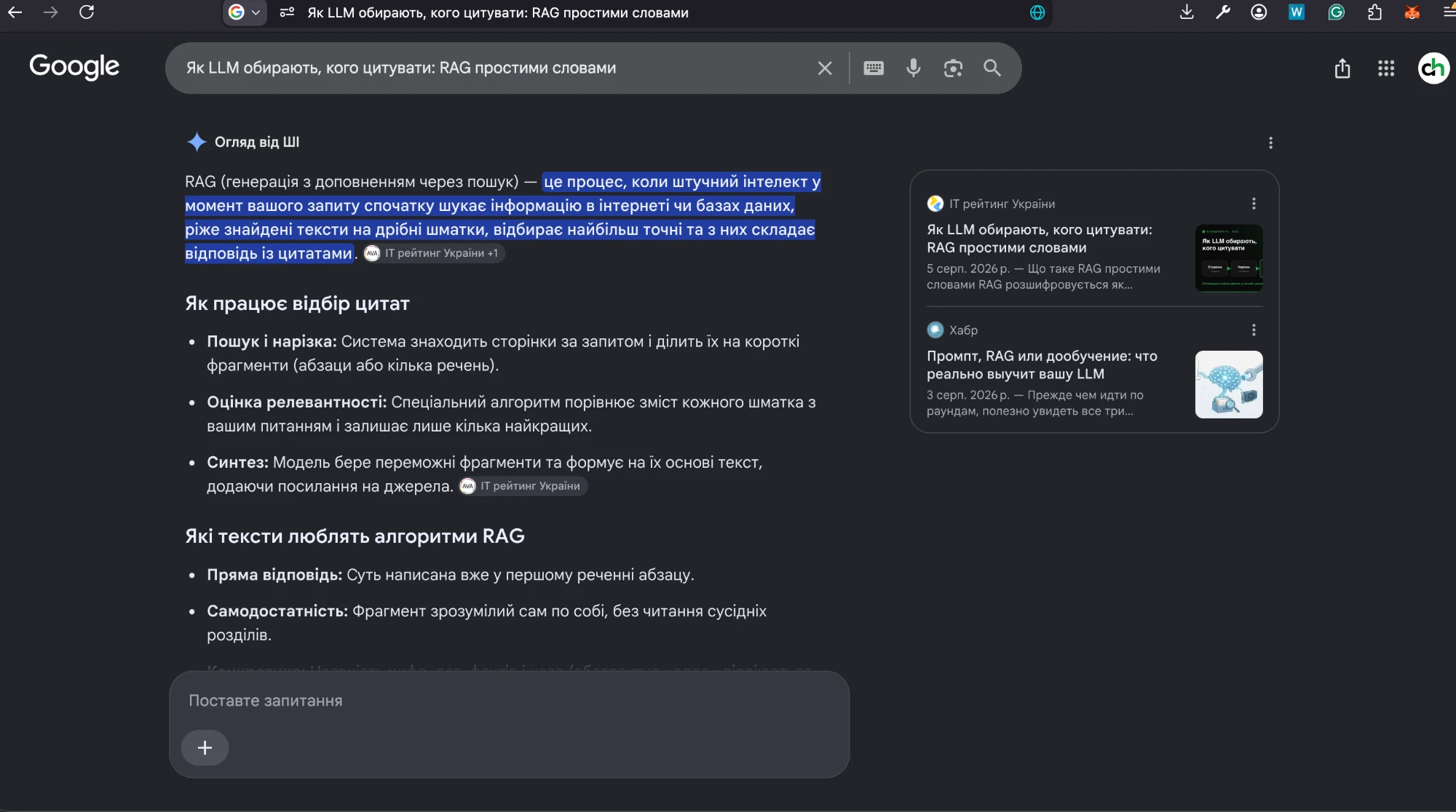
What the screenshot shows. The first sentence of the answer, that same definition of RAG, is highlighted and attributed to the source. Further on, the structure of the AI answer itself repeats the structure of our text: retrieval and chunking, relevance scoring, synthesis. The point about synthesis also has its own attribution. In the right panel there is a card of our article with our own cover, next to a Habr article.
So the AI did not just list us as a source. It retold our definition in the body of the answer and built the section on our logic.
Proof two: the article about ChatGPT Search
Query: «Як потрапити у відповіді ChatGPT» (How to get into ChatGPT answers). The article was published on 11 August 2026.
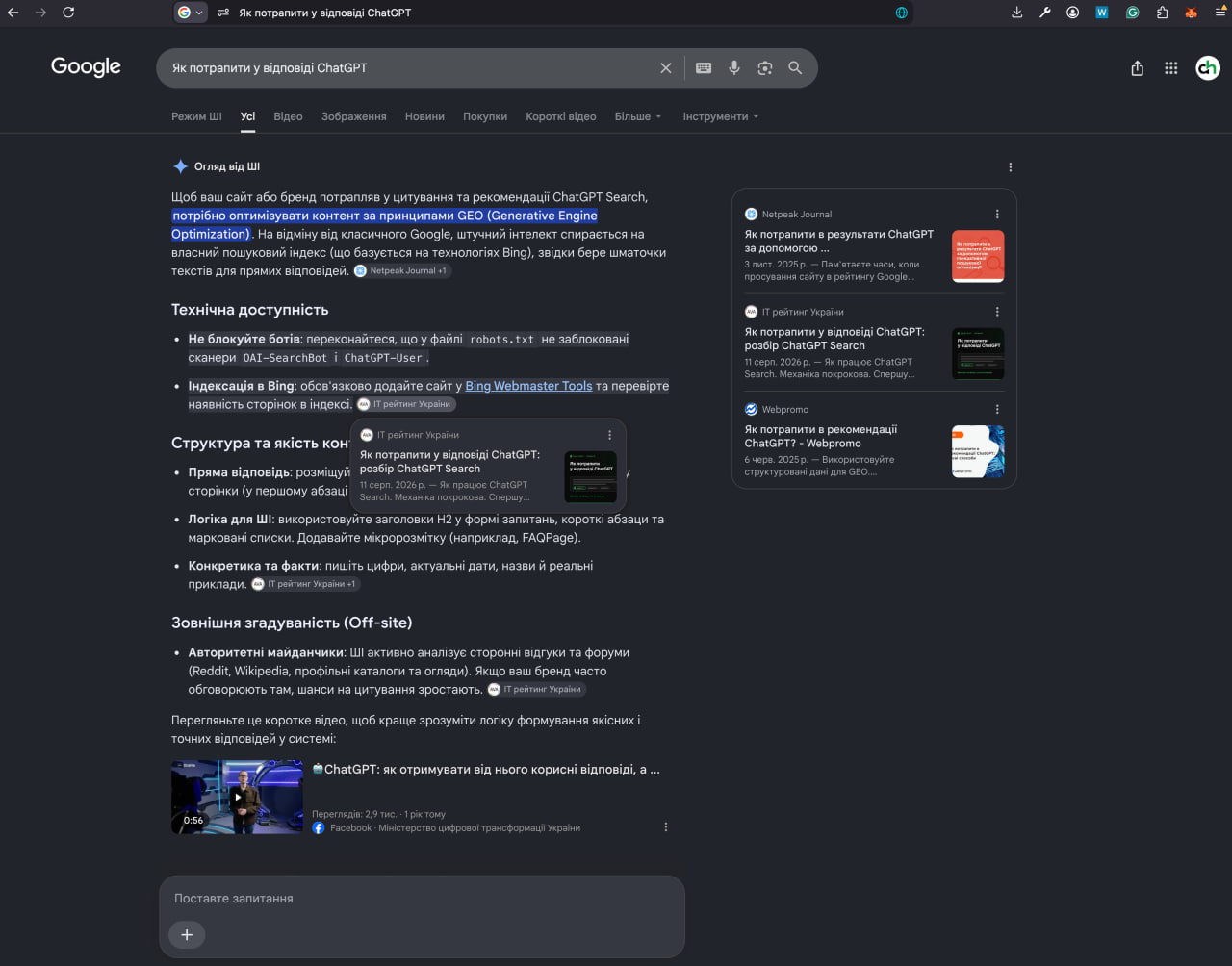
This one is more interesting. One answer had four separate attributions to our article, all in different blocks:
- the point about indexing in Bing and checking pages in Bing Webmaster Tools;
- the point about specifics and facts, where the AI advises writing numbers, dates and real examples;
- the point about authoritative platforms and external mentions;
- plus the article card in the sources panel.
And one more detail worth seeing. The same answer includes materials from Netpeak Journal dated 3 November 2025 and Webpromo dated 6 June 2025. Our article came out on 11 August 2026, days before the snapshot. Neither the age of the domain nor the age of the material stopped it from standing next to them.
What the AI took and what it ignored
Here is the main observation that made this worth breaking down.
The introduction was not taken once. In our articles the first paragraph is a short answer to the question. It would seem the ideal candidate. But in both cases the AI went deeper into the text.
It took paragraphs that carried a unique fact. In the article about ChatGPT Search, exactly the places with our information nodes were cited: the names of the bots OAI-SearchBot and ChatGPT-User, the point about the Bing index instead of Google, the requirement for specifics. These were things the neighbouring articles in the results did not have. General advice about “quality content” was not taken anywhere.
It took what reads on its own. Each cited fragment is either one complete definition sentence or a list item with the explanation inside it. None of them needs the previous paragraph to make sense.
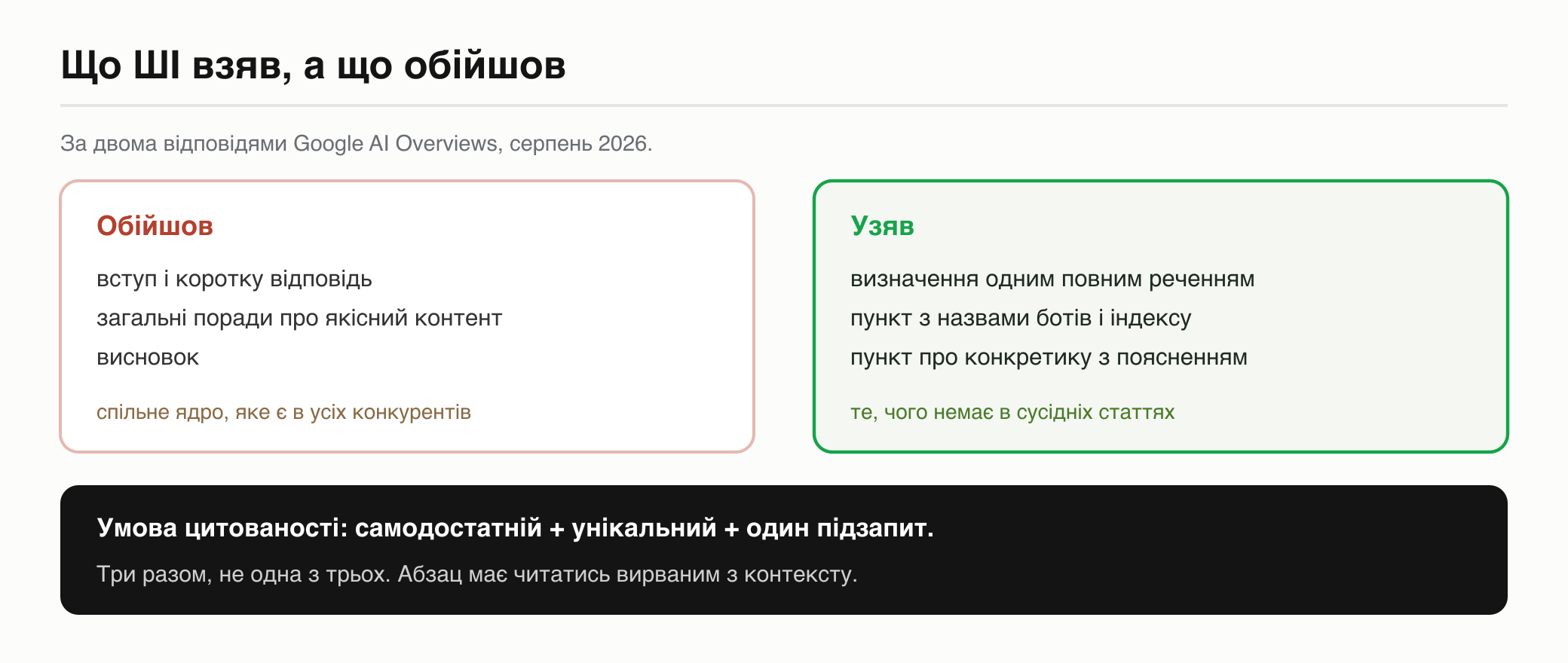
This adds up to a working requirement for a paragraph. It must be self-contained, contain specifics that competitors do not have, and close exactly one sub-question. All three conditions together, not one of the three.
Why not the introduction
My conclusion is as follows, and it is a conclusion from observation, not documented Google mechanics.
In most articles the introduction looks the same. It retells the topic in general words and is easy to replace with any competitor’s introduction. For a system choosing among dozens of candidates, such a fragment has no advantage. But a paragraph with the name of a specific bot or a point about a different search index cannot be replaced by anything, because the neighbouring texts simply do not have it.
This creates a paradox worth getting used to. You write a strong introduction for a person, and that is right, because a person decides in the first seconds. But the middle is what gets cited, if that is where the thing others lack lives.
What we did before publication
The order was the same for both articles.
A scan of the results. Before writing, we look at what is already in the top results and in the AIO itself on the topic. We write down the common core, that is, what everyone repeats. We cover this core too, because without it the text is incomplete, but it gives us no advantage.
A search for a unique node. Next we look for what this core lacks. The most productive places: what breaks, what people learn too late, when typical advice does not work, who it does not fit, what can be measured. In the article about ChatGPT Search, such nodes were the named bots and the Bing index.
Cutting for fragments. One section closes one sub-question. The first paragraph under a heading is written so that it reads when torn out of context.
Editing for natural language. We remove template phrases and even out the rhythm of sentences. This is done for the reader, not to get past detectors, and I see no reason to think it was this that influenced citation.
What did not work and what we do not know
Here I have to spoil a nice story, but without it the breakdown is incomplete.
The attribution did not go to us. In both cases the AI labelled the source as “IT rating of Ukraine”, because that is where the articles were published. Our agency’s name does not appear in the answer. The benefit we got was indirect: our cover is visible in the source card, and the text mention of the brand stayed inside the article. For strategy this is an important point. Publishing on someone else’s platform earns citations for the platform, not for you.
Not all articles got in. Two materials from the batch were cited. The rest did not appear in AIO in the same snapshot, although they were written with the same procedure. So the procedure raises the chances but does not guarantee the result, and anyone who promises otherwise is selling you confidence, not a method.
Causality is not proven. I cannot separate the contribution of the text structure from the contribution of the platform itself, which has its own history and trust. Honestly, part of the result almost certainly belongs to the platform rather than to our copywriting.
The measurement is a moment in time. A week later the composition of the answer may change. AIO is personalised, and disappearing from it will not mean that the text has got worse.
What is repeatable here
If we boil it down to three points that genuinely transfer to any text:
- Write so that a paragraph with a fact reads on its own. Those are the fragments that get cut out.
- Put the unique part not in the introduction but in the body, in a section that names the sub-question directly.
- Unique means specific: names, figures, thresholds, named mechanisms. Nobody cites general advice, because everyone has it.
And one more thing these screenshots show best. The age of the material turned out not to be decisive. An article a few days old stood next to materials months older. Not because it was better written, but because it had something they did not.
Methodology
Data: two snapshots of live Google AI Overviews results, August 2026, region Ukraine, language Ukrainian. The articles were published on 5 and 11 August 2026 on the IT rating of Ukraine platform. The screenshots are not retouched; the highlighting of fragments is ours, added for clarity.
Limitations: measured only in Google AI Overviews; ChatGPT, Perplexity and Gemini were not checked. AIO is personalised by region, language and session, so this is a moment in time. We do not attribute the result to a single factor and do not claim causality between our writing procedure and the fact of citation.