
This company’s rankings were fine before we arrived. The problem was different: Google started answering licensing questions itself, and the click from the top 10 stopped reaching the site. So we went after a place inside the answer rather than a place above it — and got there through the entity layer, not through content.
01 Why strong rankings stopped bringing enquiries
Measured Crypto and fintech licensing spans dozens of jurisdictions, and nearly every query in it looks informational while the intent behind it is commercial. Someone asks “what licence do I need in El Salvador” while actually looking for a firm to file the application with.
These are exactly the queries where Google is most willing to show an AI Overview. The answer assembles at the top, and fewer people ever reach the blue link. The top-10 position stays; the traffic from it drains away. That is not a fault in one site — it is a change in the search results themselves.
Observation A technical audit in May 2026 showed where the site was losing its chance to be part of the answer. Yoast emitted a schema graph of just two nodes — WebSite and Organization. No Article, no Person, no Service. To a search engine that reads as a site with no authors, no services and no material: the brand exists, but there is nothing to build an answer from.
The Russian-language section was a separate problem. A WPML and Yoast conflict meant its pages could not be cited by Google or by language models at all, no matter how well they were written. That was a structural block, not a content one.
02 The bet: stop fighting for the click, become the source of the answer
Team hypothesis An AI Overview is not built from “the best text”. It is built from sources a machine can place with confidence: who wrote this, what service it describes, which organisation it belongs to. A site with a two-node schema does not fit that logic — it can be read, but it is hard to lift an attributed statement out of it.
So the bet was the entity layer. Not rewriting pages, but making each one answer unambiguously: what is this, whose is it, what is it about.
03 What we actually did
Measured Work completed 25 May 2026, coverage verified on the live site.
Schema through a mu-plugin, not a plugin. Emission moved into mu-plugins/gas-schema-enhancements.php on wp_head at priority 99. Search engines merge multiple JSON-LD blocks on a page, so our nodes coexist with the Yoast graph and the theme’s inline emission without overwriting anything.
Coverage, not a sample of pages. Person — 64 of 64 team pages. Article — 32 of 32 cases. Service — 67 of 69 licensing pages across ten URL patterns; two pages excluded deliberately, since they are policies rather than services.
A structural fix for the language version. The WPML and Yoast conflict was unpicked across three layers — database options, post meta on 158 pages, and a dedicated mu-plugin. Before that, the Russian section could not be cited at all.
A change in what we measure. Rank tracking stopped being the headline metric. In its place: presence in the AI Overview body and in its sources, recorded with a date and an engine name.
04 What the result looks like in live results
Measured Snapshot 22 Sep 2026, DataForSEO, Google US, desktop. Below are examples of live results, not a complete list of queries.
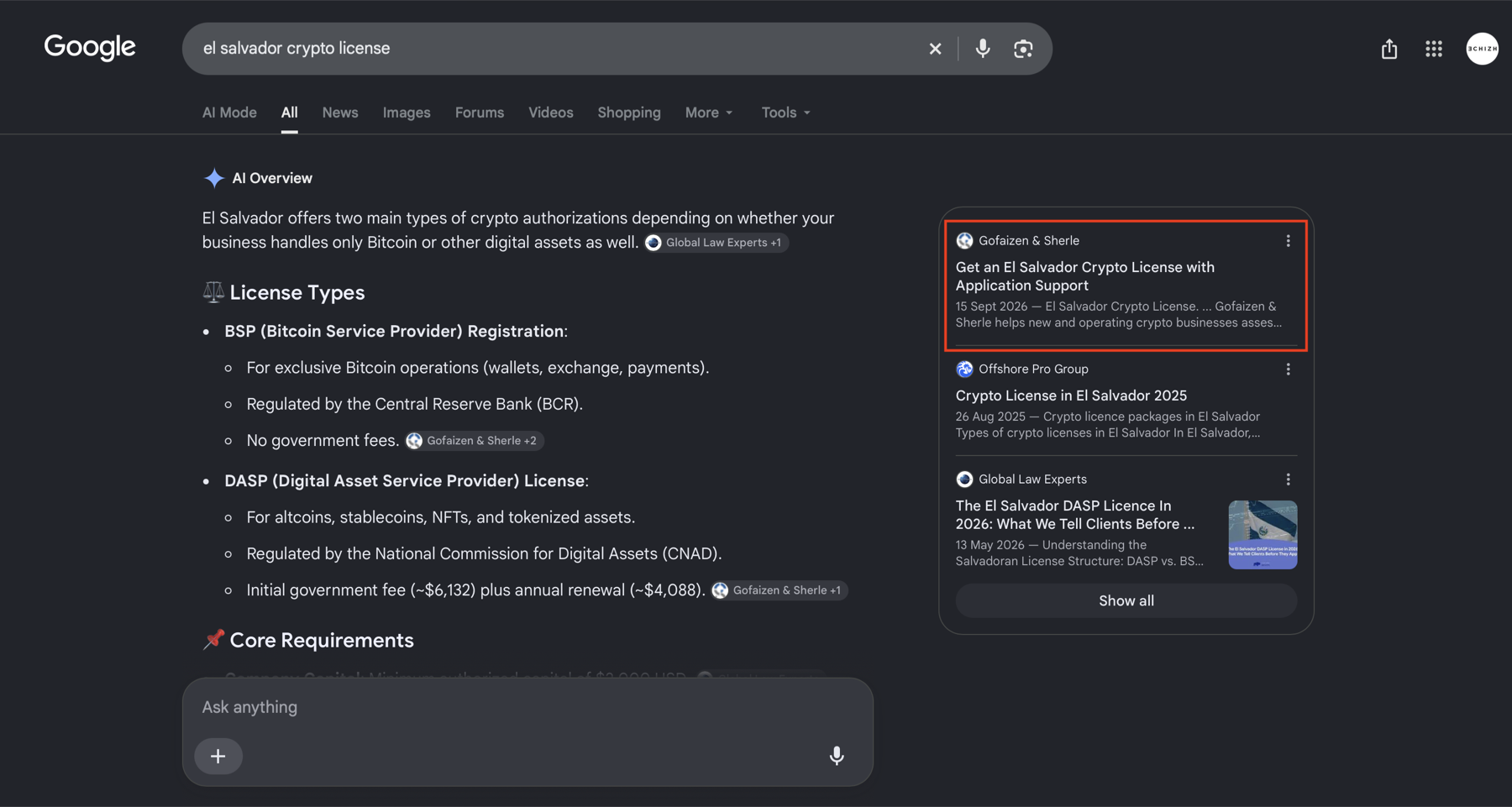
| Citations in the AI Overview body | 2 |
| Total links in the answer body | 15 |
| Position in the AIO sources panel | #1 of 10 |
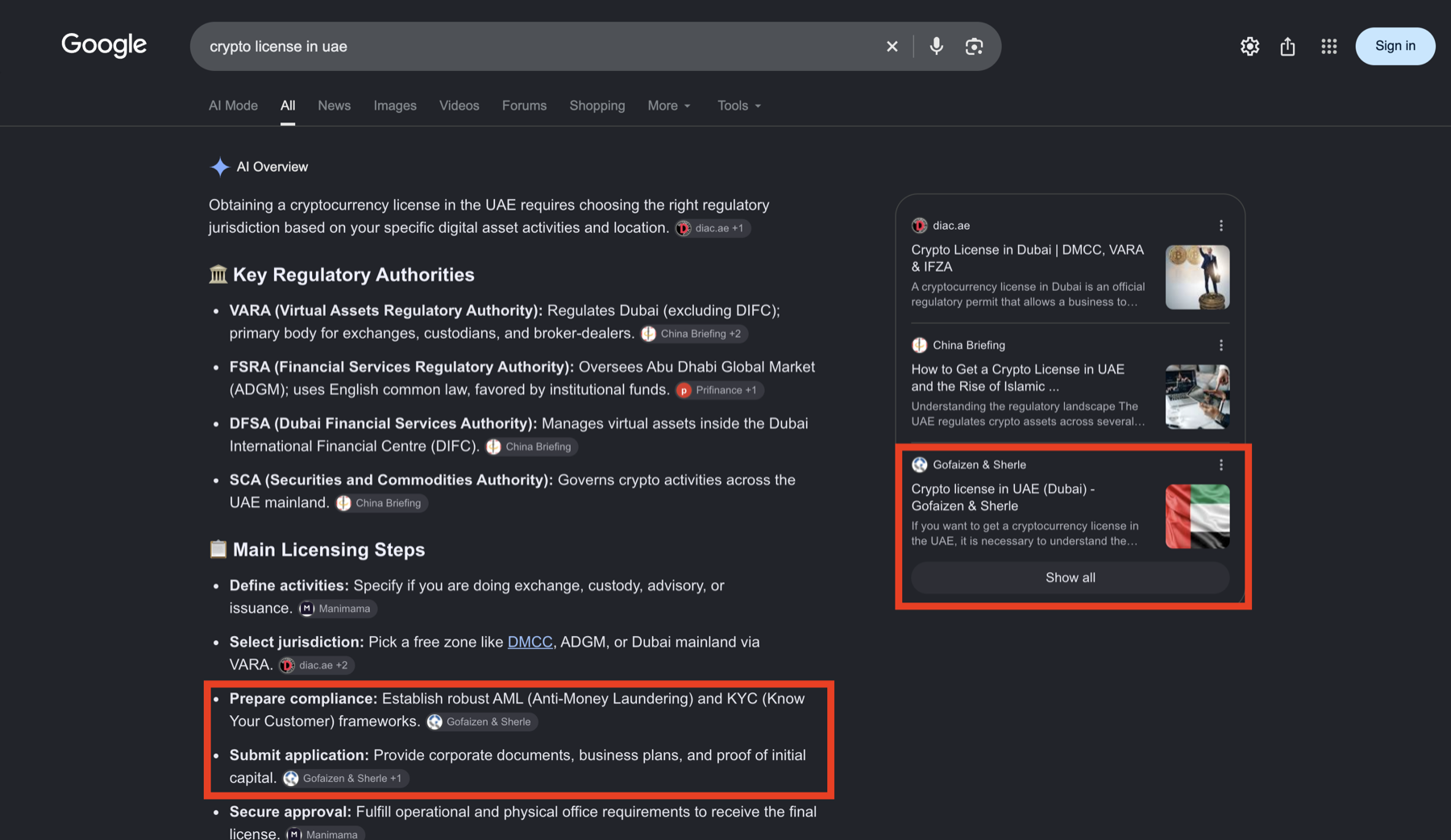
| Citations in the AI Overview body | 3 |
| Total links in the answer body | 16 |
| Position in the AIO sources panel | #3 of 9 |
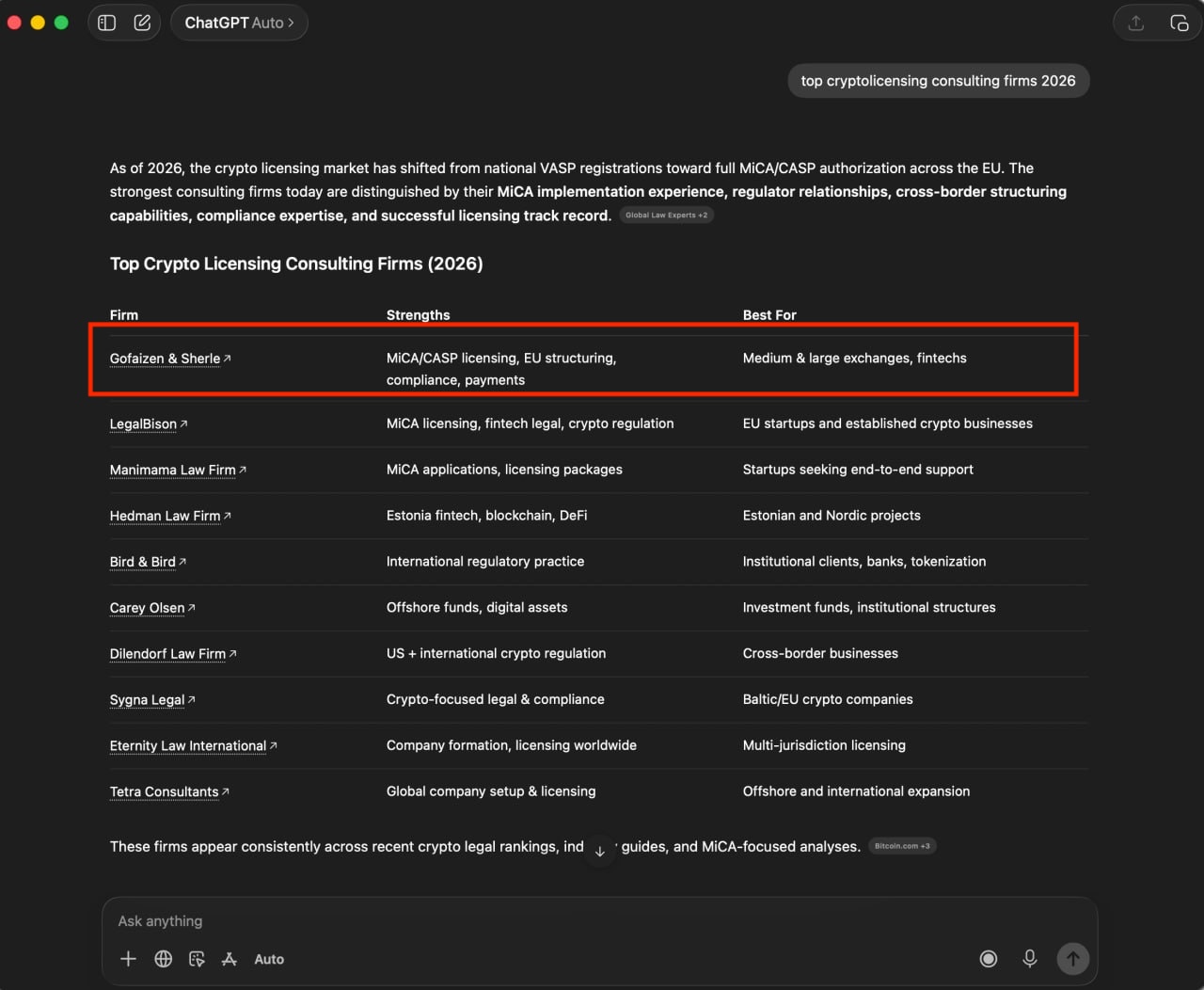
| ChatGPT app, Auto model | first table row |
| API with web search, gpt-4o-mini | first in the list |
05 The scale behind it
Measured Public organic data, DataForSEO Labs, US database, 22 Sep 2026. The client’s private Search Console figures are not published here.
| Organic keywords | 745 |
| In the top 10 | 152 |
| In positions 11–20 | 159 |
These numbers matter less in themselves than as context. They show the base for AI visibility was there: the domain already carried recognised topical weight in its niche. The entity layer did not create authority from nothing — it made existing authority citable.
06 What this case does not prove
Observation AI Overview presence is uneven across jurisdictions. There are queries where the domain sits in the answer body, and queries in the same topic where it appears neither in the body nor in the sources. Results are assembled per query, and coverage is not uniform across markets.
Causation is not proven by a single factor. The schema work and the structural fix coincided with other work on the site and with changes at Google. We can show what was there before, what we did, and what is visible now. We have no grounds to claim the Service node specifically is what worked.
AI Overview is not all of AI search. Presence in AI Mode at the May snapshot was weak — two brand mentions. That is a separate engine with separate logic, and it is a growth area rather than an achievement.
AI Overview is unstable. The same query can return a different set of sources on different days. One measurement is a snapshot, not a constant — which is why a date sits beside every number.
07 What carries over to other projects
Strong rankings no longer guarantee traffic. If a niche looks informational, the AI Overview will take the answer. The question is no longer how to rank higher, but what the answer gets assembled from.
The entity layer counts for more than volume of text. A site with hundreds of pages but a two-node schema reads to a machine as a brand with no services and no authors. That is fixed with markup, not with more content.
Structural blocks cancel out content quality. The Russian section was written perfectly well and still could not be cited. First remove whatever physically stops a page becoming a source.
Measure what sells. A top-10 position on a query that carries an AI Overview is a metric that already means little. Presence in the answer body means more.
Method and sources
AI Overview data: DataForSEO SERP API, Google US, desktop, English, snapshot 22 Sep 2026. Links in the answer body and links in the sources panel were counted separately — they are different signals. The queries shown are examples, not a complete list.
ChatGPT data: two independent routes, both on 22 Sep 2026 — the real app (Auto model) and DataForSEO chat_gpt/llm_responses with web search enabled (gpt-4o-mini). These are different models, so we record the agreement as an agreement, not as a property of ChatGPT generally.
Organic data: DataForSEO Labs, US database, 22 Sep 2026. These are publicly available estimates, not the client’s Search Console data.
Implementation data: internal deployment records dated 25 May 2026, schema coverage verified on the live site.
Limitations and what did not work: AI Overview coverage is not uniform across jurisdictions; AI Mode presence remained weak at the last measurement; no causal link between any single markup type and being cited is proven, and none is claimed here.