
What is a GEO audit: what gets checked and what the client receives
 Yevhenii Chyzh
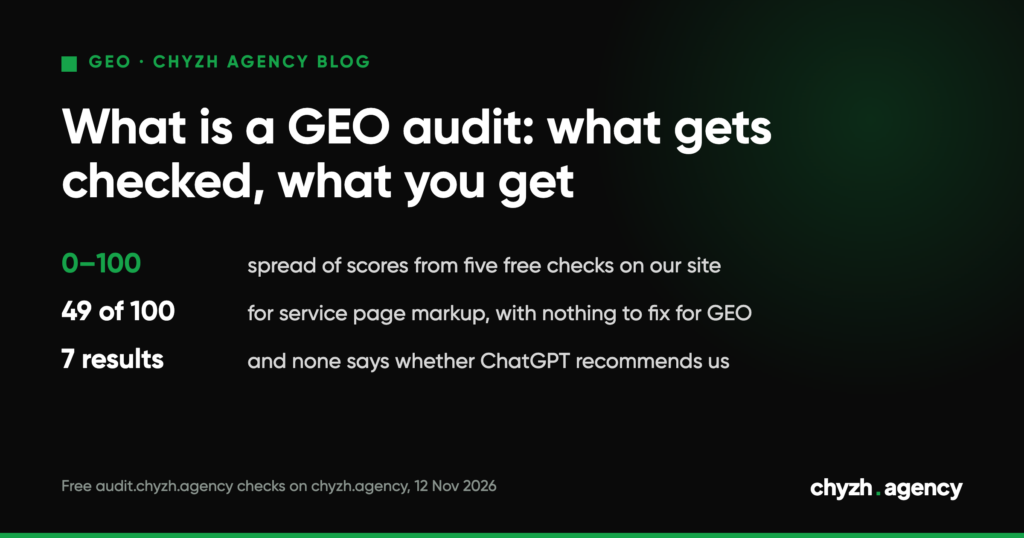
Short answer. A GEO audit checks two things. First, whether AI systems can reach your site and read it: bot access, text in the server-rendered HTML, the index, structured data and the facts about your company. Second, what ChatGPT, Gemini, Perplexity and Google’s AI Overviews actually say when your customers ask their questions: do they name your brand, which sources do they rely on, and whom do they recommend. A free automated score covers only the first part. A manual audit adds a prompt panel with repeat measurements, a map of sources and a fix plan for specific pages, where every recommendation comes with evidence and a way to verify it.
On 12 November 2026 we ran five free checks from audit.chyzh.agency on our own site. The scores ranged from 0 to 100. None of them tells you whether ChatGPT recommends us.
What a GEO audit checks, and where it overlaps with an SEO audit
Part of a GEO audit overlaps with an SEO audit: indexing, robots.txt, the sitemap, structured data. How we check that part is laid out in what an SEO audit includes. The new part starts where AI answers come in. They are collected on a fixed panel of prompts, separately for each system, and analysed for who gets named and which sources get cited.
What GEO is in general and how it differs from SEO is covered in GEO website promotion: what it is and how to check the result.
Free checks on our site: seven results
How we counted. On 12 November 2026 at 10:13 UTC we called five audit.chyzh.agency tools with the same requests each tool’s page sends. Site-wide we checked robots.txt, llms.txt and a Wikidata entry; for page checks we took the Ukrainian home page and the GEO promotion service page. We did not run the citation checker or the Google Maps audit, because both call paid APIs.
| Tool | What it looks at | chyzh.agency | What’s missing, per the tool |
|---|---|---|---|
| AI crawler checker | robots.txt rules for 23 bots | 23 of 23 allowed | nothing |
| llms.txt validator | file structure per the llmstxt.org proposal | 98 of 100 | 3 of 14 links have no description |
| Schema validator, home page | JSON-LD on the page | 100 of 100 | two warnings that don’t affect the score |
| Schema validator, GEO service page | same | 49 of 100 | three pricing plans have no exact price |
| Answer readiness, home page | structure of the server HTML | 89 of 100 | no definition sentences, no tables |
| Answer readiness, GEO service page | same | 97 of 100 | no tables |
| Entity checker | Wikidata entry | 0 of 100 | no entry |
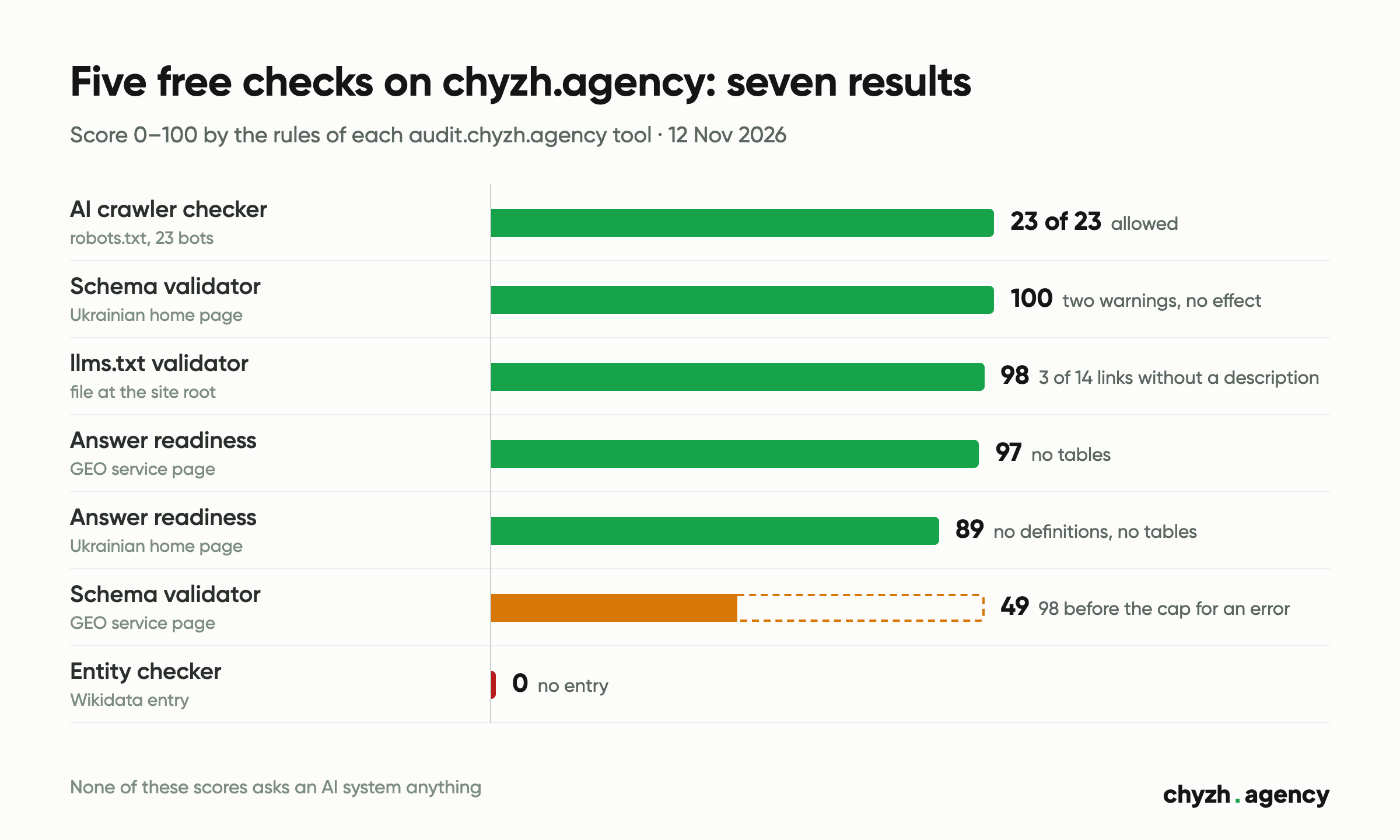
The same scores after a manual review
Every number reflects the rule of one specific tool.
49 of 100 for the service page markup. Without the cap rule the page would have scored 98 of 100. The validator deliberately drops the score to 49 for any structural error, so a good-looking number never hides broken markup. There is one error here: three pricing plans carry a minimum price (from $600, $800 and $1,000) and no exact price field. On the page those plans really are “from”, so we would not add a fixed amount just to raise the score: markup has to match the visible text. Google’s guide to generative AI features in Search (updated 10 July 2026) says structured data isn’t required for generative AI search and there is no special schema.org markup to add. The manual audit’s verdict: nothing to fix here for GEO.
0 of 100 for the entity. The tool found no Wikidata entry for Chyzh Agency, and that’s all the score tells you. The tool itself advises creating an entry only once independent coverage of the brand exists, since, as it explains, an unsourced entry gets deleted. A manual audit asks different questions: how AI systems describe the company, whether services and prices in those descriptions are right, and whether the facts match across the site, directories and profiles. Under our methodology, the effect of such an entry on AI answers has the status of a hypothesis: a plausible tactic, untested for our case.
98 for llms.txt and 23 of 23 for bot access. According to Google’s guide, its Search, including the generative AI features, doesn’t use llms.txt. Our methodology doesn’t treat llms.txt as a condition of AI visibility: the file is kept only for a specific consumer, so in a manual audit it sits at the bottom of the list. Bot access has a different trap. The crawler checker reads robots.txt only. Our file doesn’t name a single AI bot and lets everyone in with one User-agent: * rule, hence 23 of 23. Our own free 47-check audit, by the rules published on its page, gives full 18 points for access only when robots.txt names five bots one by one, so the same file wouldn’t get full points there. Both tools count correctly, each by its own rule. Neither can see whether a bot actually came.
The manual check here is short. We requested the GEO service page as six bots, including OAI-SearchBot, ChatGPT-User and PerplexityBot. All six got a 200 response and the same HTML as a browser, 169,743 bytes. That only tests filtering by bot name. Protection that verifies IP addresses may treat the real bot differently, which is why an audit also looks at server logs.
The answer readiness score awards points for question-style headings and definition sentences. Yet the same guide says you don’t need to write in a specific way for generative AI search and there’s no ideal page length. So the score works as a structure checklist, and a person makes the call on any given page.
What no automated score can see
All seven checks look at our site. None of them asks an AI system anything. So a score can’t answer the questions people bring to a GEO audit:
- which customer prompts get your brand named, and which don’t;
- which sources the answer relies on;
- who gets recommended instead of you;
- whether AI describes your services, prices and locations correctly.
On 12 November we captured Google Ukraine results for two Ukrainian-language queries, one for “GEO site audit” and one for “what is a GEO audit” (logged-out browser, one capture each). Both times an AI Overview sat above the results. For the first query it cited seomarket.ua, a reddit.com thread and a Chrome Web Store page, and the first thing it recommended was a free tool and a Chrome extension. For the second it showed cases.media and seomarket.ua as sources. Our GEO service page ranked eighth in organic results for the second query and wasn’t among the sources the overview showed. Its answer readiness score was 97 of 100 at the same time.
The same overview advised checking whether “the main answer is within the first 50 words of the page” (translated from Ukrainian). Google’s guide has no such rule, and neither does our methodology: the answer has to be clear and sufficient for the task.
A single capture only shows what an answer can look like. AI answers change from run to run, so a conclusion needs a prompt panel and repeats.
What the client receives after a GEO audit
Below are the report sections under our working SEO/GEO methodology (version 1.0 of 10 November 2026). Agree before the start which of them your audit will include.
- Prompt panel. Exact wordings grouped by intent: definition, choosing a solution, comparison, finding a provider, brand check, cost. Each one records where it came from: Search Console, conversations with customers, inquiries or our own hypothesis. The panel’s core is repeated unchanged; the exploratory part may change.
- Baseline measurement. Per system: the share of answers that mention the brand, that link to your domain and that recommend you outright. Each share is shown as “x of y”, next to the share of successful collections. Answers are stored with date, model and mode, and any of them can be opened. We run these measurements in our own tracker, tracker.answerly.agency.
- Source map. The domains that answers to your prompts link to, where competitors show up among them, and which of those platforms you can realistically get onto: directories, trade media, review sites.
- Technical layer. Each bot’s access per robots.txt and per server logs, blocking by server protection, text in the server HTML, indexing in Google and Bing.
- Recommendation cards. One card per problem at a specific URL: evidence, status (platform requirement, practice, hypothesis or unconfirmed), limitations, action, cost and risk, acceptance criterion, and the metric used to track the result.
- Re-measurement plan. When the same panel is repeated, how many observations are planned and what counts as a change.
An example from our work: amlcertification.com case: a top Google AI Overview source for AML certification.
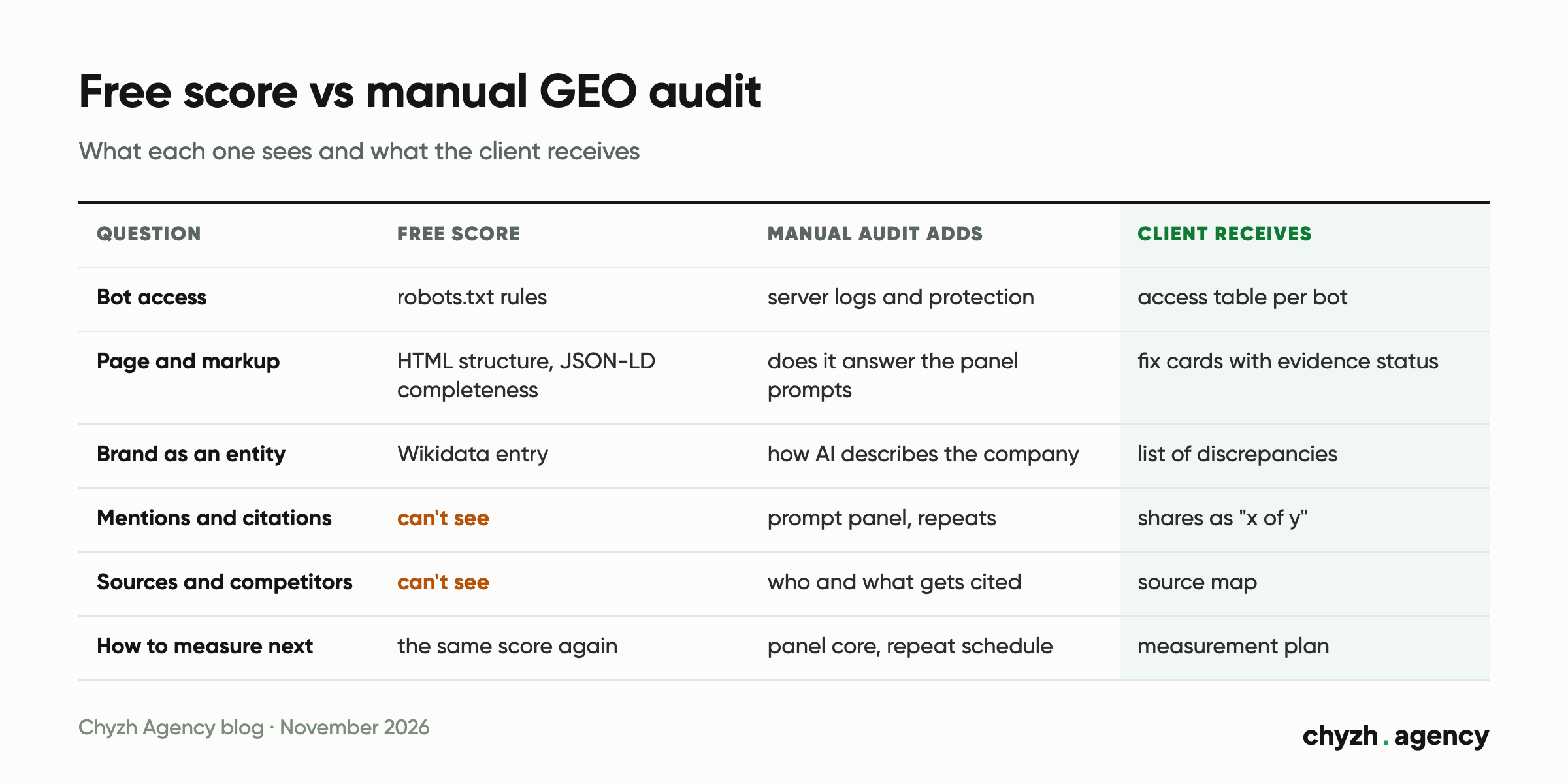
Free score vs manual audit: what each one sees
| Question | Free scoring | What a manual GEO audit adds | What the client receives |
|---|---|---|---|
| Does the site let AI bots in | robots.txt rules | server logs, server protection, separate decisions for search bots and training bots | access table with a decision for each bot |
| Is the page readable | server HTML structure scored by fixed weights | whether the page answers the prompts in the panel | list of pages with fixes and acceptance criteria |
| Structured data | completeness of JSON-LD | whether markup matches the text and is needed for the task at hand | recommendation card with a status |
| llms.txt | file structure | who the file is for and what it brings | decision on whether to maintain the file |
| Brand as an entity | Wikidata entry | how AI describes the company, errors and outdated facts | list of discrepancies and where to fix them |
| Mentions, citations, recommendations | can’t see | prompt panel per system, with repeats | baseline in “x of y” form plus stored answers |
| Sources behind answers | can’t see | domains the answers link to | prioritised source map |
| Competitors in answers | can’t see | who appears instead of you and how often | list with appearance shares |
| How to measure next | the same score again | panel core, repeat schedule, metric definitions | measurement plan |
A hypothetical measurement plan
This example is hypothetical. A panel of 30 prompts, three systems, two runs of each prompt: 180 planned observations. Say 162 answers pass the quality check and the brand is mentioned in 27 of them. The mention share is then 27 of 162, or 17%, and collection success is 162 of 180, or 90%. Failed collections don’t count as answers without the brand, and they can’t be hidden either.
There is no universal number of prompts or repeats. It depends on how much answers vary, the cost of an error and the budget. Two runs show a direction; they aren’t enough to conclude that a small change happened.
How to tell the audit was done honestly
- every share is given as a numerator and a denominator, never a bare percentage;
- each system gets its own row, with no blending with Search Console or GA4;
- collection errors are shown separately;
- stored answers can be opened and re-read;
- every recommendation has an evidence status and an acceptance criterion;
- no promise that “you will be cited” and no overall GEO score without an open formula.
A word on traffic. GA4 puts visits from ChatGPT, Gemini or Copilot into the AI Assistant channel and counts AI Overviews and AI Mode as Organic Search (Google Analytics help, checked 12 November 2026). So traffic from AI Overviews won’t show up under AI Assistant, and the report should explain where to look for it.
What to prepare for a GEO audit
- the questions customers ask before buying, word for word: from calls, emails, chats;
- the competitors you get compared with;
- markets and languages;
- read access to Search Console, Bing Webmaster Tools and GA4;
- a contact for whoever manages the server and site protection, or server logs for the last month;
- current facts about the company: services, prices, locations, directory profiles;
- what counts as a result for you: a lead, a call or a purchase.
Limits of this data
We ran the tools once, on 12 November 2026, on two pages and three site files. The scores reflect the rules of our tools and say nothing about the rules of AI systems. The bot-name check only catches filtering by name. There is one search capture, Google Ukraine, logged-out browser. The article has no measurement of AI answers of our own: that requires paid runs against the systems, and this pass was limited to free checks.
Next step
Run the free checks on your own service page: within a few minutes you’ll see the technical gaps. If the question is what ChatGPT, Gemini and AI Overviews tell your customers, book a free initial GEO diagnostic on the GEO promotion page. It describes what the work involves and what ongoing support costs.
Author: Yevhenii Chyzh, founder of Chyzh Agency. Reviewed by Dmytro Popryadukhin, Head of SEO.
Sources: run of the free audit.chyzh.agency tools on chyzh.agency, raw API responses, 12 Nov 2026; request of the GEO service page as six bots, 12 Nov 2026; chyzh.agency robots.txt and JSON-LD, 12 Nov 2026; Google Search Central, “Optimizing your website for generative AI features on Google Search”, updated 10 Jul 2026; Google Analytics help on default channel groups, checked 12 Nov 2026; description and weights of the free 47-check audit on audit.chyzh.agency, 12 Nov 2026; Google Ukraine search capture for two Ukrainian-language queries about GEO audits, 12 Nov 2026; Chyzh Agency SEO/GEO working methodology, version 1.0 of 10 Nov 2026.
Related articles
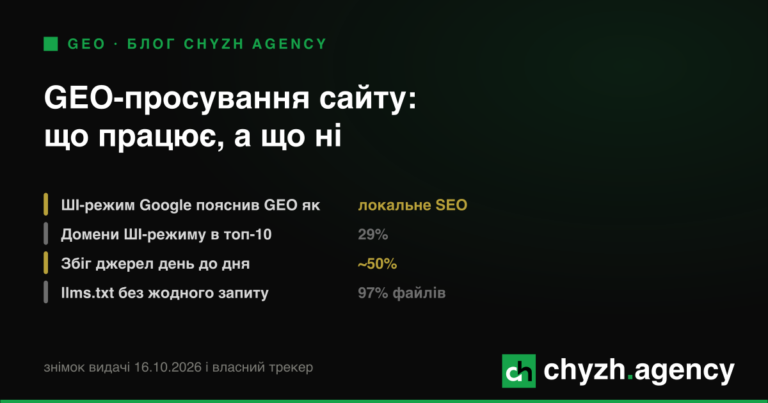
Even Google AI Mode confuses GEO with local SEO. What GEO website promotion includes, which...