
What mobile app support after release includes
 Mykola Tabuchenko
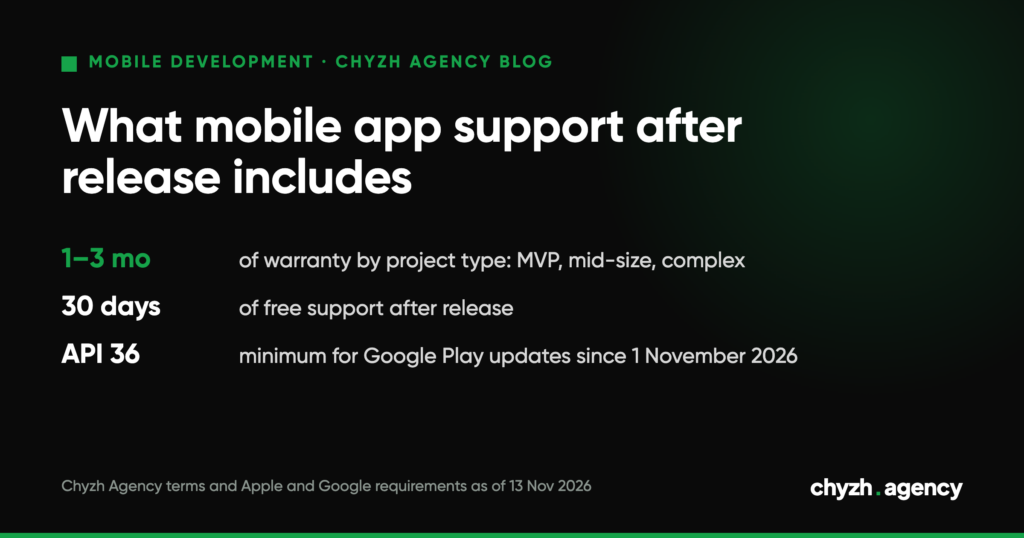
Short answer. After release, work on an app falls into three buckets: warranty, support and further development. Warranty covers defects in what you accepted, and the contractor pays for it. Support keeps the app working as iOS, Android and the App Store and Google Play rules change. Development means new features, and those are estimated separately.
Our warranty depends on the project type: 1 month for a single-platform MVP, 2 months for a mid-size project and 3 for a complex one. Enterprise projects include 3+ months of support in the package. The first 30 days of support after release are free. That is what our mobile app development page says as of 13 November 2026.
How to tell warranty from support and development
One question settles most post-release disputes: did this feature work at acceptance the way the spec describes it?
- The feature was in the spec, passed acceptance and is now broken. That is a defect, so it falls under warranty. The contractor fixes it at its own cost.
- The feature worked, but the environment changed: a new iOS came out, a store raised its requirements, a third-party SDK dropped its old version, or your server started returning data differently. That is support, and once the free period ends, you pay for it.
- The spec never described this behaviour. That is development, however small the task looks.
This is why the acceptance record matters after release too: it is what you compare “it broke” against “it was always like this”. We explain how to put one together in our article on app acceptance before store release.
Most misunderstandings happen on the line between support and development. A “half-day” change that alters how a screen behaves is development on paper. Agree with your contractor on an hours threshold above which a task gets its own estimate, and put it in the contract.
How long the warranty lasts and what applies after it
Terms from our price and timeline table, 13 November 2026:
| Project type | Build time | Cost | After release |
|---|---|---|---|
| Single-platform MVP, 5–10 screens | 1 mo | from $3,000 | 1 month warranty |
| Cross-platform MVP on Flutter | 1 mo | from $3,000 | not stated in the table, set in the contract |
| Mid-size project, 25–50 screens | 2–4 mo | from $15,000 | 2 months warranty |
| Complex project, Android + iOS | 4–6 mo | from $30,000 | 3 months warranty |
| VR/AR | 3–6 mo | from $20,000 | not stated in the table, set in the contract |
| Enterprise, 50+ screens | 6–12 mo | from $50,000 | 3+ months support |
What else the terms include:
- the first 30 days of support after release are free;
- if the App Store or Google Play rejects the app because of our mistake, we fix it for free;
- our app cost calculator has a “Support for the first 3 months” option at $1,000. The platform multiplies it like every other option: $1,000 for one platform, $1,700 for Flutter on iOS and Android, $2,000 for two native apps;
- support for us means bug fixes and updates for new iOS and Android versions, while new features after launch go into quarterly sprints of $1,000–3,000.
Agree in the contract on the exact list of work in the free 30 days and in the 3-month option, and on how support is billed after them: a block of hours, hourly or per task.
Ask any contractor which date the warranty runs from. Store review sits between signing the acceptance act and the app going live, and you do not control how long it takes.
What the stores change every year
The stores raise their requirements on a schedule and announce them in advance. We checked the dates against Apple’s and Google’s official pages on 13 November 2026.
| Date | Store | Requirement for new apps and updates |
|---|---|---|
| 25 Apr 2023 | App Store | built with Xcode 14.1 and the iOS 16.1 SDK or later |
| 29 Apr 2024 | App Store | built with Xcode 15 for iOS 17 |
| 31 Aug 2025 | Google Play | target API 35 (Android 15) or higher |
| 28 Apr 2026 | App Store | built with Xcode 26 or later and the iOS 26 SDK |
| 31 Aug 2026, extendable to 1 Nov 2026 | Google Play | target API 36 (Android 16) or higher |
| 9 Sep 2026 | App Store | minimum deployment target iOS 13 or later |
| April 2027 | App Store | built with the iOS 27 SDK, minimum target iOS 15 |
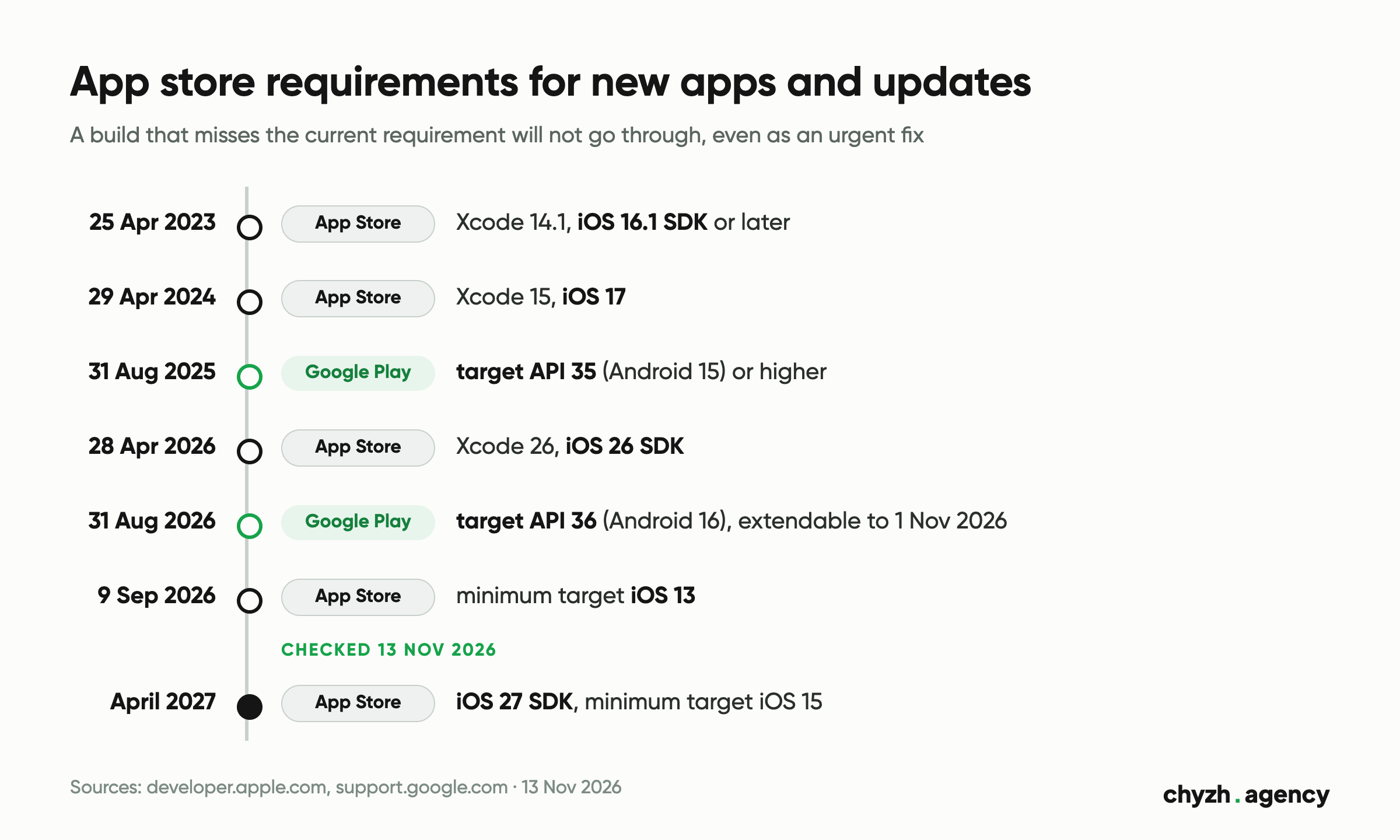
Two things follow from this calendar, and owners usually find them out too late.
First, an urgent fix turns into a migration. Stores only accept updates that meet the current rules. If your app was last built in 2025, then in November 2026 even a one-line fix first needs a move to target API 36 for Google Play and a rebuild in Xcode 26 for the App Store. We recommend putting the yearly update in the plan as its own task, dated before the store deadline.
Second, an app that is never updated fades out gradually.
- On Google Play, new users will find an app that targets API 34 or lower only on devices running the same Android version or older. Newer Android versions need target API 35 or higher.
- Apple warns the owners of apps that have not been updated in three years and have had almost no downloads over the past 12 months. They then have 90 days to submit an update, or the app is removed from the App Store.
- If the Apple Developer Program membership ($99 a year) lapses, the app is no longer available for download and you cannot submit new builds. People who already installed it can keep using it.
We treat the yearly update for store requirements as a mandatory part of support, even when no new features are planned. The one exception is a one-off campaign app that you plan to take down yourself.
Do people look for support before release? Our search data
We looked at the queries for which Google showed 18 pages of our mobile development section in Ukrainian, Russian and English between 13 May and 11 November 2026. Search Console reports 63,725 impressions across all these pages and 827 distinct queries that it shows by name.
Not one of them is about support, maintenance, warranty or app updates. 346 queries, with 26,722 impressions between them, are about development cost or the calculator. It looks as if budgets get planned up to release, and the costs after it come as a surprise.
Limits of this data. Search Console hides rare queries, and they account for 17% of these pages’ impressions. Impressions are not demand. We leave clicks out entirely, because on 2–5 November bots generated part of the clicks on our Russian-language pages.
Matrix: who owns the task and how fast
You can use this table as the starting point for a contract annex. We deliberately do not invent response times here: where our public terms do not state one, it has to be agreed in the contract.
| Post-release situation | Type of work | Who does it and who pays | Response time |
|---|---|---|---|
| Payments fail, although the flow was in the spec and passed acceptance | Warranty | Contractor, free within the warranty period | A separate contract line for critical failures |
| A store rejected the build because of a developer error | Warranty | Free with us | Until resubmission, timing set in the contract |
| After a new iOS release a screen breaks or the camera stops working | Support | Contractor; free with us in the first 30 days after release, then as agreed | Agree in the contract |
| Google Play requires a new target API | Support, planned | Contractor, against an agreed estimate | Known in advance: API 36 applies now |
| The App Store only accepts builds made with a new SDK | Support, planned | Contractor, against an agreed estimate | April 2027: iOS 27 SDK |
| A payment, maps or analytics SDK ends support for its old version | Support | Contractor; the client pays the service’s own fees | Deadline set by the SDK vendor |
| Your team changed the server or CRM API and the app no longer shows data | Not warranty: support if the fix is small, otherwise development | Client | In the contract: how many days’ notice the contractor gets |
| The Apple Developer Program membership expired | Account administration | Account owner, $99 a year | Renewal opens 30 days before the expiry date |
| You need a loyalty programme or a new language | Development | Separate estimate; with us, a quarterly sprint | Next sprint |
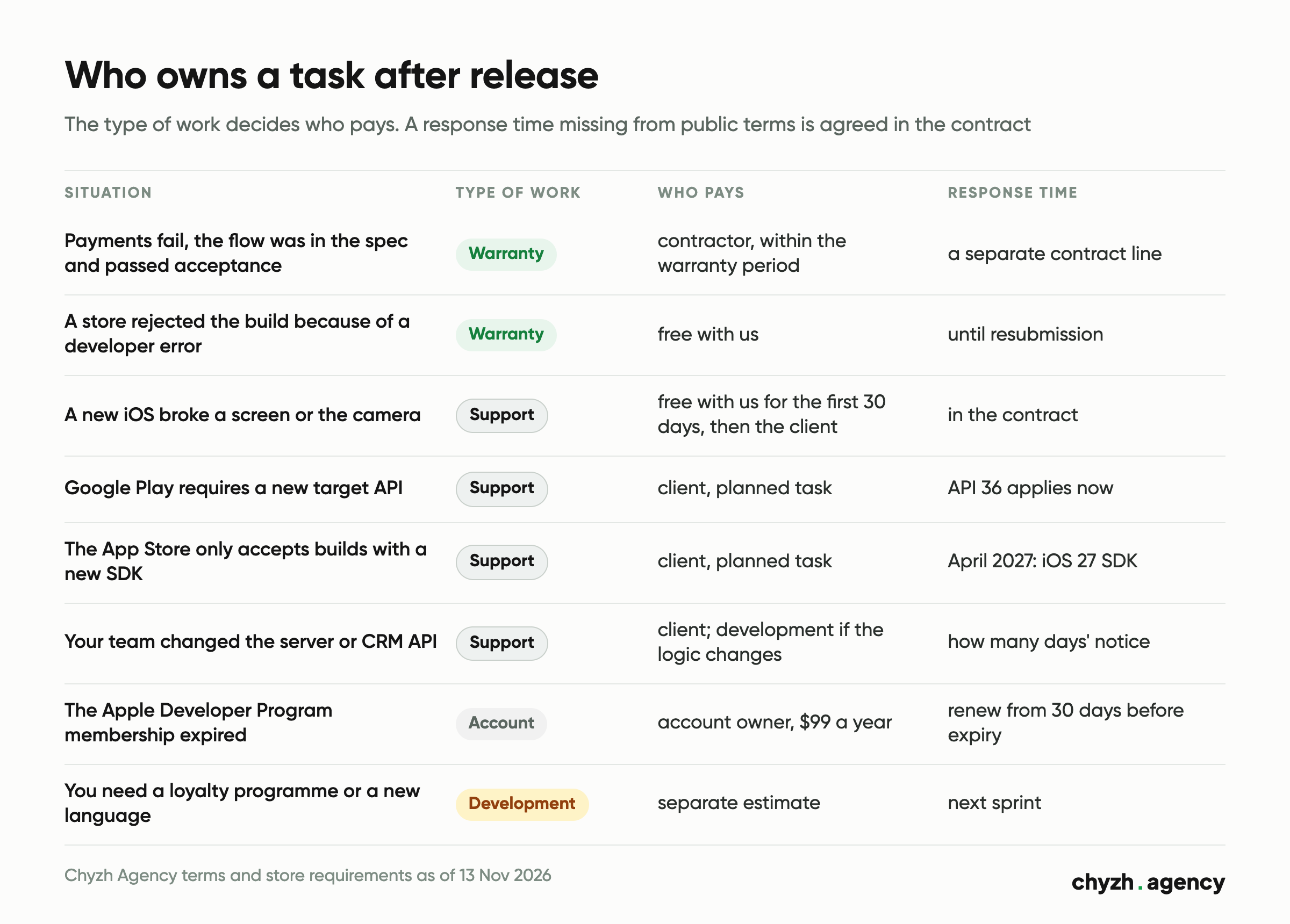
For critical failures, when the app will not open or payments fail, write the response time down separately from everything else.
What to put in the support contract
- The date the warranty runs from: the acceptance act or store publication.
- What counts as a defect: a deviation from the spec and the acceptance record.
- Failure classes and a response time for each, for example “will not open or payments fail”, “a feature works with an error”, “cosmetic”.
- Who on your side files requests, and through which channel.
- How support is billed after the free period, and what a fixed fee covers, if there is one.
- Who owns the App Store Connect and Google Play Console accounts. We recommend registering them to your company, so renewals and access stay in your hands.
- What voids the warranty, including whether it still applies after another team changes the code or the server changes without notice.
- How to hand support over to another team. With us you have GitHub access from day one, and the code rights pass to you once the final milestone is paid, so support can move to another team without our involvement.
These questions are best asked before you sign the development contract, together with the rest of our checklist for choosing an app development company.
What to do now
If the app is still being built, ask for three separate lines in the proposal: warranty, support and development, and for support, the store deadlines for the coming year. The calculator shows how much 3 months of support adds for your platform.
If the app is already live, check two numbers in the latest build: the target API for Google Play and the Xcode version for the App Store. A target below 36 or a build older than Xcode 26 means your next update starts with a migration.
Warranty terms by project type and how our post-launch support works are on the mobile app development page.
Author: Mykola Tabuchenko, Senior Mobile Developer. Reviewed by: Serhii Kolodynskyi, Head of App Development.
Sources: price and timeline table and FAQ on the chyzh.agency mobile app development page (EN, UA, RU), 13 Nov 2026; the chyzh.agency app cost calculator model (data-price and data-multiplier attributes), 13 Nov 2026; Apple Developer, Upcoming Requirements and Submitting to the App Store, viewed 13 Nov 2026; Apple, App Store Improvements, Membership renewal and Program enrollment, viewed 13 Nov 2026; Google Play Console Help, Target API level requirements, viewed 13 Nov 2026; Android Developers, Meet Google Play’s target API level requirement, last updated 28 Oct 2026; Google Search Console, property https://chyzh.agency/, 18 pages of the mobile development section, 13 May–11 Nov 2026, data for 11 Nov preliminary.
Related articles
A checklist for accepting a test build: 5 test devices by market share, sandbox payments,...
By our calculator model, the same app costs $17,450 or $27,650 depending on what the...
Does your app need its own server and admin panel: a feature table, data schema,...