
How to estimate an app MVP without a finished spec
 Serhii Kolodynskyi
Short answer. You don’t need a technical specification for a first MVP estimate. One user scenario written out step by step is enough, plus a “now or later” decision for every feature and answers to a few questions a developer can’t price without: one platform or two, where the data comes from, and what the app sells. The developer writes the spec afterwards, from that conversation.
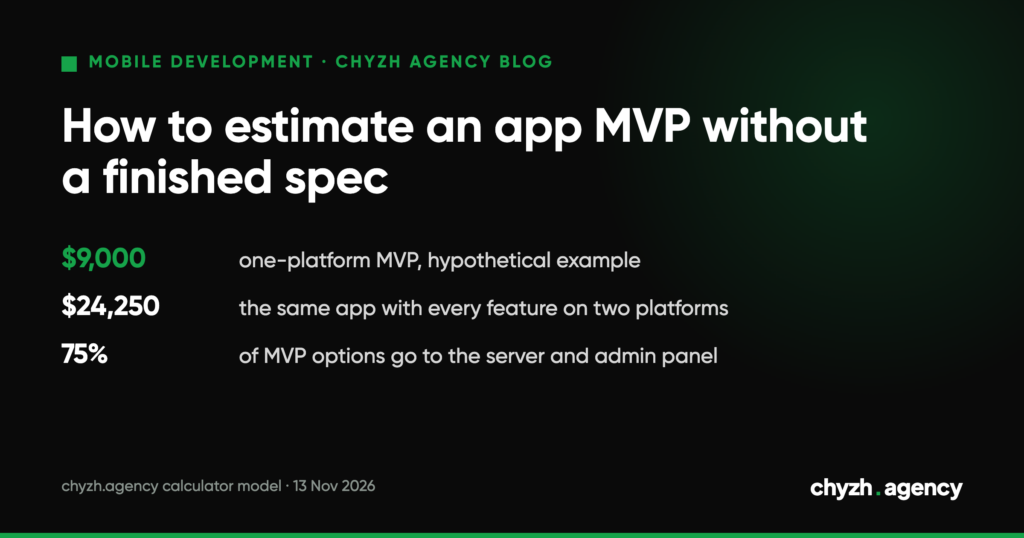
Scope matters more than it looks. We ran one hypothetical scenario through our cost calculator. The minimum set on one platform, Android or iOS, comes to $9,000. The same app with every wished-for feature at once, built in Flutter for both the App Store and Google Play, comes to $24,250. The 2.7× gap comes from scope decisions alone.
For reference: a single-platform MVP with us starts at $3,000 and takes a month, and a cross-platform MVP in Flutter also starts at $3,000 (price table on our mobile app development page, as of 13 November 2026).
What to give a developer instead of a spec
For the first conversation, bring:
- Who the user is and what situation they open the app in.
- One scenario from first launch to the outcome, in 5–8 steps. Describe the outcome as something that happens in real life, such as “came to the class”. That decides which features are required.
- What is definitely out of the first version.
- Which platform comes first. The answer depends on where your customers are today.
That’s enough for a range. Next comes a free 30-minute call, after which we prepare the spec and an itemised estimate within five working days (that’s how the process is described on our calculator page as of 13 November 2026). So the spec is an output of the estimate, and you don’t have to write it yourself.
Our usual approach to an MVP: 3–4 features, one store, a month of work, then new features in quarterly stages of $1,000–3,000. So “later” in the table below means the next stage. Nothing gets deleted for good.
A hypothetical example: the now/later table
The example is hypothetical, not a real client. A yoga studio wants new customers to book a trial class from their phone. The scenario: a person installs the app, signs in, browses the schedule, picks a class, books it, gets a reminder and shows up. The MVP has one thing to test: how many of the people who installed the app made it to a class.
We ask one question of every feature: can a new customer complete the scenario without it? If they can, the feature moves to “later”. Prices are the options in our calculator as of 13 November 2026, for one platform.
| What’s needed | Decision | Why | Calculator option |
|---|---|---|---|
| Sign-in with email or social accounts | now | a booking has to belong to a person | Authorization, +$500 |
| In-app account deletion and privacy policy | now | the App Store and Google Play always require a privacy policy, and account deletion once there’s sign-up | no separate option; clarified during the estimate |
| Schedule and class page | now | without them there is no scenario | in the base: up to 10 screens, basic design |
| Booking and a “my bookings” list | now | bookings must be stored on a server | Backend + REST API, +$2,500 |
| Reminder before the class | now | the scenario ends when the person shows up | Push notifications, +$500 |
| The studio edits its own schedule | now | otherwise every change goes through the developer | Admin panel (web), +$2,000 |
| Analytics on each scenario step | now | without it you can’t see where people drop off | Analytics integration, +$500 |
| Publishing to one store | now | no launch without it | free |
| Online payment for passes | later | a trial class can be paid for at the studio | Online payment, +$1,000 |
| Chat with the instructor | later | the studio’s phone covers questions for now | Chat / messenger, +$1,500 |
| Loyalty program | later | it makes sense after repeat visits | +$500 |
| Three interface languages | later | test the scenario in one language first | Multilingual, +$1,000 |
| Brand-specific design | later | the basic interface is enough to test the scenario | Custom design, +$2,000 |
| Map with the studio address | later | the address can be plain text | Geolocation + maps, +$500 |
| Second platform | later | test the scenario on one platform first | multiplier ×1.7 or ×2.0 |
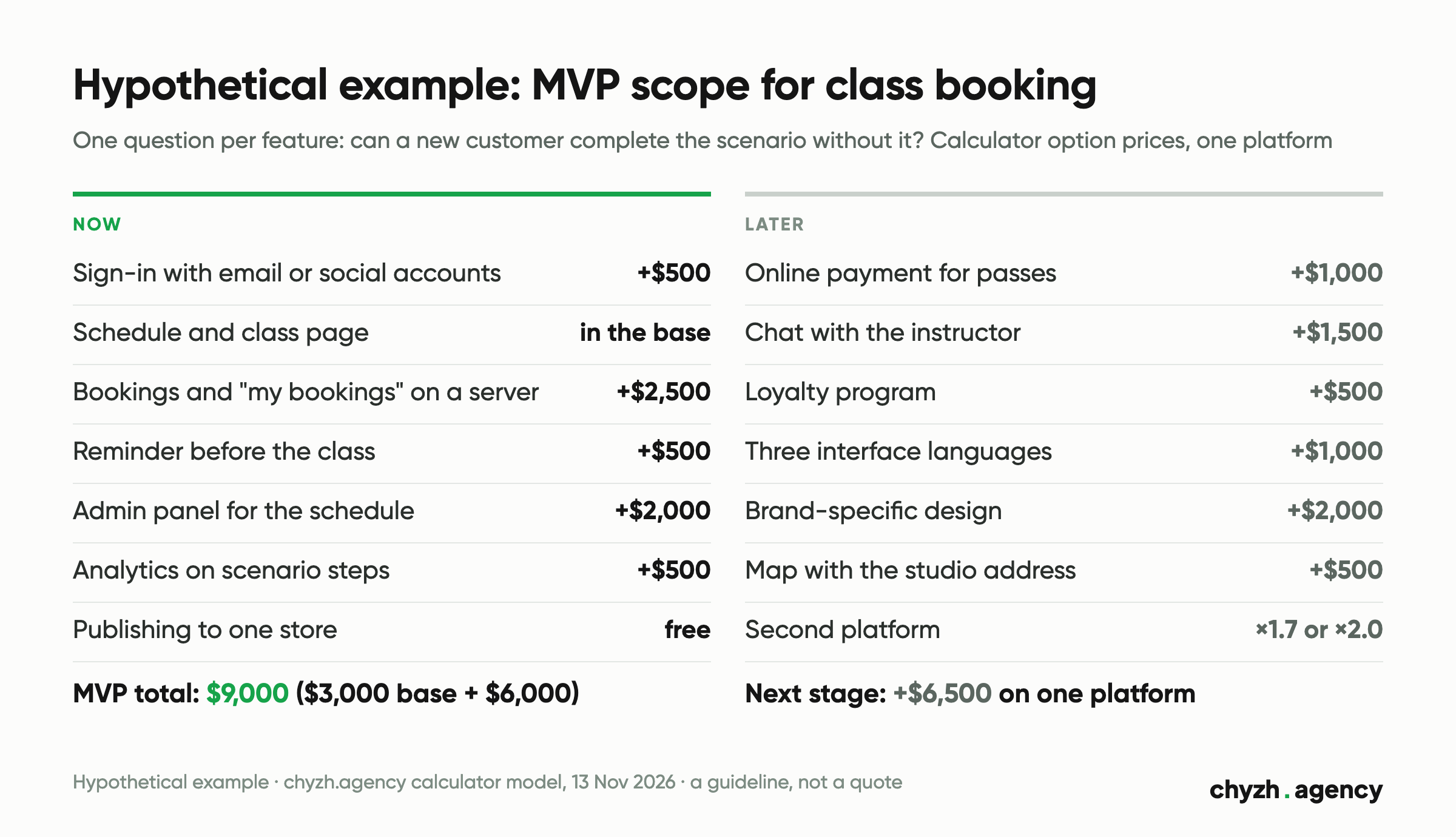
The required set adds up to $6,000 in options. With the $3,000 base, that’s $9,000 on one platform. The scenario has six screens (sign-in, schedule, class page, booking confirmation, my bookings, profile), so it fits the base size of up to 10 screens.
That’s three times the lower bound of an MVP in our price table. There, the MVP from $3,000 lists “business card, catalog, promo app” as examples. Class booking needs more: the server stores bookings and the studio manages the schedule. The calculator prices those parts as separate options.
What moves the number most
The mobile app cost calculator works like this: a $3,000 base plus the sum of selected options multiplied by a platform factor. One platform is ×1.0, iOS and Android in Flutter ×1.7, two native apps ×2.0. The factor doesn’t touch the base.
| Version | One platform | iOS and Android in Flutter | Native iOS and Android |
|---|---|---|---|
| MVP, required set | $9,000 | $13,200 | $15,000 |
| Everything at once, plus six “later” features | $15,500 | $24,250 | $28,000 |
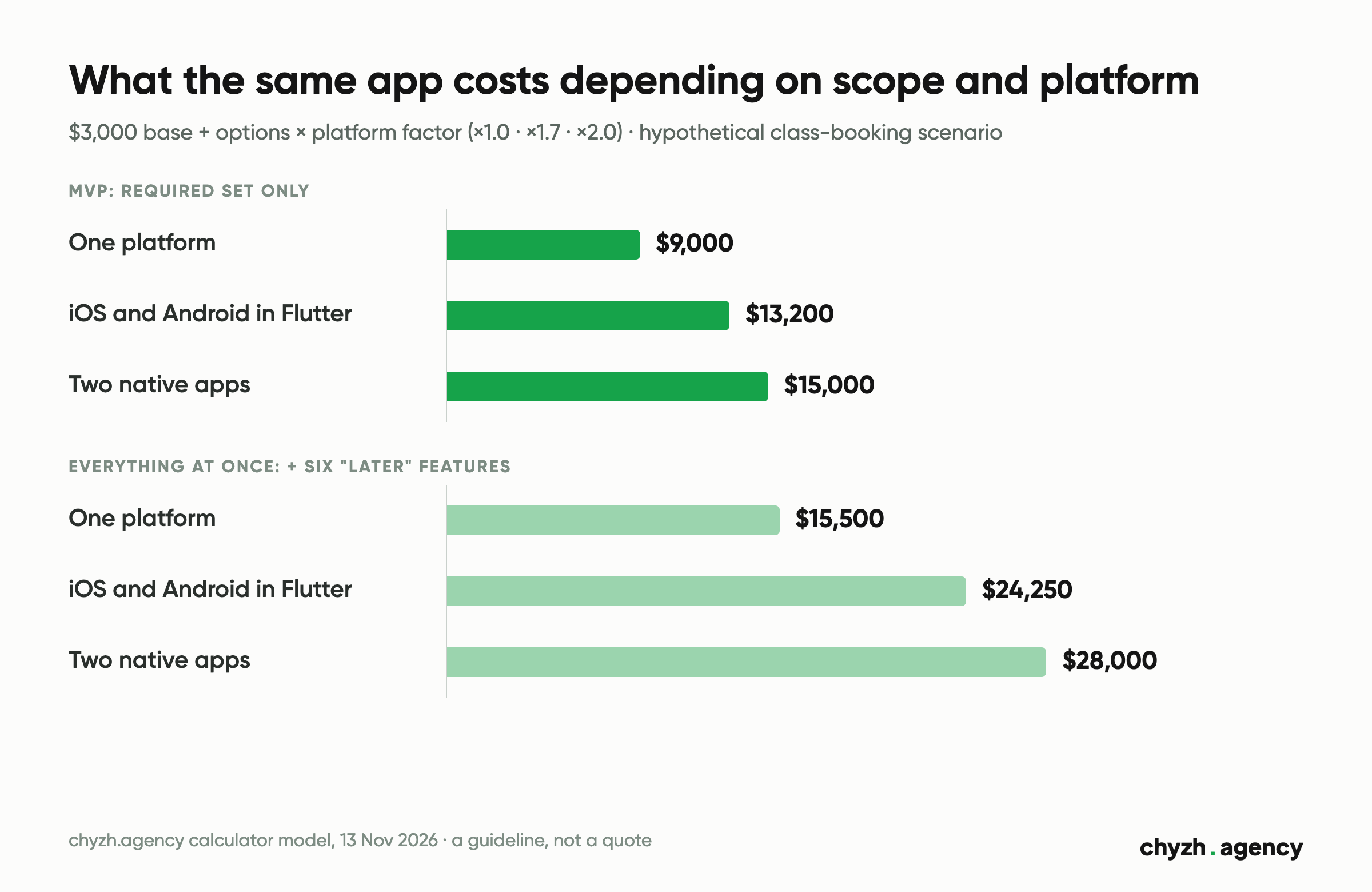
The server outweighs the screens. Backend and admin panel account for $4,500 of the $6,000 in MVP options, or 75%. The six screens fit inside the base. So the most expensive question in this example is where the data comes from and who changes it.
A second platform multiplies everything you add. In Flutter the MVP goes up by $4,200, and with native development by $6,000. Every “later” feature costs 1.7–2 times more on two platforms as well: brand-specific design is $2,000 on one platform, $3,400 in Flutter and $4,000 native. How Flutter differs from two native apps is covered on our Flutter app development page.
Moving six features to “later” saves $6,500 on one platform and $11,050 in Flutter. That money is useful at the second stage, once the MVP shows people actually get to the class.
Limits of the estimate. The calculator gives a guideline based on our team’s rates, and it isn’t a quote. It doesn’t cover complex integrations with legacy systems, regulatory requirements in healthcare and finance, load above 100,000 monthly active users, or work with hardware devices.
Questions that block an estimate until answered
Some questions only shift the total by a known amount: design (basic is included, brand-specific +$2,000, a full design system +$5,000), number of screens (10–25 screens +$2,000, 25–50 screens +$4,000), languages, a tablet version. These can wait.
Others block the estimate. Until they’re answered, an honest developer can only give a wide range.
- One platform or two, and which comes first? The ×1.0, ×1.7 or ×2.0 factor applies to every feature.
- Where does the data come from, and who changes it? Your own admin panel, an existing CRM or an accounting system. The calculator prices a warehouse or CRM integration at +$1,000; complex legacy integrations are estimated separately once their API is visible.
- What does the app sell? If the service is used outside the app, like a class at a studio, the App Store requires payment methods other than in-app purchase (guideline 3.1.3(e)), and Google Play prohibits its own billing system for gym memberships. Digital content and subscriptions, such as video lessons, go the other way: through the stores’ in-app purchases (App Store guideline 3.1.1; Google Play Payments policy). The answer decides which payment provider gets integrated.
- How do people sign in? If the main account is created with Google or Facebook, the App Store requires an equivalent login option that collects only name and email and lets users keep their email private (guideline 4.8). If there’s sign-up, account deletion has to be available inside the app (App Store guideline 5.1.1(v)). Google Play also requires a web link where users can request account deletion.
- Are there regulatory requirements? The calculator doesn’t cover healthcare or finance requirements.
- Does the app work with hardware? Sensors, terminals and other devices are also outside the calculator.
- How many users will there be? The calculator doesn’t price load above 100,000 monthly active users.
“I don’t know” is a useful answer too. The developer marks that question as a risk and gives a range instead of a single figure.
What our Qela case showed
Qela isn’t a $3,000 MVP. It’s two native apps for communities: quests, voting, rewards. Serhii Kolodynskyi wrote the Android app and Mykola Tabuchenko the iOS app. The client came with an idea and the main design. From the first task in the tracker (14 June 2023) to the first App Store release (16 May 2024) took 11 months.
Two lessons from the public Qela case study apply to any first version.
Describe the rule the product rests on before the estimate. In Qela, that rule is proof a quest was really completed: location, a QR code, a photo or an admin’s decision. A loophole that let people repeat a quest still under review was found only in testing. Closing it at the design stage would have been cheaper.
Scope grows along the way. In Qela, some features were handled as additional work on top of the original scope. It’s better to plan a development stage after the first release from the start.
For the hypothetical yoga studio, a rule like that arrives with the loyalty program: what counts as a visit and who confirms it. Write it down before that stage gets estimated.
What our Search Console shows about price and MVP queries
From 13 May to 11 November 2026, all 18 pages of our mobile development section (services, calculator, iOS, Android, Flutter, design; in Ukrainian, Russian and English) appeared in Google for 827 visible queries (Search Console hides some queries), 52,775 impressions from visible queries in total. Of those, 346 queries and 26,722 impressions were about price, cost or the calculator. Queries containing “MVP”: three, with 28 impressions, none of them in English. Queries about a technical specification: zero.
The most frequent English wording over the same period:
| Query | Impressions |
|---|---|
| mobile app cost calculator | 283 |
| app cost calculator | 142 |
| app calculator cost | 93 |
| mobile application cost calculator | 78 |
| calculate app cost | 62 |
| mobile app development cost calculator | 35 |
| how much does an app cost | 24 |
People ask what an app costs and almost never ask how to define the first version. “From $3,000” is a true answer to that question, but it says little about a specific app: the same hypothetical scenario costs anywhere from $9,000 to $28,000 depending on scope and platform. That’s why we start an estimate with scope.
Limits of this data. These are our pages only, and 87% of impressions on price queries sit below position 10, so we see only part of market demand. Search Console doesn’t show anonymised queries. We don’t read clicks as demand: of 52 clicks on price, calculator and MVP queries, 43 came from Russia, and on the Russian-language calculator page 41 of 42 clicks from Russia fell on 2–5 November, when we recorded bot clicks.
What to do now
- Write the scenario in 5–8 steps, with the outcome as a real-life action.
- Go through each feature with the question “can a person complete the scenario without this?” and fill in the now/later table.
- Answer the seven questions above. Where you have no answer, write “don’t know”.
- Put the required set into the calculator and work out a preliminary budget for one and for two platforms.
- Bring the scenario, the table and the calculator figure to a 30-minute call, which is free. You can discuss your MVP development on our mobile app development page.
Author: Serhii Kolodynskyi, Head of App Development. Reviewed by: Mykola Tabuchenko, Senior Mobile Developer.
Sources: Chyzh Agency app cost calculator model (option prices and platform factors in the page code), 13 Nov 2026; price table and timelines on the Chyzh Agency mobile app development page, as of 13 Nov 2026; App Store Review Guidelines, guidelines 3.1.1, 3.1.3(e), 4.8, 5.1.1(i), 5.1.1(v), last updated 16 Oct 2026, checked 13 Nov 2026; Play Console Help: account deletion requirements, Payments policy, User Data policy, checked 13 Nov 2026 (no update date shown on the pages); Qela case study on chyzh.agency, data verified 6 Oct 2026; Google Search Console, property https://chyzh.agency/, 13 May to 11 Nov 2026, queries to the 18 mobile development pages, exported 13 Nov 2026.
Related articles
A checklist for accepting a test build: 5 test devices by market share, sandbox payments,...
By our calculator model, the same app costs $17,450 or $27,650 depending on what the...
Does your app need its own server and admin panel: a feature table, data schema,...