
Why Is My Organic Traffic Dropping? How to Tell If It’s AI Overviews
 Євгеній Чиж
16 min
By Yevhen Chyzh, Founder, and Dmytro Popriadukhin, Head of SEO, Chyzh Agency. November 19, 2026.
If your rankings held and your clicks fell, AI Overviews are a suspect, not a verdict. In November 2026 there are at least three other suspects: Google’s November core update (rolling out since November 10), a click-through rate decline that also hits queries with no AI Overview at all, and Search Console noise from bots and prompt-like queries. You can separate them in Search Console. Compare year-over-year CTR for queries that show an AI Overview against queries that don’t, at the same positions, and blame AI Overviews only for the gap. If that gap is real and large, you can now opt out with a Search Console toggle. The price is every click and impression from AI Overviews and AI Mode, and the overview keeps showing without you.
Why would organic traffic drop when rankings stay the same?
Because the loss happens per click, not per ranking. A page can hold position 2 all year and still lose visits once an answer sits above it.
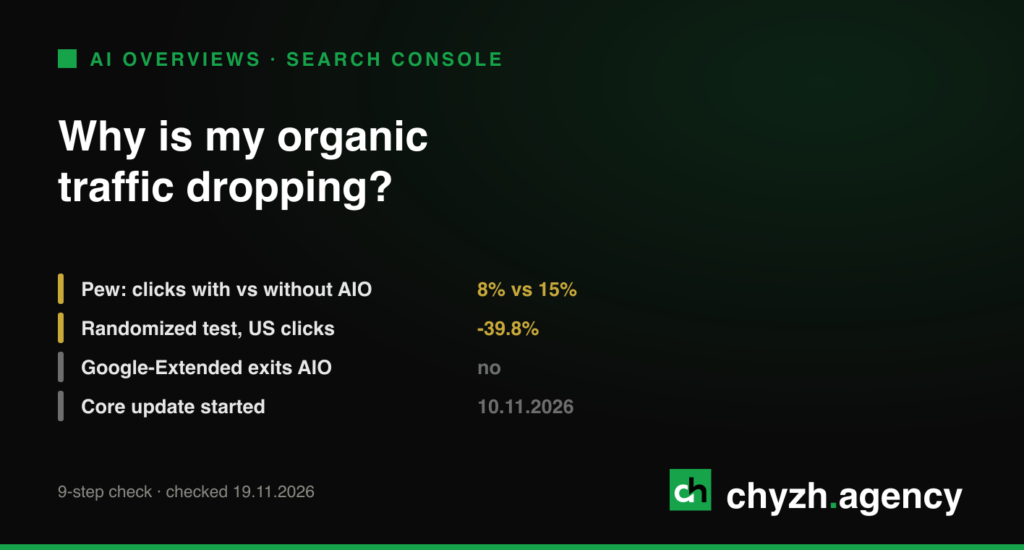
The cleanest estimate we know of is a randomized field experiment by Agarwal and Sen (ISB and CMU): where an AI Overview appeared, organic clicks fell about 39.8%. That’s 1,000+ US participants over two weeks of real browsing, desktop Chrome only, in a working paper that hasn’t been peer-reviewed. It’s still the only causal number in the pile.
Here’s the part most people skip. CTR is falling where there’s no AI Overview too. In Ahrefs’ data (published February 2026, desktop, position 1, informational keywords, market not stated), CTR went from 7.6% to 3.9% on keywords without an AI Overview between December 2023 and December 2025. On keywords with one, it went from 7.3% to 1.6%. Both sets fell; the AI Overview set fell further. Look only at your own falling CTR and you’ll probably blame AI Overviews for a drop that would have partly happened anyway.
Google says total organic click volume is “relatively stable” year over year (August 2025, with no figures or method published). Both can hold at once. Google also reports a 10%+ increase in usage for query types that show AI Overviews in the US and India (May 2025, company-reported). More searches with fewer clicks each can net out flat for Google and still cost your pages. That’s likely why so many forum threads describe the same pattern: impressions up, clicks down.
How do I tell if AI Overviews caused my traffic drop? A 9-step Search Console check
Run these in order and stop when one explains the drop. Google’s own guide to traffic drops covers updates, seasonality, technical issues, changing interests, and reporting glitches, but not AI Overviews. Steps 1 to 5 clear those causes; steps 6 to 8 test AI Overviews.
1. Is the drop real, or is it measurement?
Open the Data anomalies page first. Then look for spikes or crashes in one country or on one device while impressions stay flat.
We learned this on our own Ukrainian-language agency site, so read it as a method lesson, not a market fact. From November 2 to 5, 2026, clicks from one country ran 25, 15, 20, and 15 a day against a normal 0 to 2. Impressions didn’t move. Pages at positions 12 to 56 were getting almost one click per impression, which no human audience does. That was about 75 clicks, roughly 29% of the site’s 261 clicks from October 1 to November 9. It looked like growth. It was bots. A drop might be the mirror image, when bot traffic you’d been counting stops.
Two more traps. A rank tracker showing a drop while Search Console clicks are flat is often snapshot noise. In our own daily tracker (one narrow B2B niche, 7 queries in the US and UK, 252 snapshots from October 6 to 13, 2026), a page was #1 in the morning and outside the top 10 an hour later with no change on the site. And never diagnose from a logged-in screenshot. On November 12, 2026, one showed our site first for a query whose Search Console average position over the previous 28 days was 23.6.
2. When exactly did it start?
Find the first day of the drop and line it up against Google’s ranking updates, your own releases and migrations, and the AI Overview launch in your market. If the drop starts the day after a redesign went live, you probably don’t need the other steps.
3. Is it just seasonality?
Compare year over year, same weeks, never month over month. Check Google Trends for your head topics, because sometimes demand fell and your share didn’t.
AI Overviews reached the US on May 14, 2024, and more than 200 countries in 40+ languages by May 20, 2025 (Google). So if you compare November 2026 with November 2025, both periods already had AI Overviews in most markets. A year-over-year drop reflects growing exposure, not the launch.
4. What shape does the drop have?
Open Performance, Web search type, and read impressions, average position, and clicks together.
| Impressions | Avg. position | Clicks | Most likely cause | Unlikely cause |
|---|---|---|---|---|
| Down | Down | Down | Ranking loss, indexing, falling demand | AI Overviews |
| Flat or up | Flat | Down | CTR compression: AI Overviews, other SERP features, prompt-like impressions | Ranking loss |
| Down in one directory | Mixed | Down | Technical issue on that template | AI Overviews |
| Flat | Flat | Spike or crash in one country | Bots or a reporting glitch | Everything else |
The prompt-like impressions in row two deserve a minute. On our own site (July 19 to October 17, 2026), queries of 7 or more words were 112 queries and 2.2% of impressions, with zero clicks. They drag CTR down with no real loss behind it. Filter them out first.
5. Is the drop branded or non-branded?
Use the branded queries filter, available to all eligible sites since March 11, 2026, and in the Search Analytics API since November 16, 2026. The classification is AI-assisted, so spot-check it.
AI Overviews rarely show on brand searches. In Amsive’s study only 4.79% of branded keywords triggered one, though that’s early 2025 data. If branded clicks fell, look at demand and reputation before Google’s layout.
6. Which of your queries actually show an AI Overview?
Build two query sets.
- Set A, AI Overview present. Start with the pages in the Generative AI performance report and their queries. Add question and comparison queries: Seer Interactive found AI Overviews on 85.9% of question queries and 95.4% of comparison queries in its keyword set (April 2026 report, client brands, market not stated). Confirm with logged-out snapshots on several different days.
- Set B, AI Overview absent. Everything else.
Drop 7+ word queries from both.
7. Did CTR fall more where AI Overviews appear?
Compare year-over-year CTR for Set A and Set B within the same position buckets, 1 to 3 and 4 to 10. The AI Overview effect is roughly the CTR change in Set A minus the CTR change in Set B, which is the same counterfactual logic Ahrefs used.
If both sets fell by about the same amount, AI Overviews aren’t your main problem, and opting out won’t fix it. Don’t skip Set B. Without it you’re measuring the whole market’s CTR decline and calling it AI Overviews.
8. Is it one device or one country?
Exposure differs by market. SparkToro, on Similarweb panel data for January to April 2026, put zero-click searches at 69.5% in the UK, 68.0% in the US, and 62.1% in Germany. Those figures compare with each other, not with other panels. Split mobile from desktop too, since the Ahrefs study and the randomized experiment are both desktop only.
9. What do you do with the answer?
Re-forecast with an AI Overview-aware CTR instead of last year’s curve, and change what you report:
- Generative AI report impressions, kept separate. They’re already inside the overall Performance report, so adding them to totals double counts, and the report doesn’t list clicks or queries.
- Branded demand over time.
- Citations as n out of N on a fixed prompt set, per engine. On our own site in October 2026, 78 prompts run on two dates gave visibility of 5/156 in ChatGPT, 36/156 in Gemini, 27/156 in Perplexity, and 5/156 in Google AI Mode. A blended “AI visibility” number would hide that. Third-party trackers such as Answerly Tracker can run prompt sets on a schedule.
- Leads’ self-reported source, and conversions.
Did the November 2026 core update cause my drop, or was it AI Overviews?
Probably too early to say. The November 2026 core update started on November 10 and was still rolling out when we wrote this, so any drop that began this month has to clear it first.
| Update | Start | Duration |
|---|---|---|
| December 2025 core | Dec 11, 2025 | – |
| March 2026 spam | Mar 24, 2026 | – |
| March 2026 core | Mar 27, 2026 | 12 days |
| May 2026 core | May 21, 2026 | 11 days 21 hours |
| June 2026 spam | Jun 24, 2026 | – |
| August 2026 spam | Aug 18, 2026 | – |
| September 2026 spam | Sep 24, 2026 | 13 days 16 hours |
| November 2026 core | Nov 10, 2026 | ongoing on Nov 19 |
Source: Google Search Status Dashboard, read November 19, 2026. When you later compare December 2026 with December 2025, keep in mind the baseline month contains a core update too.
The shapes from step 4 do most of the work. A core update tends to move positions and impressions across many queries, in both sets. An AI Overview effect shows up as lost CTR at stable positions, concentrated in Set A. Our rule: wait until the dashboard marks the rollout complete, then rerun steps 4 to 7 on a window that starts after it. We don’t touch opt-out settings during a core update. You’d be changing two variables at once.
Should I opt out of AI Overviews? Toggle vs nosnippet vs data-nosnippet vs Google-Extended
The levers do very different things, and the one people reach for first, Google-Extended, doesn’t touch AI Overviews.
| Control | Where | Effect on AI Overviews and AI Mode | Effect on classic results |
|---|---|---|---|
| Search Console toggle (worldwide since Aug 31, 2026) | Search Console | Site stops appearing in and grounding AI Overviews, AI Mode, and AI Overviews in Discover; no traffic or impressions from them | Not a ranking signal outside those features |
nosnippet |
Robots meta, page | Content isn’t used as direct input | Your normal text snippet disappears too |
max-snippet |
Robots meta, page | Limits text used as direct input | Limits snippet length |
data-nosnippet |
HTML attribute, section | Google lists it among the ways to limit what’s shown | Only the marked section is affected |
Google-Extended |
robots.txt | None. It governs Gemini training and grounding in Gemini Apps and Vertex AI | None, not a ranking signal |
| AIPREF “AI training” | robots.txt | None. A training control Google plans to honor in 2027 | None stated |
The toggle takes your site out of the AI Overview. It doesn’t take the AI Overview off the page; the box likely keeps appearing and cites somebody else.
That matters because being cited seems to be worth something. Seer’s data on 53 client brands (January 2025 to February 2026) showed cited pages got 120% more organic clicks per impression than uncited ones, and still 38% fewer than on queries with no AI Overview. It’s a correlation; stronger brands probably get cited more. Our reading, which Seer didn’t test: opting out moves you from “cited” to “not cited” on those queries. It doesn’t move you to “no AI Overview.”
Getting cited is its own job, the one we call GEO. In a published case of ours (AP University, a distance-learning university in Ukraine), the AI Overview names the university in the answer text for queries like “online university” (August 2026). For a young domain in a crowded niche, that mention was the goal.
So our view is that most sites shouldn’t opt out. We’d only consider it when your page is the answer (a definition, a figure, a table), you earn from the visit itself, step 7 shows a large Set A gap, and you’re rarely cited anyway. Even then we’d start with data-nosnippet on the passages being lifted, or nosnippet on one directory, and measure for a few weeks. A publisher whose traffic is mostly Set A could reasonably disagree and go straight to the toggle. Google’s May 2025 guidance says restrictive preview settings limit how content is featured in its AI experiences.
What should I do about AI Overviews, depending on my business?
Exposure follows intent. Seer’s keyword set showed AI Overviews on 36% of informational, 8% of commercial, and 5% of transactional queries. That’s share of keywords, not of real searches, so read it as a ranking of risk.
| Business type | Exposure signal | Check first | What we’d do |
|---|---|---|---|
| E-commerce | Commercial SERPs with an AI Overview up 71%, Nov 2025 to Apr 2026; transactional down 5% (Semrush, US desktop, relative growth) | Guide and category questions vs product queries | Protect product and category pages, keep Merchant Center feeds complete, expect buying guides to take the hit |
| Local services | Informational “near me” queries: AI Overview 76.9% of the time (Seer) | Informational “near me” vs booking queries | Count calls and direction requests in Business Profile, not only Search Console |
| B2B and services | Branded keywords rarely trigger one (4.79%, Amsive, early 2025) | Brand vs non-brand (step 5) | Watch branded demand and lead source; build comparison pages that can get cited |
| Publishers | About 39.8% fewer organic clicks with an AI Overview (randomized, US desktop, working paper) | Set A vs Set B gap (step 7) | Run the opt-out math seriously; build owned channels like email |
For e-commerce, exposure is moving toward you; Semrush also saw AI Overviews and Google Ads appear together about twice as often as a year earlier. If category pages lost clicks and product pages didn’t, guide-style queries are probably getting answered.
In B2B and services, brand searches are the safest traffic you have. On our own site in November 2026 (Ukrainian market), AI answers named us in 6 of 6 branded questions and in 2 of 54 non-branded answers across three AI systems. Protect the first number. Work on the second.
Publishers carry the most risk. For news, Similarweb measured zero-click searches rising from 56% (May 2024) to 69% (May 2025). That’s news queries only, though it often gets quoted as all searches. With a large Set A gap and few citations, this is the one group where we’d test the opt-out on purpose.
FAQ
Can I opt out of AI Overviews on Google?
Yes. Since August 31, 2026, a Search Console toggle lets sites worldwide opt out of appearing in and grounding AI Overviews, AI Mode, and AI Overviews in Discover. You lose all traffic and impressions from those features, and the overview still shows with other sources.
Does blocking Google-Extended remove my site from AI Overviews?
No. Google-Extended controls Gemini training and grounding in Gemini Apps and Vertex AI. Google’s crawler documentation says it doesn’t affect inclusion in Search and doesn’t mention AI Overviews. Use the toggle or nosnippet instead.
Does nosnippet remove my site from AI Overviews?
It stops the page’s content from being used as direct input for AI Overviews and AI Mode, but it also removes your normal snippet in classic results. To protect only certain passages, put data-nosnippet on those sections.
Why did my CTR drop when my rankings stayed the same?
Usually something above your result answers the query: an AI Overview, another SERP feature, or both. But CTR also fell on queries without AI Overviews in Ahrefs’ data, and long prompt-like queries add impressions with no clicks. Compare both query sets at equal positions before deciding.
How do I track traffic from AI Overviews?
Search Console reports AI Overview and AI Mode clicks inside the Performance report, Web search type, mixed with everything else. The Generative AI report shows impressions by page, country, and device, but no clicks or queries. For citations, run a fixed prompt set per engine and report n out of N.
Is my traffic drop from the Google core update or AI Overviews?
If it started on or after November 10, 2026, assume the core update until shown otherwise. Wait for the rollout to finish, then rerun the Set A vs Set B comparison. A core update moves positions in both sets; an AI Overview effect cuts CTR at stable positions in one.
What’s the difference between AI Overviews and AI Mode?
AI Overviews sit on top of normal results; AI Mode is a separate conversational search. Google reports over 1 billion monthly AI Mode users (May 2026, company-reported), yet SparkToro found only 0.34% of US searches went to AI Mode in January to April 2026. In our own tracking (October 2026), AI Mode and ChatGPT sources overlapped only 27 to 29%, so measure each separately.
What we don’t claim
- We don’t claim AI Overviews cut traffic by any single percentage. Ahrefs’ 58% figure is position-1, desktop, correlational CTR, not traffic.
- Our own measurements don’t describe the US. They come from a Ukrainian-language site and illustrate method only.
- We don’t claim opting out raises clicks. We haven’t seen published data on sites that flipped the toggle.
- We haven’t re-verified Search Console’s help rules on how AI Overview positions and clicks are counted. Check the current help pages before building reports on them.
- Nobody knows yet what the November 2026 core update did, us included. It was still rolling out on November 19.
- The randomized experiment we cite is a working paper, and a second preregistered experiment on the same question is a preprint.
If you’ve run the nine steps and want a second pair of eyes on the numbers, this diagnosis is part of our SEO services.
Related articles
Why a Google Maps profile gets views but no calls: what views and call clicks...
How to add a business to Google Maps without a duplicate: find an existing listing,...
Definitions, a monthly report template and a real shop where organic search brought 9.5% of...