
Mention, Citation and Recommendation in AI Answers: How to Count Each One
 Yevhenii Chyzh
Short answer. A mention means the AI named the brand in the text of its answer. A citation means a link to your site sits among the sources of that answer. A recommendation means the brand was offered as a provider when the person asked for advice. Each metric is counted separately as “k out of n”: n is the number of valid answers (prompts × systems × repeats), and for recommendations n includes only answers to prompts that ask for advice.
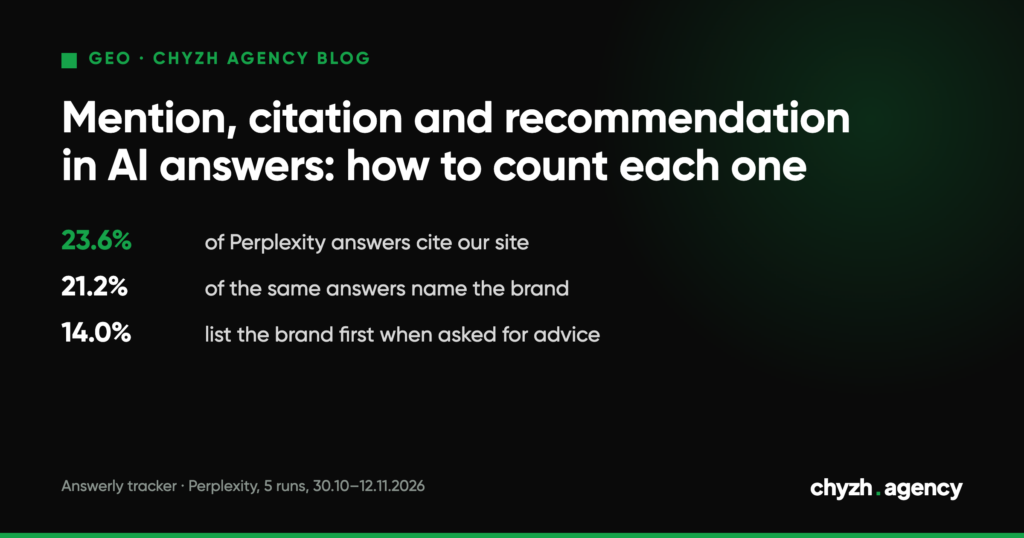
On 1,575 answers about our own brand, collected between 30 October and 12 November 2026, these three numbers split apart even within one system. Perplexity cited chyzh.agency in 23.6% of answers, named the brand in 21.2%, and listed it first among providers in 14.0% of answers to a request for advice. Google AI Mode over the same days gave 3.3%, 2.4% and 0.6%.
Three metrics: what counts and what you divide by
| Metric | What counts | Numerator | Denominator | Common mistake |
|---|---|---|---|---|
| Mention | the brand name in the answer text (company name, domain used as a name, former name) | answers that name the brand | all valid answers in the panel | counting a name that appears only inside a link address or a source chip |
| Citation | a link to your domain among the answer’s sources or in its text | answers with at least one such link | all valid answers in the panel | counting links instead of answers; counting the domain written as plain text with no link |
| Recommendation | the brand is offered as a provider for the user’s task | answers with such an offer | valid answers to prompts that ask to recommend, choose or compare providers | dividing by all answers; counting a mention in a pricing question |
| Recommended first | the brand is the first provider offered | answers where the brand comes first | same as for recommendation | reading the position from one snapshot as a ranking |
| Collection success | a request that returned a usable answer | valid answers | all planned requests | recording a collection error as “brand not mentioned” |
These are our working definitions from our internal measurement guideline (version 1.0, 10 November 2026). Platforms set no such standards, so every share in a report sits next to the rule used to count it.
The unit is one answer. Five links to your site in one answer make one citation. If the denominator is zero, we write N/A, not 0%.
The three metrics do not form a chain. A page can be cited in an answer that recommends a competitor. A brand can be named as a price example, and that is no recommendation. A screenshot, like the ones in our breakdown of what AI Overviews cited, proves that a citation happened once. You cannot get a share from it.
How we counted on our own brand
The data comes from our tracker tracker.answerly.agency, project chyzh.agency. For this article we only read stored answers and ran nothing new. How the tracker collects answers is described in the Answerly Tracker case study.
- Panel: 108 prompts, 91 in Ukrainian and 17 in English. None contains the brand name. 72 ask to recommend, choose or compare providers; 36 ask about price, how to choose an approach, or for an explanation.
- Systems: ChatGPT (app answers the tracker receives through a data provider), Perplexity (sonar model via API), Google AI Mode.
- Repeats: five runs, on 30.10, 02.11, 05.11, 09.11 and 12.11.2026.
- n: 108 × 3 × 5 = 1,620 planned answers, 1,575 valid. 45 Perplexity requests ended with error 429 (too many requests); we do not count them as answers.
- Gemini 2.5 Flash is counted separately. The tracker ran it four times; in two runs all 216 requests failed with an API error (215 times 402, once 503), and one more answer came back empty.
We fixed the rules before counting. Mention: the name in the text after removing link addresses and source chips. Citation: a chyzh.agency (or subdomain) address among the sources or in the links of the text. A recommendation cannot be detected automatically, so we read all 187 answers that named the brand in response to a request for advice and labelled each one: first, not first, or named without being offered.
Results: three metrics on the same answers
| System | Valid answers | Mention | Citation | Recommendation | First |
|---|---|---|---|---|---|
| ChatGPT | 540 of 540 | 70 of 540 (13.0%) | 49 of 540 (9.1%) | 60 of 360 (16.7%) | 16 of 360 (4.4%) |
| Perplexity | 495 of 540 | 105 of 495 (21.2%) | 117 of 495 (23.6%) | 98 of 321 (30.5%) | 45 of 321 (14.0%) |
| Google AI Mode | 540 of 540 | 13 of 540 (2.4%) | 18 of 540 (3.3%) | 9 of 360 (2.5%) | 2 of 360 (0.6%) |
| Gemini, 2 runs | 215 of 432 | 22 of 215 (10.2%) | 33 of 215 (15.3%) | 19 of 144 (13.2%) | 0 of 144 |
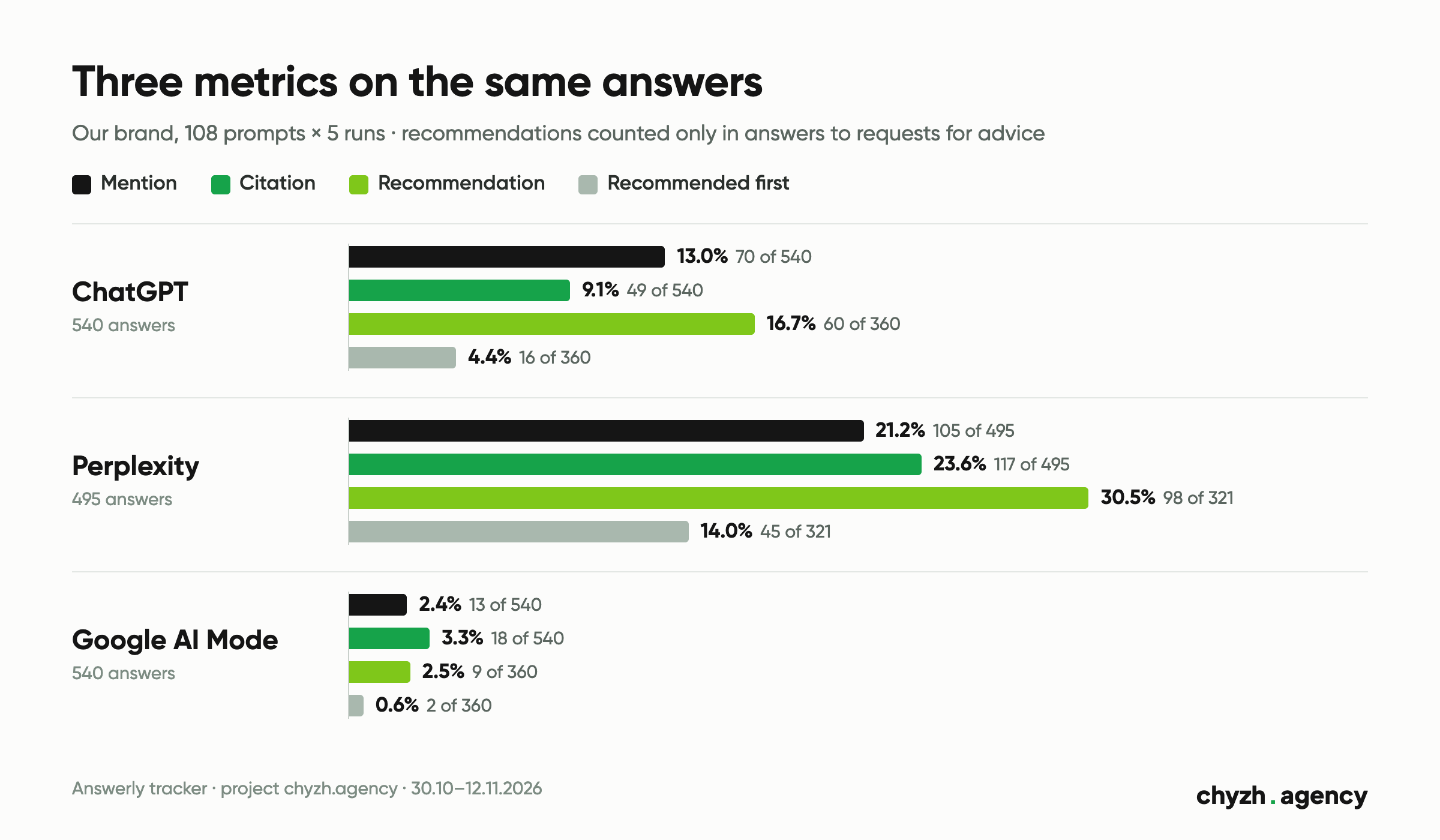
Here is where the metrics split.
Perplexity cites without mentioning. Of 117 answers with our link, 43 do not name the brand. Most of them answer questions about price, choosing an approach, or explanations: across 174 such answers our site was among the sources in 42, while the company name appeared in 7. For example, on 12.11.2026, for the prompt “Recommend a Ukrainian agency that can help get into ChatGPT and Google AI Overviews answers” (asked in Ukrainian), Perplexity listed our article among ten sources and recommended three other agencies. A citation, with no mention and no recommendation.
ChatGPT names without linking. 22 answers mention the brand while our site is absent from the sources. If you count only citations, this presence disappears from the report.
A mention is not always a recommendation. In questions about price, services or choosing an approach, the brand appeared as a price example, a calculator or a type of agency: 20 answers across three systems. They do not enter the recommendation share, because the person did not ask for a provider. When people did ask for advice, almost every mention was a recommendation: 167 of 168.
Recommended and first are different things. Perplexity recommended the brand in 98 answers and put it first in 45. Gemini recommended it in 19 and never first.
Different denominators do not compare. If you pool the three systems, the recommendation share is 16.0% and the mention share 11.9%. Recommendations look “higher” only because their denominator is smaller: 1,041 answers to requests for advice versus all 1,575.
How the same answers give a different percentage
Every row below was counted on the same stored answers. Only the rule changed.
| What we did | By the rule | After changing the rule |
|---|---|---|
| Merged mention and citation into one “visibility” (three systems) | mention 11.9%, citation 11.7% | 15.0% (237 of 1,575) |
| Counted links instead of answers (Perplexity) | 117 of 495 (23.6%) | 134 of 495 (27.1%) |
| Recorded collection errors as “not mentioned” (Gemini) | 22 of 215 (10.2%) | 22 of 432 (5.1%) |
| Pooled three systems into one number (mention) | from 2.4% to 21.2% by system | 11.9% pooled |
| Took one run instead of five (ChatGPT, mention) | 70 of 540 (13.0%) | from 10 to 20 of 108 (9.3–18.5%) |
| Counted any string match without review (Google AI Mode, mention) | 13 answers | 18 answers |
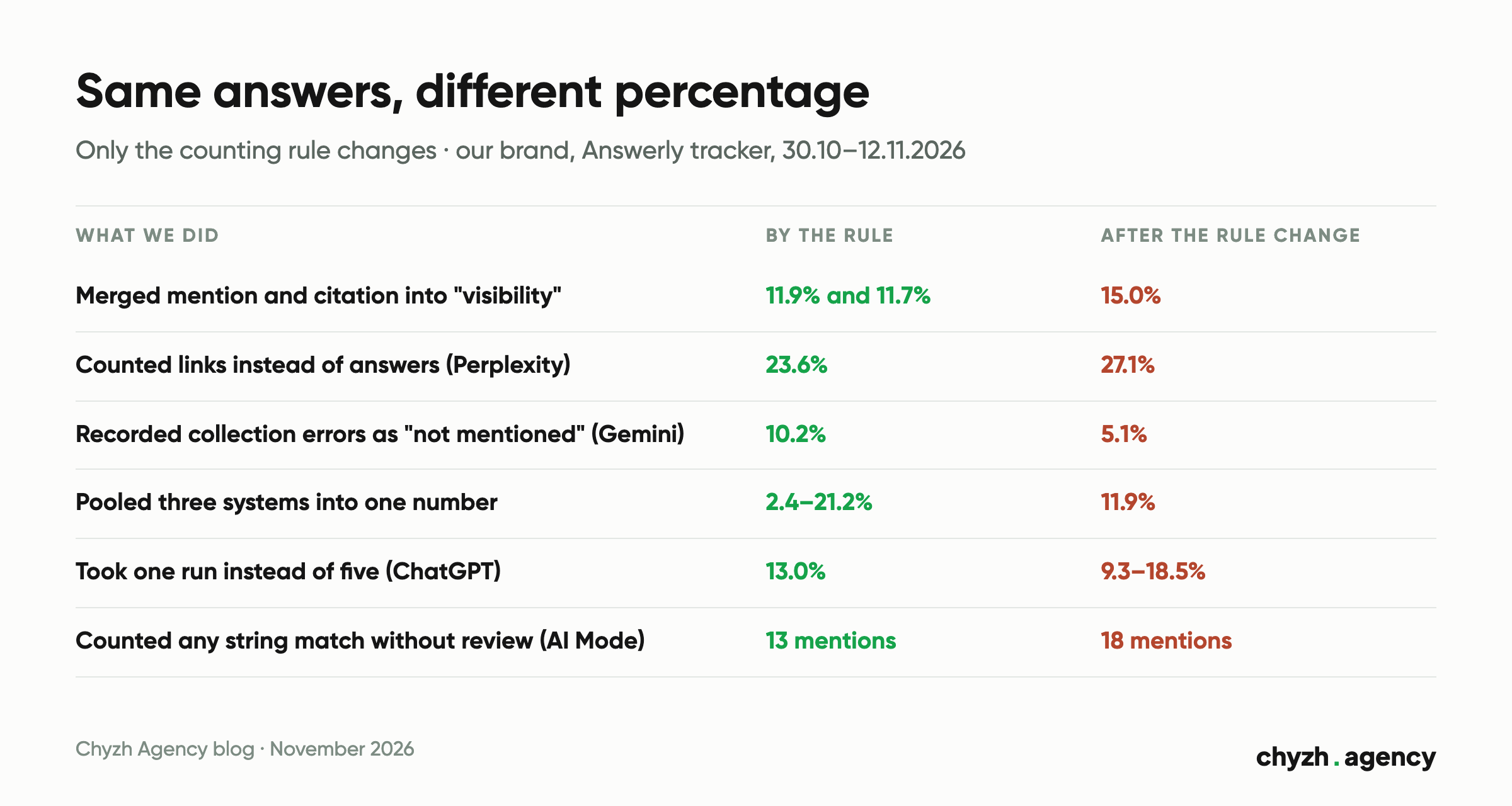
In the last row, five answers contain the name only inside the address of a link to our site. By the rule that is a citation without a mention. An automatic search for the name in the raw text counts them as mentions too. Perplexity shows the reverse: five answers write “chyzh.agency” as plain text with no link, and the automatic rule records them as citations.
The shares in the results table are counted per answer: every prompt wording weighs the same. This hides the least visible trap, paraphrases.
We grouped the 108 prompts by intent (topic × question type) and got 17 groups. “Find a mobile app developer” has 19 wordings, “find an agency for AI search promotion” has 20. That is exactly where the brand was named most often: in 25.4% and 22.6% of answers. The group “how much does SEO cost” has four wordings and zero mentions.
If each of the 17 intents weighs the same, the mention share across three systems is 7.6%. If each answer weighs the same, it is 11.9%: the strong topics have several times more wordings and pull the average up. Both numbers can be shown, labelled with how they were counted. Presenting 11.9% as the share “across all topics” is already a mistake.
Paraphrases also inflate the sample itself. 1,575 answers look like a large n, but they are dependent. Of 324 “prompt × system” pairs, 243 never showed the brand in any run, 9 showed it every time, and only 72 pairs changed between runs. So we show the spread between runs and do not present 1,575 answers as 1,575 independent observations.
Position needs even more caution. SparkToro’s study of 28 January 2026 (600 volunteers, 12 prompts, ChatGPT, Claude and Google’s AI answers, 2,961 responses) found that the chance of getting the same list of brands twice is under 1 in 100. The author considers how often a brand appears across many runs more informative than its place in the list. In our data, Perplexity put the brand first between 4 and 12 times per run.
What to check when the metrics diverge
- Cited but not named. Open the page that gets cited and check whether the company name sits next to the figures and terms the AI takes. This is a hypothesis; our data does not prove it.
- Named but not cited. Look at which sources the system uses instead of your site for that prompt: the tracker stores them with the answer. Separately, check whether ChatGPT and Perplexity bots can open your pages at all, see our article on how to check AI crawler access.
- Named but not recommended. First look at the prompt type. In a pricing question this is normal. If the prompt asks for advice, read the brand’s role in the answer: example, comparison or warning.
- Recommended, but not first. Position in one snapshot is random, so track the recommendation share across repeats and keep list position as a secondary metric.
- Everything is low in one system. Google AI Mode gave us 2–3 mentions per 108 answers in each run, Perplexity between 12 and 25 mentions per run. Count each system separately, because an average across three hides this.
Limits of this data
- One brand, our own, one market, two weeks and five runs.
- We built the panel around our services, so two topics have 19–20 wordings each. The shares describe this panel only; we do not extend them to brand presence in AI in general.
- The systems were collected in different ways: ChatGPT as an app through a data provider, Perplexity and Gemini via API. That is why we do not pool them into one number.
- Recommendations were labelled by hand, in one pass, by rules written before labelling. There is no second independent labelling.
- The intent groups are ours and coarse (topic × question type). Another grouping would give another weighted share.
- Gemini has only two valid runs; its numbers are preliminary.
- A mention or a citation says nothing about visits or leads. That data is not here. Our 9-step check for traffic drops shows how to gauge the effect of AI Overviews on clicks in Search Console.
Next step
For your own panel, fix four things before the first collection: brand name variants and domains, which prompts count as requests for advice, what counts as a collection error, and how paraphrases are grouped. Without this, your next report may show “growth” that came from a rule change.
For how these metrics sit as separate rows in a client report, see reporting for a specialist legal practice.
How to build a fixed prompt set and repeat measurements is covered in our article GEO website promotion: how to check the result. For a one-off probe there is our citation checker: it shows mention and citation separately for up to three prompts, and it is one probe at one moment. Regular measurements with a numerator and denominator run in the Answerly tracker. If you need work on your brand’s presence in answers alongside measurement, the scope of the service is on the GEO promotion page.
Author: Yevhenii Chyzh, founder of Chyzh Agency. Reviewed by: Dmytro Popryadukhin, Head of SEO.
Sources: stored answers in the tracker tracker.answerly.agency, project chyzh.agency, runs of 30.10, 02.11, 05.11, 09.11 and 12.11.2026 (ChatGPT, Perplexity, Google AI Mode; Gemini 30.10 and 02.11), read on 12.11.2026; manual recommendation labelling by Chyzh Agency, 12.11.2026; Chyzh Agency internal SEO/GEO measurement guideline, version 1.0, 10.11.2026; description of data collection in the Answerly Tracker case study on chyzh.agency, 12.11.2026; SparkToro, study of the consistency of brand recommendations in AI tools, published 28.01.2026, updated 28.06.2026.
Related articles
Roles of OpenAI, Anthropic, Perplexity and Google bots, a six-step check from robots.txt to IPs,...
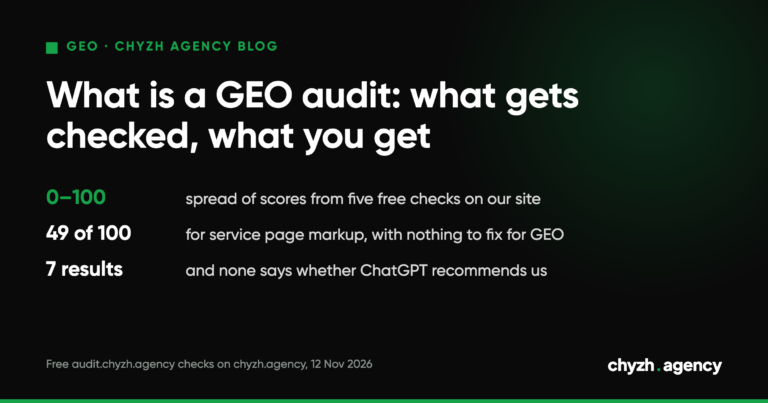
We ran free audit.chyzh.agency checks on our own site: scores from 0 to 100. What...
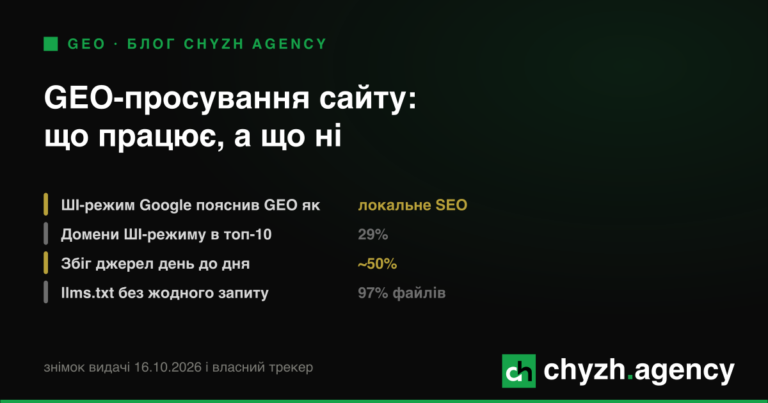
Even Google AI Mode confuses GEO with local SEO. What GEO website promotion includes, which...