
What owning an app costs after launch: a 12-month model
 Serhii Kolodynskyi
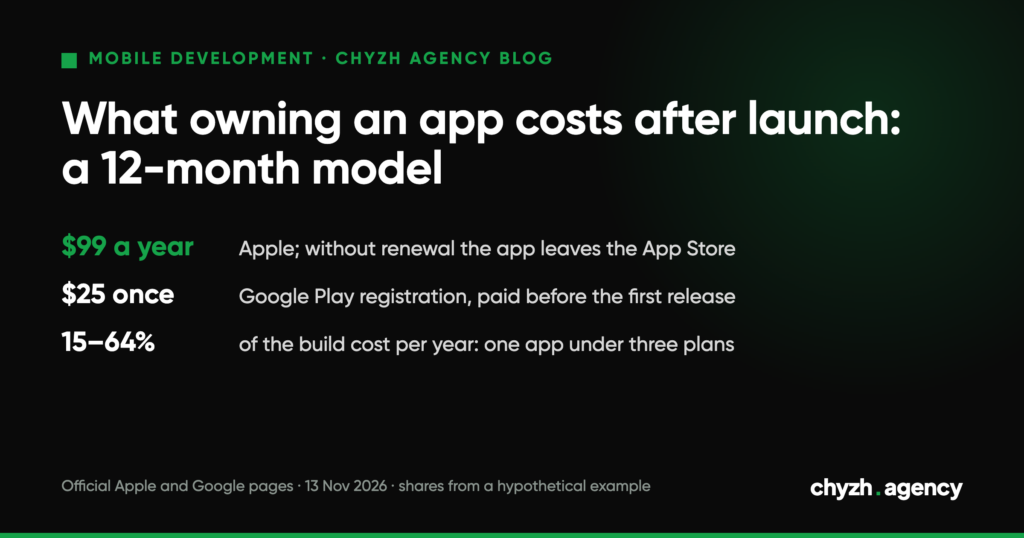
Short answer. After release, an app costs money along six lines: store accounts, hosting and backend, updates for new iOS and Android versions, third-party services, analytics, and the team’s work. Only the platform fees are known in advance: the Apple Developer Program costs $99 a year and Google Play registration is a one-time $25 (official Apple and Google pages, checked on 13 November 2026). Everything else depends on how many people use the app and whether you keep building it. So instead of a single number, below is a 12-month table with formulas and a filled-in example with hypothetical figures.
The cost to build is a separate calculation, and it ends on release day. This article is about what starts after it.
Why the build cost doesn’t tell you the cost of owning
On 13 November 2026, Google’s AI overview for the Russian-language query “cost of owning a mobile app” in Ukraine advised budgeting 15–20% of the development cost per year for support. We don’t use that percentage. Apple’s fee is the same for a $3,000 MVP and a $50,000 enterprise system. The server bill depends on how many people open the app; the number of screens designed barely affects it. In the hypothetical example below, the same app costs its owner anywhere from 15% to 64% of its build cost per year, depending on the owner’s plan.
Few owners seem to plan for this up front: among the 827 visible queries for which Google showed 18 pages of our mobile development section between 13 May and 11 November 2026, not one was about support, maintenance, hosting or updates (we break down this Search Console slice in what app support after release includes).
What we cover after handover: the first 30 days of support are free, and the warranty runs 1 month for an MVP, 2 months for a mid-size project and 3 months for a complex one (enterprise projects get 3+ months of support). Put in the contract what exactly the warranty covers, for example whether it includes an update for a store requirement that appears during the warranty period. Hosting, accounts and third-party services are on the owner from day one.
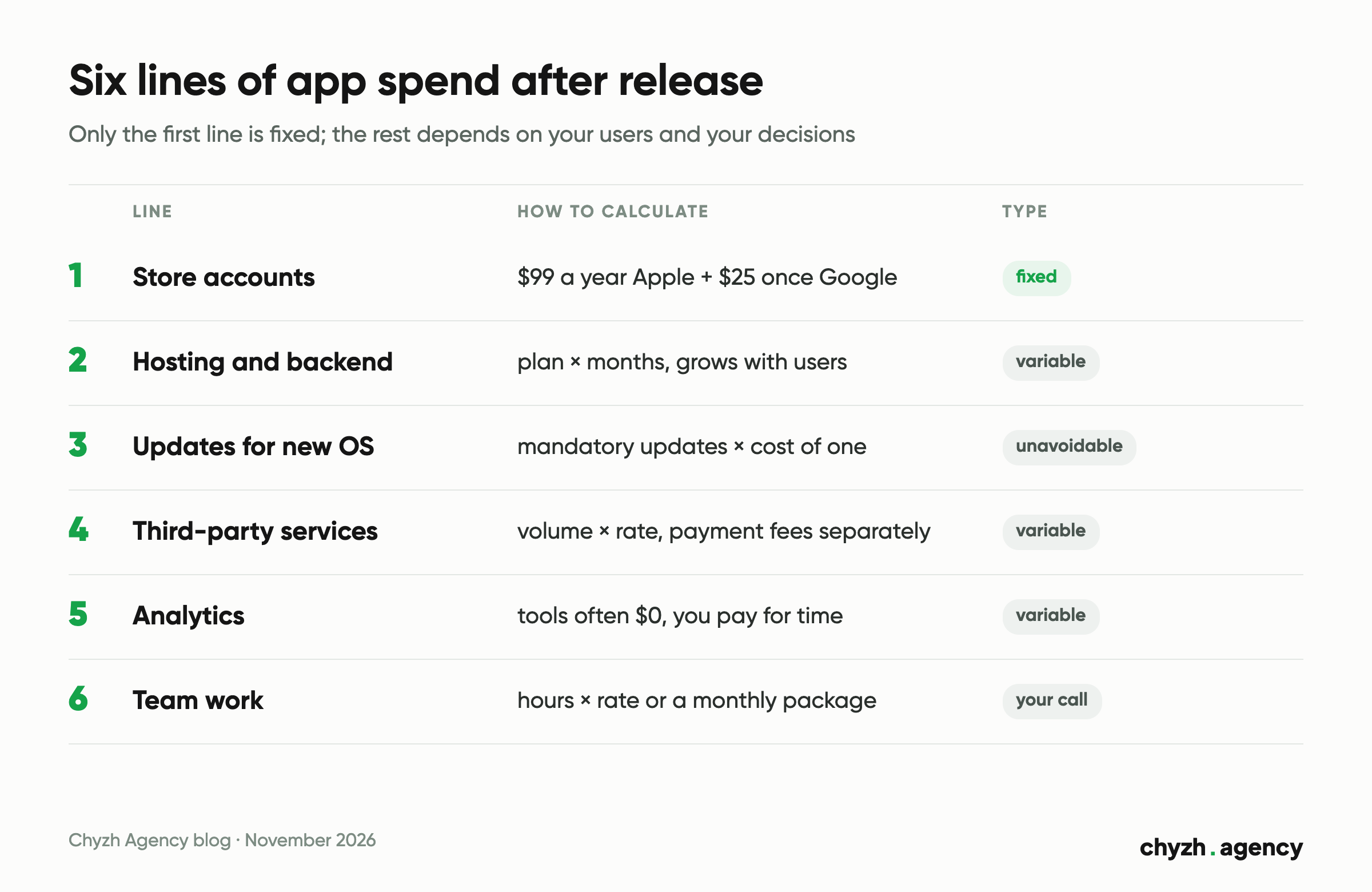
Six budget lines after release
| Line | What’s in it | How to calculate | Type |
|---|---|---|---|
| Store accounts | Apple Developer Program, Google Play Console | $99 a year plus $25 once | fixed |
| Hosting and backend | server or cloud database, files, backups | plan price × months, grows with users and data | variable |
| Updates for new OS versions | a new build for Apple and Google requirements, testing on new versions | number of mandatory updates × cost of one | variable but unavoidable |
| Third-party services | SMS for sign-in, email, maps, payment provider | volume × rate; payment fees separately, as % of turnover | variable |
| Analytics | events, crash reports | tools often free; you pay for setting up events and reading reports | variable |
| Team work | fixes, update reviews, monitoring, new features | hours × rate or a monthly package | depends on your decisions |
If your support contract already covers OS updates, don’t count the third line twice.
Fixed platform fees, and what happens if you skip them
Apple charges $99 per membership year for the Apple Developer Program, in local currency where available. The separate Apple Developer Enterprise Program at $299 a year is only for organizations that distribute an app to their employees through an internal system. When a membership expires, your apps are no longer available for download and you can’t submit updates. People who already installed the app can keep using it. The renewal date is in the Membership details section of the account; put it in the owner’s calendar.
Google Play charges $25 once. There is no annual fee.
For a company account, both platforms ask for a D-U-N-S number. Google says getting one from Dun & Bradstreet is free; Apple says it is free in most jurisdictions. The App Store lists the legal entity that owns the account as the seller, so register it to your own company. You can add the developer to the account’s team.
Store commission applies only to digital goods and subscriptions sold inside the app. Apple takes 30%, or 15% for members of the App Store Small Business Program and for qualifying subscriptions. Google Play charges a different structure in Australia, the EEA, Japan, the UK and the US; in the remaining markets it takes 15% of the first $1M of yearly revenue in the 15% tier, 30% above that, and 15% on subscriptions. For services consumed outside the app (a haircut booking, a delivery), Apple requires payment by other means, such as a card or Apple Pay (guideline 3.1.3(e)). Then you pay only your payment provider’s fee.
OS updates: requirements already in force
Since 28 April 2026, App Store Connect only accepts builds made with Xcode 26 or later using the iOS 26 SDK. Any fix after that date, even a one-line one, has to be built in the new toolchain. If the project hasn’t been touched for a while, the libraries get upgraded first, and a small fix becomes a task of its own.
Since 31 August 2026, Google Play only accepts new apps and updates that target Android 16 (API level 36). Existing apps targeting below Android 15 (API level 35) are not shown to new users on newer Android versions. An extension to 1 November 2026 was available; it has passed.
Our advice for the model: at least one mandatory update per platform per year. A Flutter app has one codebase but two builds, so both stores’ requirements apply to it all the same. We cover what else post-launch work includes in what app support after release includes.
Hosting, services and analytics: what grows with your users
On the Firebase pricing page (checked 13 November 2026), Analytics, Crashlytics for mobile apps and Cloud Messaging for push notifications are listed as no-cost. Firestore is no-cost up to 1 GiB of stored data, 50,000 document reads and 20,000 writes per day, then Google Cloud pricing applies. SMS sign-in (Phone Auth) is billed per SMS sent.
A hypothetical calculation: if one active user makes 50 reads a day, the free quota covers roughly 1,000 daily active users. How many operations your app actually makes depends on how the backend is written, so ask your developer for that number.
With your own backend (the “Backend + API” option in our calculator), you pay monthly for the server, database and backups. The price comes from the provider’s calculator and your user forecast. For each third-party service, write down the billing unit the same way: per SMS, per 1,000 map requests, % of turnover. How your own backend differs from ready-made cloud services is explained in our article on the app backend and admin panel.
The 12-month model: a hypothetical example
This is a hypothetical example, not a real client. A booking app for a chain of salons: iOS and Android on Flutter, 10–25 screens, custom design, sign-in, push notifications, geolocation with a map, online payment, own backend with an API, a web admin panel, analytics.
Our calculator puts this configuration at $22,550: a $3,000 base plus $11,500 of options multiplied by 1.7 for Flutter. That is the cost to build. We left the “Support for the first 3 months” option unticked: it would add $1,700 ($1,000 × 1.7), about $570 a month, and that already belongs to the cost of owning. Check before signing whether the free first 30 days of support are part of those 3 months.
| Line | Formula | Mo 1–3 | Mo 4–6 | Mo 7–9 | Mo 10–12 | Year, $ |
|---|---|---|---|---|---|---|
| Store accounts | $99 Apple yearly; $25 Google paid before release | 0 | 0 | 0 | 99 | 99 |
| Hosting and backend | plan × months, hypothetically $40 to $100 a month | 120 | 180 | 240 | 300 | 840 |
| OS updates | 2 mandatory updates × hypothetically $800 | 0 | 800 | 0 | 800 | 1,600 |
| Third-party services | SMS, email, maps, hypothetically $20 to $50 a month | 60 | 90 | 120 | 150 | 420 |
| Analytics | free tools; setup is part of team work | 0 | 0 | 0 | 0 | 0 |
| Support | first month free, then hypothetically $500 a month | 1,000 | 1,500 | 1,500 | 1,500 | 5,500 |
| New features | a quarterly sprint, hypothetically $2,000 | 0 | 2,000 | 2,000 | 2,000 | 6,000 |
| Total | 1,180 | 4,570 | 3,860 | 4,849 | 14,459 |
The payment provider’s fee is not in the table: it depends on the salons’ turnover, so it is easier to model next to revenue. There is no App Store commission either, because the service is consumed outside the app.
The Apple renewal falls in months 10–12 here because the account was registered about a month before release. Register earlier, and the line moves closer to the start.
Servers and third-party services in the example cost $1,260 a year. The rest, $13,100 of $14,459 (91%), is people’s work: updates, support, new features. The shares rest on hypothetical figures, so recalculate them with your own numbers for your app.
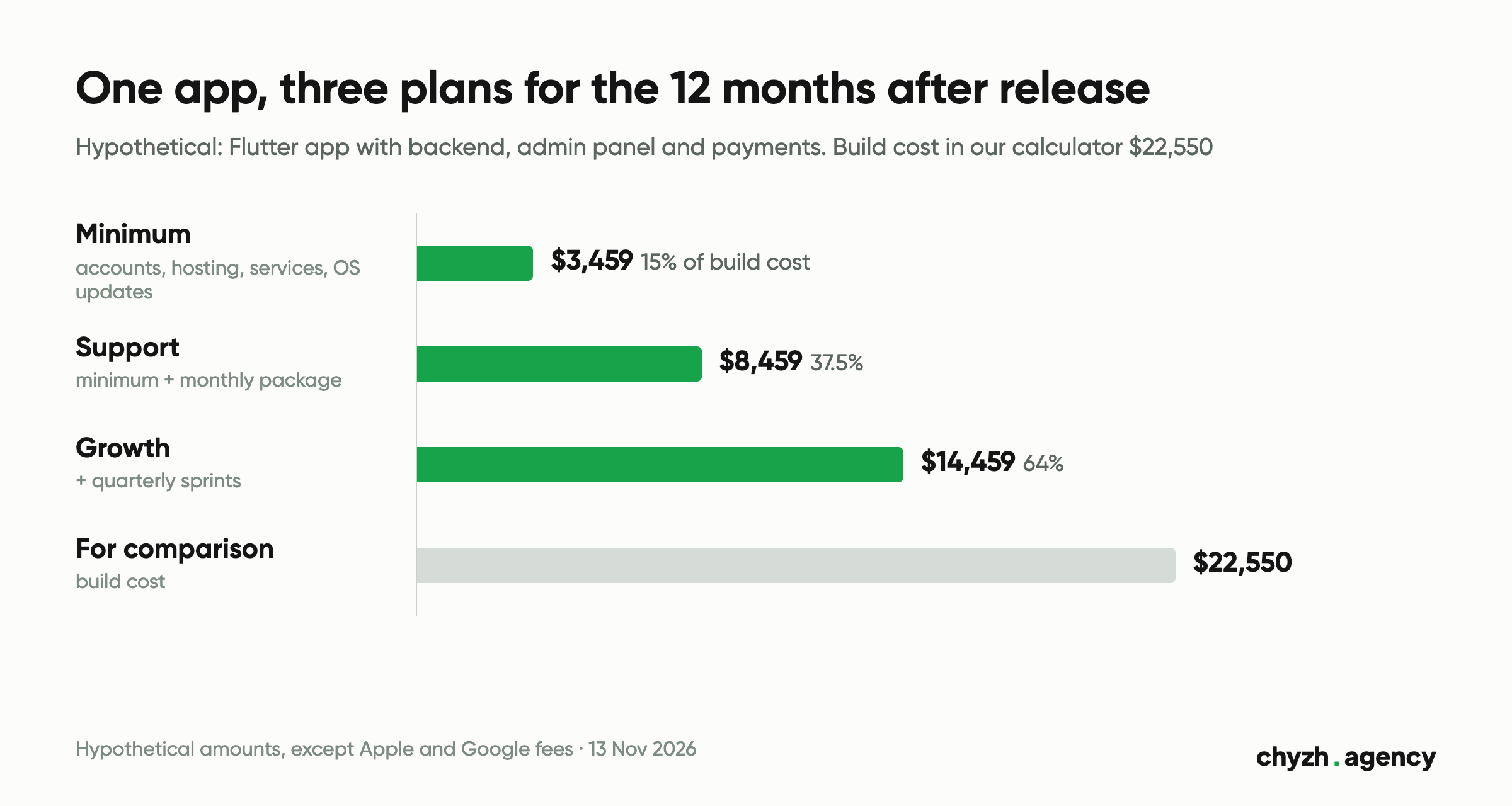
Depending on the owner’s plan, the yearly total varies more than fourfold.
| 12-month scenario | What’s included | Total | Share of build cost |
|---|---|---|---|
| Minimum | accounts, hosting, services, 2 mandatory updates, fixes as needed (hypothetically $500) | $3,459 | 15% |
| Support | the same plus a monthly support package instead of ad hoc fixes | $8,459 | 37.5% |
| Growth | plus quarterly sprints with new features | $14,459 | 64% |
Limits of the example. Only the Apple and Google fees are exact. The hosting and service amounts are hypothetical and are not provider prices. The $500 monthly support rests on our “Support for the first 3 months” option, and the $2,000 quarterly sprint comes from the $1–3k range we quote on our mobile development page for the post-MVP stage.
The minimum without which the app disappears
The lines of the first scenario can’t be postponed. Here is what happens if they go unpaid.
| What was skipped | Consequence |
|---|---|
| Apple Developer Program renewal | the app disappears from the App Store for new downloads; updates can’t be submitted |
| A build for Apple’s new SDK | App Store Connect won’t accept even a one-line fix |
| Android target API level | Google Play won’t accept the update; new users on newer Android versions won’t see the app |
| Hosting | the backend stops, and with it sign-in, payments and user data |
| Third-party service bills | sign-in codes and emails stop arriving; maps don’t load |
So we advise approving the 12-month minimum before release and holding the growth budget for 1–3 months, until there is data on how people actually use the app. If the app works without a backend or third-party services, the model is shorter: accounts, updates and team work.
What to gather to fill in the model for your app
- A forecast of active users at 3, 6 and 12 months: hosting and SMS depend on it.
- A list of third-party services with the billing unit and a link to each pricing page.
- How many database operations one active user makes per day, if the backend runs on Firebase or a similar service.
- The Apple Developer Program renewal date and the legal entity both accounts are registered to.
- What the warranty covers, what support covers, and from which day support is paid.
- A feature plan for the two quarters after release.
What to do next
If the app doesn’t exist yet, first estimate the development cost separately in our calculator, then add the minimum from the table above. For an MVP the lines are the same, only the amounts are smaller; how to estimate the MVP itself is covered in how to estimate an app MVP. Warranty terms and the free first 30 days of support are described on our mobile app development page.
Author: Serhii Kolodynskyi, Head of App Development. Reviewed by: Mykola Tabuchenko, Senior Mobile Developer.
Sources: Apple, What’s included (Pricing and fees) and Program enrollment, 13 Nov 2026; Apple, Membership renewal (Expired memberships), 13 Nov 2026; Apple, Upcoming Requirements (SDK minimum requirements, since 28 Apr 2026), 13 Nov 2026; Apple, App Review Guidelines, guideline 3.1.3(e), last updated 16 Oct 2026; Google Play Console Help, Create and set up your developer account ($25), Choose a developer account type (D-U-N-S), Service fees, 13 Nov 2026; Android Developers, Meet Google Play’s target API level requirement, last updated 28 Oct 2026; Firebase Pricing, 13 Nov 2026; Google Search Console for chyzh.agency, 18 mobile development pages, 13 May to 11 Nov 2026; chyzh.agency cost calculator and mobile development page, 13 Nov 2026; Google Ukraine results snapshot for the Russian-language query “cost of owning a mobile app”, 13 Nov 2026.
Related articles
1–3 months of warranty by project type, 30 free days of support, the app stores'...
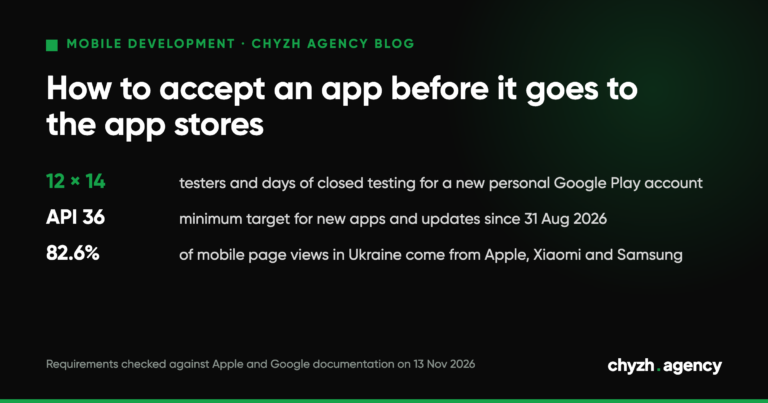
A checklist for accepting a test build: 5 test devices by market share, sandbox payments,...
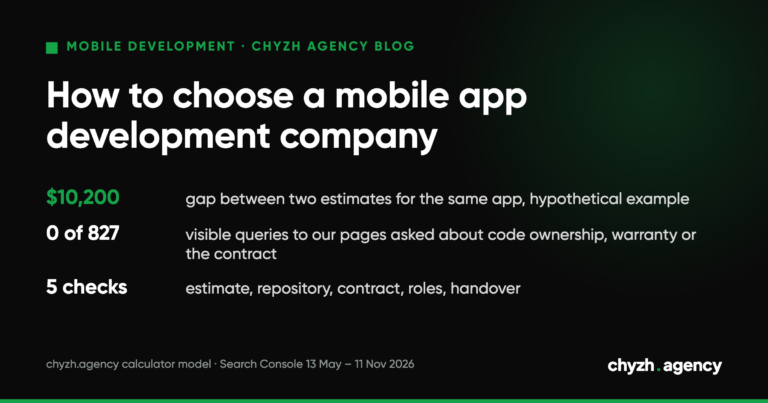
By our calculator model, the same app costs $17,450 or $27,650 depending on what the...