
Ecommerce filters: which pages to index and which to block
 Dmytro Popryadukhin
Short answer. Only index filter combinations that people search for as a product in their own right (“men’s winter jackets”, “sneakers size 9”), that have enough products, and that you can give their own URL, title and copy. Block the rest from crawling. Sorting, price ranges and combinations of three or more filters shouldn’t end up in search. Empty combinations should return a 404.
Below is a decision tree, the part of Google’s guidance that overviews usually skip, and numbers from a real store we work with. It’s also where we got things wrong twice, and both mistakes are useful.
A decision tree for a single filter
- Do people search for “category + value”? Check the queries in the store’s Search Console and in Keyword Planner. If there’s no demand, don’t index the page, even if shoppers find the filter handy.
- Is there enough to show? The combination needs enough products to make a selection. One product card isn’t a selection. The threshold depends on your catalog, so set one for yourself and stick to it.
- Can you give the page its own identity? A permanent URL without parameters, its own H1, title, description and copy that helps people choose. If you can’t, the page will be a copy of the category with fewer products.
- Is it a technical combination? Sorting, price, availability, three or more filters at once, and any empty combination stay out of the index.
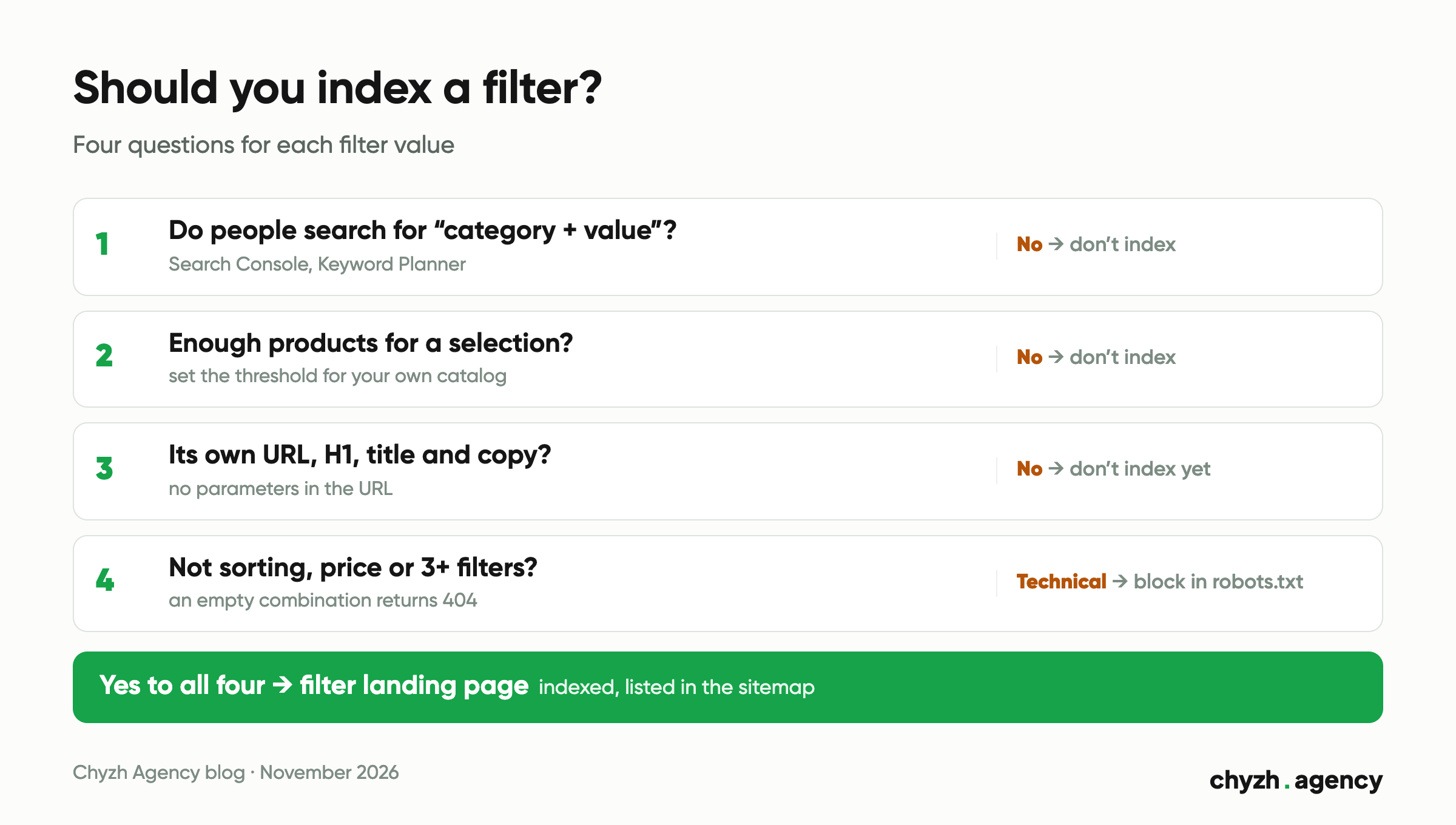
Only pages that pass all four questions become filter landing pages. Everything else stays a tool for shoppers on the site.
What Google says, and what usually gets skipped
Google’s guide to faceted navigation (updated 18 December 2025) gives two options if you don’t need filtered URLs in Search: disallow crawling them in robots.txt, or pass the filters in the URL fragment after #, which Google doesn’t crawl. Google also mentions a canonical to the category and nofollow on links, but says these are generally less effective in the long term.
Most overviews recommend canonical and noindex as the main tools. The difference is practical. Google has to crawl a noindex page to see the directive, so thousands of combinations still eat into crawling resources. A robots.txt disallow avoids that.
For filters you deliberately open to search, Google adds three more requirements: keep the filters in the same order in the URL, don’t repeat the same filter twice, and return a 404 for any combination with no products.
Numbers from a real store
A clothing and gear store on OpenCart with a filter module, one we work with. Search Console data for 90 days, 12 August to 10 November 2026: 7,725 URLs with impressions, 129,583 impressions, 1,681 clicks.
| URL type | URLs with impressions | Impressions | Clicks |
|---|---|---|---|
| Clean URLs: categories, products, filter landing pages | 7,228 | 118,376 (91.4%) | 1,593 |
| Articles | 103 | 5,719 | 56 |
Pagination ?page= |
356 | 5,373 | 29 |
Landing pages reached through the ?ocfilter_page_id= parameter |
24 | 62 | 1 |
Filter combinations through the ?ocf= parameter |
6 | 14 | 1 |
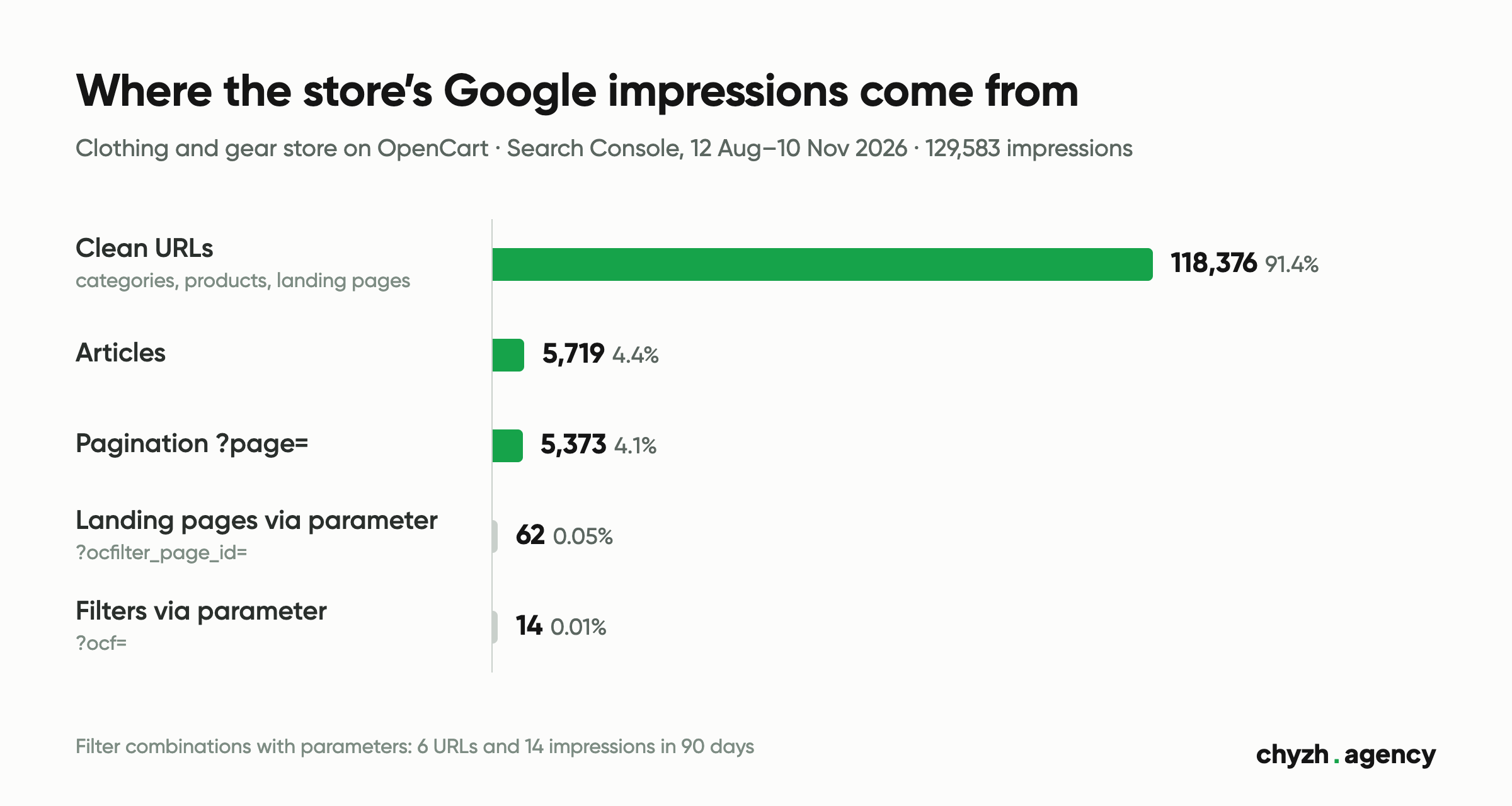
Filter combinations with parameters barely show up in search: 6 URLs and 14 impressions in three months. Search visibility comes from clean URLs.
One row is worth a closer look. Filter landing pages reached through a technical parameter also made it into the results, though their impressions were negligible. They duplicate pages that already have their own clean URL. Find URLs like these and block them, so they don’t compete with the main ones.
Two mistakes we made on this store
Empty landing pages. In September 2026 we created a batch of filter landing pages, and 18 of them turned out to have no text at all. Another 38 had text that was just a templated list of models. The script wrote the meta tags, skipped the text step for some of the pages, and the report said “done”. We spotted it by chance, on one weak page. Now, after every batch, we check the text length on each new page, and we don’t mark a category as done while any landing page in it is still empty.
Pagination that hid products. On 18 September we pointed the canonical on paginated pages to the first page of the category. We wanted to stop page 2 from taking queries away from page 1. A month later, URL Inspection told a different story: in the sweatshirts category, 82 of 92 products were only on pages 2–8, and in a sample of products from the deep pages, 6 out of 10 had the status “URL is unknown to Google”. Page 2 was competing with page 1 because the titles and descriptions were identical, and the canonical didn’t fix that. On 24 October we gave every paginated page its own canonical again and added the page number to the title. Google’s pagination guide says it plainly: “Don’t use the first page of a paginated sequence as the canonical page.”
What to check on your own store in an hour
- Search Console, Performance report, filtered to URLs containing
?: how many impressions parameter URLs get. - The Pages report: are there thousands of URLs with sorting or price in the index?
- One filter landing page: does it have its own URL without parameters, plus an H1 and copy that differ from the category?
- An empty filter combination: what does the server return, a 404 or a 200 with an empty list?
- Category pagination: does every page have its own canonical?
Next step
If you have a lot of filters and can’t tell which ones have demand, start by exporting Search Console queries by category. That shows which combinations people already search for. How we work with categories, filters and Merchant Center is described on our ecommerce SEO page.
Author: Dmytro Popryadukhin, Head of SEO at Chyzh Agency. Reviewed by Yevhenii Chyzh, founder.
Sources: Google Search Central, “Managing crawling of faceted navigation URLs”, updated 18 December 2025; Google Search Central, “Pagination, incremental page loading, and their impact on Google Search”, updated 10 December 2025; the client store’s Search Console, 12 August–10 November 2026, page-level data; URL Inspection in Search Console, 15 October 2026; Google Ukraine search results for a Ukrainian-language query on indexing online store filters, 12 November 2026.
Related articles
Definitions, a monthly report template and a real shop where organic search brought 9.5% of...
A five-step URL Inspection route: status, crawl, canonical, quality. Plus 346 of our own URLs:...
Split organic traffic by landing page. At a real store, articles drove 32% of organic...