
Why a page isn’t indexed: checking without guesswork
 Viktoriia Repetuk
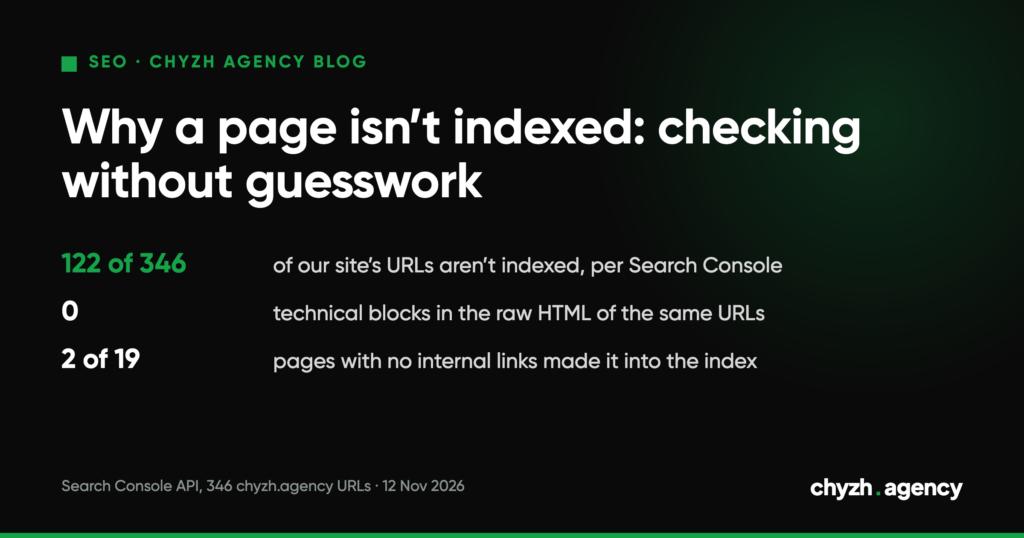
Short answer. Open the specific URL in the URL Inspection tool in Search Console and work through it in order: the status and its reason, how Google found the page, when it last crawled it, whether indexing is allowed, and which canonical Google chose. Questions about page quality only make sense once all of those check out. The number of results for a site: query won’t help here: Google says plainly that the operator doesn’t necessarily return every indexed URL.
We ran this route on all 346 URLs in the chyzh.agency sitemaps on 12 November 2026. The raw HTML had no technical blocks at all, and 122 URLs still weren’t indexed.
Why a site: count doesn’t measure your index
The site: operator is handy for seeing whether a site shows up in Search at all. The Page indexing report help even suggests it as a first step for owners of sites under 500 pages. But you can’t count your index with it, and Google explains why in the site: operator documentation (last updated 10 Dec 2025):
- a
site:query doesn’t necessarily return all the URLs indexed under the prefix; - without a search term, results aren’t ranked, and after the shortest URL they’re “relatively random”.
For a single page, Google points you to URL Inspection. The Page indexing report shows the overall picture, but according to the report’s own help page you can’t look up a specific URL’s status there.
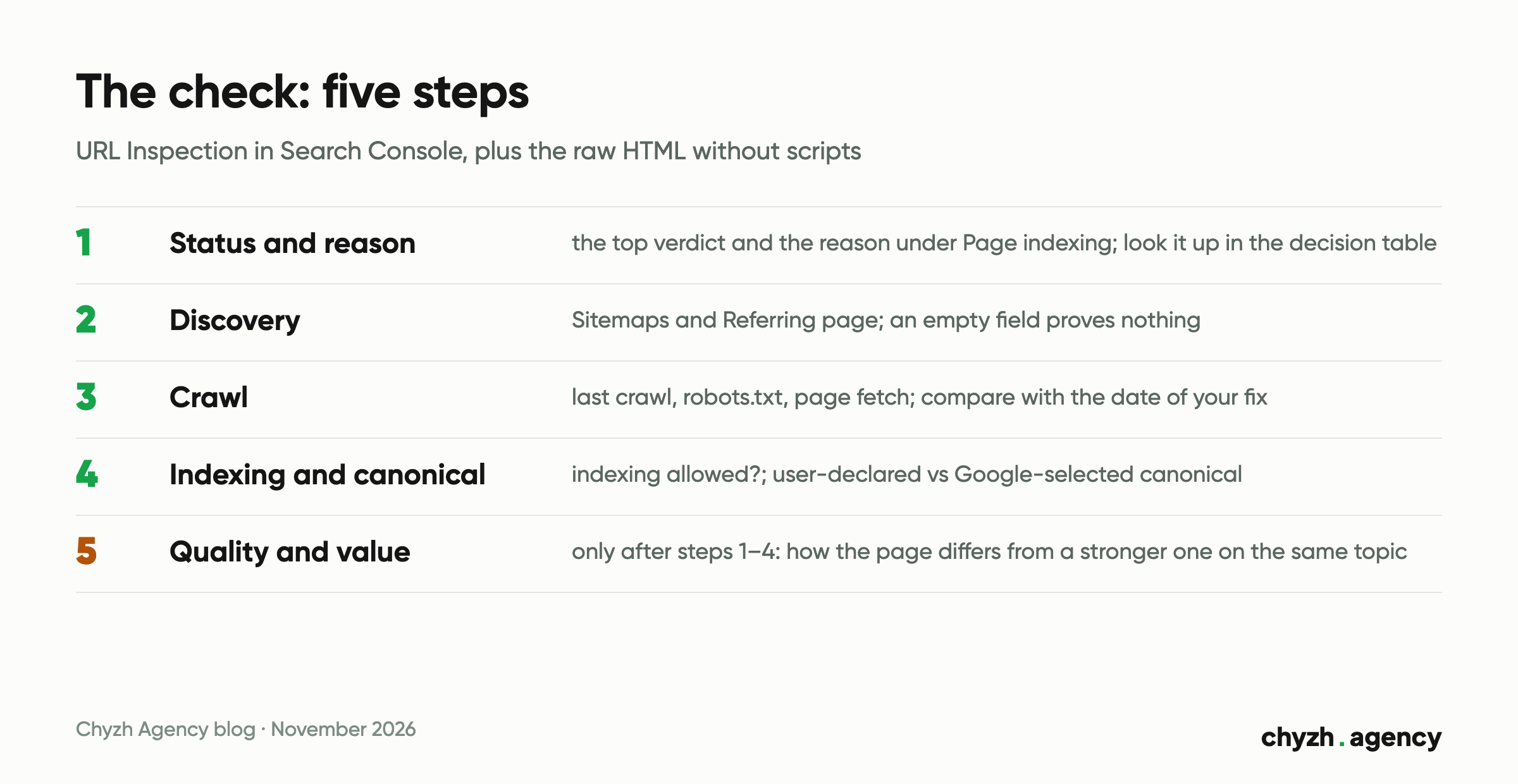
The check: five steps
- Status and reason. The verdict at the top (“URL is on Google” or “URL is not on Google”) tells you whether the URL can appear in Search. The reason sits below it, in the Page indexing section. Look up what it means in the decision table below.
- Discovery. The Sitemaps and Referring page fields. An empty field proves nothing: in our sample the Sitemaps field was empty for all 346 URLs, even though 224 of them had the status “Submitted and indexed”. So count the internal links to the page yourself.
- Crawl. Last crawl, Crawl allowed?, Page fetch. Everything the tool shows comes from the last crawled version. If you fixed something after that date, Google hasn’t seen it yet.
- Indexing and canonical. Indexing allowed?, User-declared canonical and Google-selected canonical. If the two differ, Google considers the page a duplicate of another one. The live test doesn’t check duplicates or canonicals; you only see that in the data for the indexed version.
- Quality and value. Only now: what question the page answers, how it differs from a stronger page on the same topic on your site, and whether it has anything you can’t find elsewhere.
Alongside steps 2–4, look at the raw HTML, without running scripts. curl -sI <url> shows the response code and any X-Robots-Tag header. curl -s <url>, searched for robots, canonical and hreflang, shows the matching tags in <head>.
What checking 346 chyzh.agency URLs showed
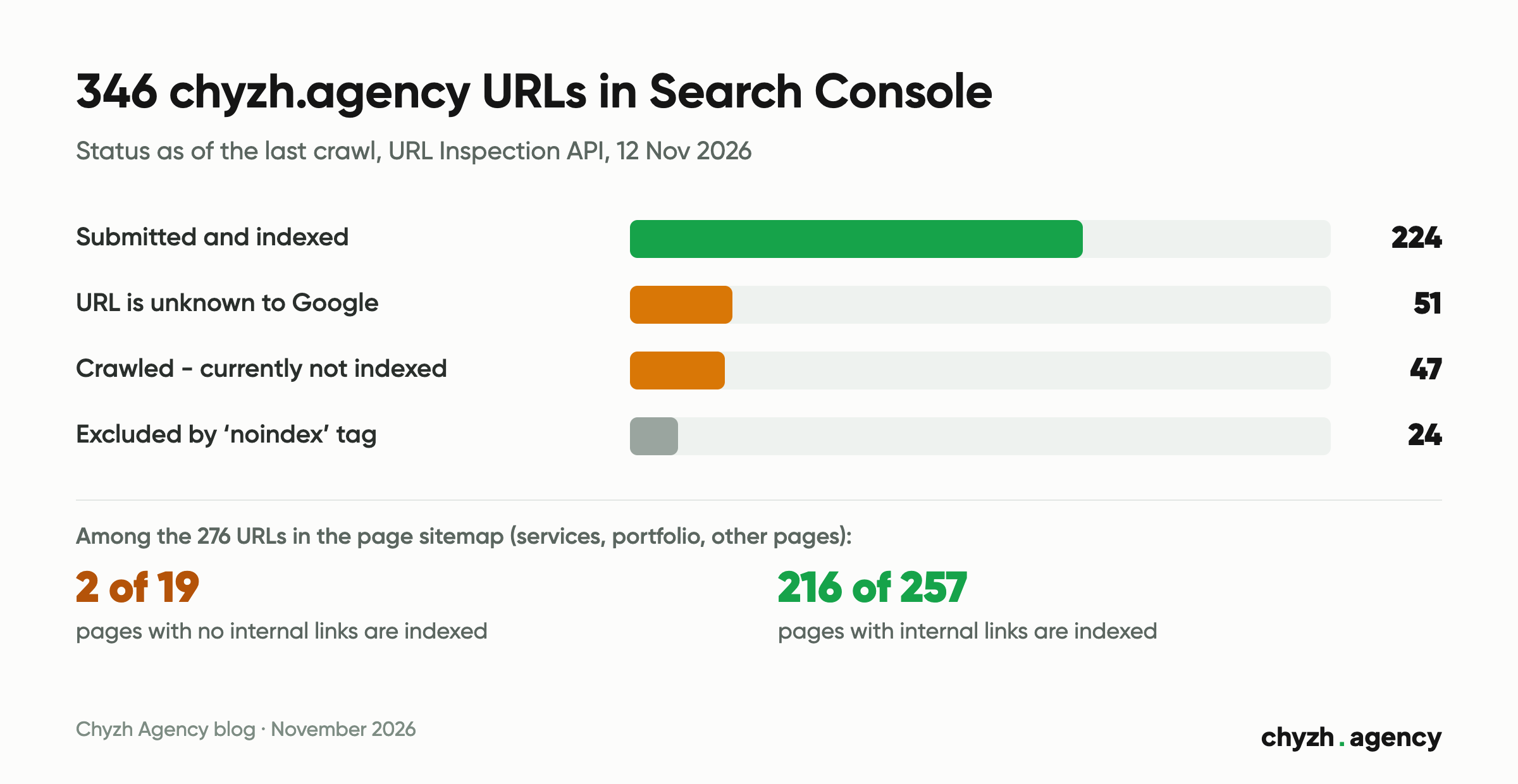
How we counted. On 12 November 2026 we took every URL from our four sitemaps: 276 pages, 24 blog posts, 39 team profiles and 7 categories. We ran each one through the Search Console API (the URL Inspection method). The same day we downloaded the raw HTML and counted internal links from all 346 pages plus 45 portfolio listing pages. We didn’t request indexing and didn’t change anything on the site.
| Status in Search Console | URLs | What they are |
|---|---|---|
| Submitted and indexed | 224 | most services, case studies and posts |
| URL is unknown to Google | 51 | 21 blog posts (15 published that same day, 6 moved to new URLs in November), 14 pages, 12 profiles, 4 categories |
| Crawled – currently not indexed | 47 | 36 portfolio pages, 8 other pages, 3 profiles |
| Excluded by ‘noindex’ tag | 24 | team profiles |
What this tells us.
In the raw HTML, all 346 URLs return 200, carry index, follow, send no X-Robots-Tag header and have a self-referencing canonical. A technical check of the pages that day would have found nothing, yet over a third of the URLs weren’t indexed.
The declared and Google-selected canonicals differed in just one of the 268 cases where the tool shows both.
Google last crawled the problem URLs a long time ago. For indexed URLs, the median time since the last crawl was 10.5 days. For “Crawled – currently not indexed” it was 70 days, and for noindex 73.
Links track closely with indexing. Of the 276 URLs in the page sitemap, 19 have no internal links at all, and only 2 of them are indexed. Of the 257 URLs that do have links, 216 are indexed, or 84%. That doesn’t prove cause: on our site the pages without links also tend to be older and less important.
Four walkthroughs from our own site
Six pages Google doesn’t know about
We published our targeted advertising and influencer advertising pages in three languages on 30 July 2026. Between then and 11 November (104 days) they didn’t get a single impression. On 12 November, URL Inspection returned “URL is unknown to Google” for all six.
What the raw HTML showed: a 200 response, index, follow, a self-referencing canonical, and hreflang pointing to all three language versions. The URLs are in the page sitemap. None of the 346 pages and none of the portfolio listing pages link to them, apart from their own language versions.
The sitemap is listed in robots.txt. But the Sitemaps report in our Search Console property shows only one of the four sitemaps, last downloaded on 20 March 2025, so we can’t confirm that Google read these URLs from a sitemap.
The fix: links from closely related pages, such as the PPC page and the services section; submitting the sitemap index in Search Console so we can see when it’s read; then an indexing request for each language version. We looked at how these pages compare with our other new pages on timing in our article on how long SEO takes.
An important page Google crawled and left out
Our Ukrainian-language PPC page has the status “Crawled – currently not indexed”. It was last crawled on 4 October. From May to September it collected 116 impressions, the last one on 28 September. Its average position for the main queries ranged from 47 to 83.
We went through the route. The canonical we declared and the one Google selected are the same. 115 pages in our sitemaps link to it: 9 from the main content, the rest from shared template blocks. The main part of the page has about 2,200 words. The Russian and English versions are indexed, and according to Google’s canonicalization documentation (last updated 20 Aug 2026), language versions aren’t treated as duplicates when the main content is translated.
The technical steps are clear, which leaves step five. From 1 October to 10 November, impressions for queries containing the Ukrainian or Russian word for “contextual” (as in contextual advertising, the local term for PPC) went to the Russian version (94 impressions) and to our Ukrainian homepage (129 impressions, average position 7). Our hypothesis: for these queries Google sees the homepage as the better answer, and the service page doesn’t offer anything different. The fix for a case like this: give the page what the homepage doesn’t have, such as prices, terms and examples for the Ukrainian market, and only then ask for reindexing.
A canonical Google ignored
When Google crawled our English SEO blog category on 2 October, the page declared its Russian version as canonical. Google chose the category page itself as canonical and indexed it. Today the canonical in the HTML points to the page itself.
Two Google rules were at work. A canonical is a hint, and Google may not accept it. And if your site uses hreflang, the canonical should be in the same language, as the guide to specifying a canonical URL (last updated 10 Jul 2026) says. Our categories run through a multilingual plugin, so it’s worth checking the canonical in every language version of category and archive templates.
A noindex that’s already gone
24 team profiles have the status “Excluded by ‘noindex’ tag”. On 12 November their raw HTML says index, follow. Google last crawled these pages between 26 and 182 days earlier, with a median of 73 days.
The lesson for any site: first compare the last crawl date with the date of your fix. If the fix is newer, the status is out of date and there’s no need to rewrite the page. For important URLs, run a live test, confirm the noindex is gone, and request indexing.
Decision table: status → what to check first
Status names are as they appear in the English Search Console interface.
| Status in Search Console | What it means | What to check first | Typical fix |
|---|---|---|---|
| URL is unknown to Google | Google hasn’t seen this URL yet | whether any internal link points to it, whether it’s in the sitemap, whether it’s new | links from related pages, sitemap, indexing request |
| Discovered – currently not indexed | found but not crawled yet; Google says it rescheduled the crawl to avoid overloading the site | server response speed, how many new URLs the site generates | cut low-value filter and parameter URLs, link to important pages |
| Crawled – currently not indexed | crawled but not indexed; Google says this is common and not necessarily a problem | canonical, crawl date, how the page differs from a stronger page on the same topic | make the page a distinct answer or merge it with another |
| Excluded by ‘noindex’ tag | noindex was present at the last crawl | raw HTML and headers now, last crawl date | remove noindex, run a live test, request indexing |
| URL blocked by robots.txt | Google can’t crawl the page | the robots.txt rule | remove the rule; to keep a page out of the index, use noindex, since robots.txt doesn’t guarantee that |
| Duplicate, Google chose different canonical than user | Google sees the page as a duplicate of another URL | the Google-selected and your canonical, both pages side by side | a correct canonical to a similar page, or substantially different content |
| Alternate page with proper canonical tag | the page correctly points to its canonical | nothing | nothing |
| Page with redirect | the URL redirects, so it isn’t indexed | whether the target URL is indexed | nothing, if the redirect is intended |
| Not found (404), Server error (5xx), Soft 404 | the page doesn’t return content | the response code and how the page looks in a live test | a 301 to the new URL, a real 404 for removed pages, a stable server |
When to request indexing
An indexing request helps once the cause is fixed. It doesn’t replace the fix. The URL Inspection tool help (no update date on the page, checked 12 Nov 2026) lists three limits:
- there’s a daily limit on requests;
- a request doesn’t guarantee the page will be indexed;
- for many new or updated pages, it’s better to submit a sitemap with
lastmoddates.
For “URL is unknown to Google”, Google itself suggests requesting indexing and says it typically takes a few days. Our data adds one thing: Google didn’t find six pages with no internal links in 104 days, so we wouldn’t rely on the request alone.
Limits of this data
- One site, 346 URLs, one day. Our site is small, so the proportions on a site with thousands of pages will differ.
- The Search Console API returns the state of the last crawled version, and for some URLs that version is old.
- We show a link between internal links and indexing, but we don’t prove cause.
- Impressions, positions and queries come from Search Console; we didn’t use search result snapshots for these figures.
Next step
Take your five to ten most important pages and run them through the five steps above. For any that aren’t indexed, find the matching row in the decision table. Indexing and crawling are the first section of an SEO audit, and we covered the rest in what an SEO audit includes. If you’d like us to do this work on your site, the details are on our SEO services page.
Author: Viktoriia Repetuk, Middle SEO Specialist. Reviewed by Dmytro Popryadukhin, Head of SEO.
Sources: Google Search Central, “site: search operator”, last updated 10 Dec 2025; “What is canonicalization”, last updated 20 Aug 2026; “How to specify a canonical URL with rel=”canonical” and other methods”, last updated 10 Jul 2026; Search Console Help, “Page indexing report” and “URL Inspection tool”, no update date shown, checked 12 Nov 2026; Search Console API, URL Inspection for 346 chyzh.agency URLs, 12 Nov 2026; Search Console, impressions and queries by page, 1 May to 10 Nov 2026; Sitemaps report in the chyzh.agency Search Console property, 12 Nov 2026; raw HTML of 346 URLs and 45 portfolio listing pages, 12 Nov 2026; Google Ukraine search results for a Ukrainian-language query on why a page isn’t indexed, 12 Nov 2026.
Related articles
Definitions, a monthly report template and a real shop where organic search brought 9.5% of...
Split organic traffic by landing page. At a real store, articles drove 32% of organic...
A decision tree for store filters, what Google says about robots.txt and 404s, and real...